Generation AI: Why Young People Are Questioning the Technology Revolution?
Posted 4 months ago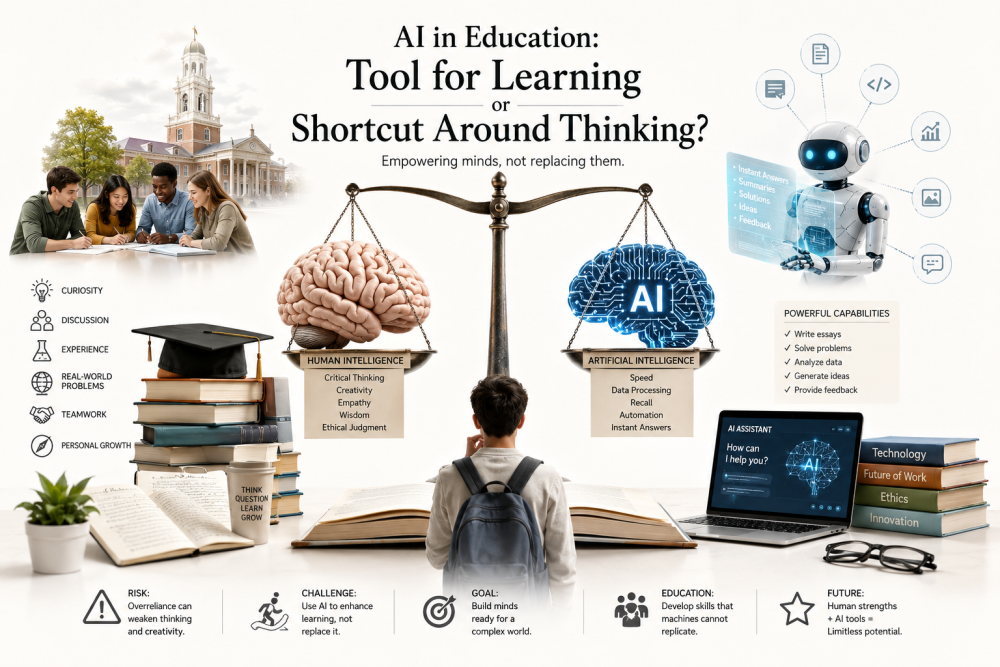
87/2026
Something unexpected is unfolding on university campuses. While technology companies and many educators are racing to adopt artificial intelligence (AI), a growing number of students are pushing back.
According to a recent article in Nature, at graduation ceremonies across the United States this year, speakers praising AI were met with skepticism. Instead of celebrating technology as the future, many young people questioned whether AI is helping them learn or quietly making them less capable thinkers.
This reaction may seem surprising. After all, today's students grew up with smartphones, social media, and digital tools. They are often described as the most technologically connected generation in history. Yet their doubts about AI reveal a deeper concern: What happens when machines start doing too much of our thinking for us?
The Fear of Becoming Passive Thinkers
Generative AI systems can write essays, summarize books, answer questions, generate images, and even write code in seconds. These capabilities make them incredibly useful. But they also raise an important question: if students rely on AI for every difficult task, will they lose the chance to develop critical skills on their own?
Learning is not simply about obtaining answers. It is about struggling with problems, making mistakes, analyzing information, and building mental resilience. These cognitive exercises strengthen the brain much like physical exercise strengthens muscles.
Many students worry that constant reliance on AI could short-circuit this process. Why wrestle with a complex idea when a chatbot can instantly provide a polished response?
A Tool, not a Replacement
The concern is not that AI is inherently harmful. Like calculators, search engines, and word processors before it, AI can be an extraordinarily powerful educational tool.
The challenge lies in how it is used.
A calculator helps students perform calculations efficiently once they understand mathematics. But if students never learn arithmetic because calculators do everything, an essential skill is lost.
AI presents a similar dilemma. It can help students brainstorm ideas, explain difficult concepts, and offer personalized tutoring. However, if it replaces thinking rather than supporting it, learning may suffer.
The article quoted above argues that AI technology should serve human cognitive development, not the other way around.
Why Universities Must Rethink Education
The rise of AI is forcing universities to confront difficult questions.
Traditional assignments such as essays, reports, and take-home exams can now be completed, at least in part, by AI systems. This reality means educators can no longer assume that submitted work reflects a student's own understanding.
Rather than fighting technology, universities may need to redesign learning experiences. Greater emphasis could be placed on problem-solving, discussion, creativity, laboratory work, teamwork, and real-world project activities that demand genuine human engagement.
The goal should not be to ban AI but to ensure that students continue to develop the intellectual abilities that define higher education.
Human Advantage
Despite impressive advances, AI still lacks many qualities that make humans unique. Curiosity, ethical judgment, empathy, wisdom, and creativity often arise from lived experience rather than data processing.
A chatbot can generate thousands of words in seconds, but it does not experience uncertainty, compassion, or personal growth. Humans do.
The most successful graduates of the future may not be those who know how to use AI. Instead, they will be those who can combine AI's speed with uniquely human strengths: critical thinking, innovation, leadership, and moral reasoning.
A Valuable Warning
The skepticism many young people express should not be dismissed as resistance to progress. It may be a healthy warning.
Students are reminding society that education is about more than efficiency. It is about developing minds capable of questioning assumptions, solving novel problems, and making sound decisions.
AI will undoubtedly transform universities, workplaces, and everyday life. But if we allow technology to replace thinking rather than enhance it, we risk creating a generation that knows how to ask machines for answers but struggles to find them on its own.
The challenge for educators, policymakers, and technology developers is clear: build an AI-powered future that strengthens human intelligence rather than weakens it. If that balance is achieved, AI could become one of the greatest educational tools ever created. If not, students' concerns may prove remarkably prescient.