HEC Establishes National Chair on AI and Robotics at NUST
Posted 3 months ago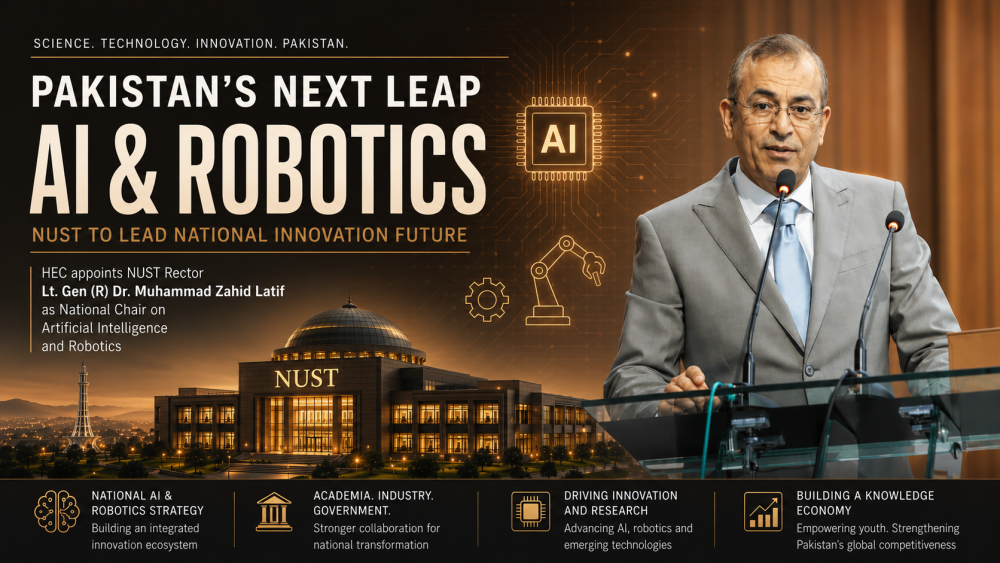
74/2025
The Higher Education Commission of Pakistan has appointed Lt. Gen (R) Dr. Muhammad Zahid Latif, Rector of the National University of Sciences & Technology (NUST), as the National Chair for Artificial Intelligence and Robotics, underscoring Pakistan's commitment to leading in AI and robotics. This appointment positions NUST as the central hub for a transformative national initiative aimed at elevating Pakistan’s role in the global AI ecosystem and garnering support from stakeholders across sectors.
Based at the NUST Islamabad campus, the National Chair will steer strategic policy, governance, and coordination across Pakistan’s AI and robotics sectors. This role includes oversight and alignment with the National Center of Artificial Intelligence and the National Center of Robotics and Automation, catalyzing the development of a robust innovation ecosystem to transform Pakistan into a competitive knowledge economy.
Globally, artificial intelligence is driving a new industrial revolution powered by algorithms, data, and computational intelligence. Countries that excel in these technologies are poised to dominate future economies, military systems, healthcare, and digital infrastructure. For Pakistan, with its young population, the challenge is to harness human capital effectively before the opportunity diminishes, making this appointment a strategic step toward global competitiveness.
The HEC initiative reflects a growing recognition that scientific leadership in the 21st century depends on integration. Universities can no longer operate as isolated academic islands. Industry, government, researchers, entrepreneurs, and technology leaders must work within a coordinated ecosystem where ideas move rapidly from laboratories to real-world applications.
In many ways, this appointment is more than an administrative decision. It acknowledges that the future of national progress will increasingly be written in the language of intelligent systems and autonomous technologies. Whether Pakistan emerges as a regional innovation leader or remains technologically dependent may well depend on how effectively this new national framework translates research into capability and ambition into execution.