Pakistan Introduces AI and Robotics Education from Grade One
Posted 9 months ago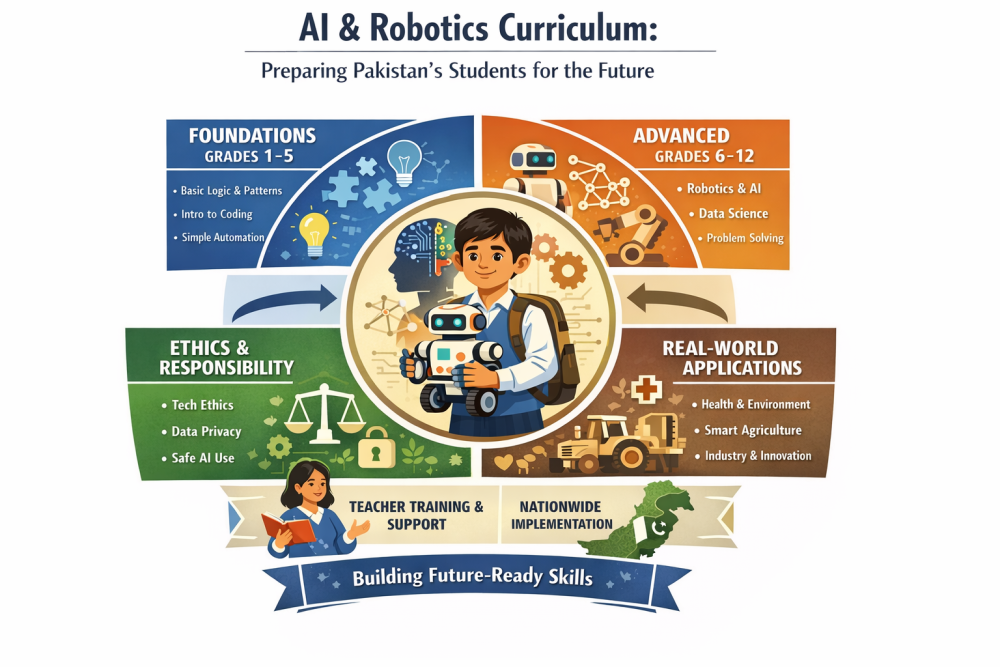
12/2026
Education systems rarely move faster than the world they are meant to prepare students for.
Pakistan has officially introduced an Artificial Intelligence and Robotics curriculum for Grades 1 through 12, signaling a strategic shift that aims to empower students to actively shape the future with technology. It is more than just a curriculum update; it is a declaration of intent to build confidence in young learners, inspiring educators and policymakers to support this transformative change.
Under the guidance of the Secretary of the Ministry of Federal Education & Professional Training, the National Curriculum Council, in collaboration with experts, has finalized and approved a nationally aligned framework that introduces young learners to computational thinking, automation, intelligent systems, and robotics design. Equally important, it incorporates ethics, responsibility, and real-world problem-solving at every stage.
For a country with one of the youngest populations in the world, the implications are significant.
From Memorization to Meaning
For decades, classrooms across much of the developing world have relied heavily on rote learning, an approach poorly suited to an era marked by rapid technological change. The newly announced AI & Robotics curriculum advocates a different philosophy: learning as exploration, making logic a habit, and viewing technology as a tool to address human problems rather than as a replacement for human judgment.
The structure is intentionally progressive. Younger students encounter foundational ideas, patterns, sequencing, and basic logic long before they learn about code or circuits. As students advance through middle and high school, these ideas develop into hands-on robotics, data-driven reasoning, and applied artificial intelligence, all carefully aligned with their cognitive development.
Ethics at the Center
The most notable feature of the curriculum is what it chooses not to overlook. Along with technical skills, students are introduced early to questions of ethics, bias, data privacy, and responsible technology use. In a global moment where AI’s risks often overshadow its ambitions, this focus is both timely and uncommon.
By making ethical reflection a standard part of technical education, the curriculum sends a clear message: innovation without responsibility is an incomplete form of learning.
The framework aligns with international best practices while staying rooted in national priorities, fostering a sense of pride and confidence that Pakistan is contributing to global innovation and education standards, encouraging policymakers and educators to see this as a significant achievement.
The framework aligns with international best practices while staying rooted in national priorities, a balance many countries find hard to reach. It aims not only to develop coders and engineers but also flexible thinkers who can apply intelligent systems to agriculture, healthcare, climate resilience, manufacturing, and public services.
This curriculum will be distributed nationwide, with orientation programs, teacher training, and phased implementation, to address regional disparities and ensure equitable access and success, fostering a sense of inclusion and fairness among parents and students.
Why This Decision Matters
In the global race for talent, countries no longer compete only on natural resources. They compete on skills, creativity, and the ability to leverage technology effectively. By starting AI and robotics education early in schools, Pakistan is making a long-term investment in its children, not just to use technology, but to create it.
This is education policy thinking several decades ahead, not several examination cycles.
The true test will happen in classrooms, where curiosity is encouraged, teachers are supported, and these opportunities are offered inclusively. But the direction is clear.
The future has been knocking on school doors for years. This time, Pakistan has opened them and invited its youngest citizens to step forward, not as spectators, but as creators of the world to come.