A Clear Roadmap to Excellence for Business Education: USP Commends NBEAC’s Leadership in Business Education Quality
Posted 1 day ago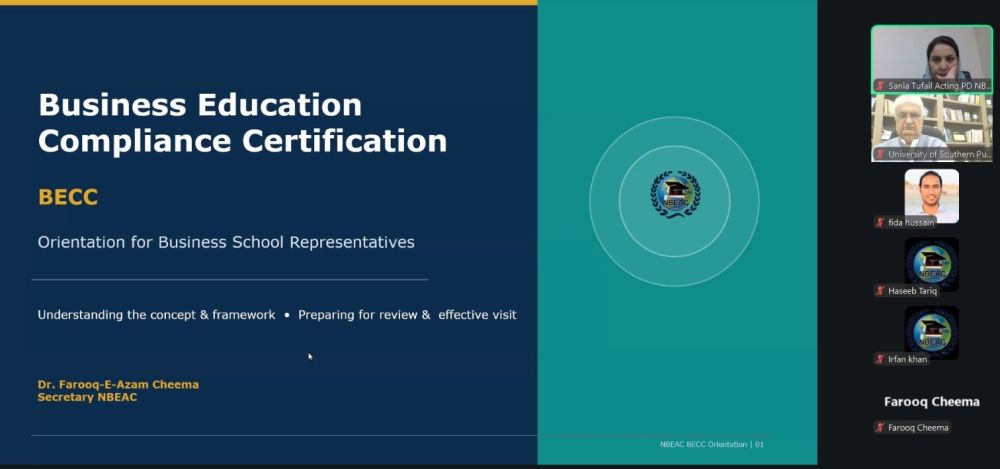
217/2026
The University of Southern Punjab (USP), Multan, has warmly appreciated the National Business Education Accreditation Council (NBEAC) for its proactive efforts to strengthen quality assurance and promote a culture of continuous improvement across Pakistan’s business and management education.
Rector USP, Prof. Dr. Muhammad Mukhtar, praised the highly articulate and insightful presentation by Dr. Farooq-E-Azam Cheema, Secretary NBEAC, calling it a valuable and timely contribution that helps universities understand the evolving quality and compliance requirements in business education. Prof. Mukhtar particularly appreciated the lecture's clarity, depth, and excellent delivery, noting that it clearly explained the distinction between Business Education Compliance Certification (BECC) and formal NBEAC accreditation. The systematic explanation of the three-stage pathway, which includes meeting the minimum threshold, undergoing structured improvement, and ultimately attaining accreditation, provided institutions with a clear roadmap for strengthening their academic programs.
He also commended Dr. Cheema for expertly managing the question-and-answer session, noting that participants' questions were addressed with clarity, patience, and professionalism. The interactive discussion helped university representatives better understand the practical implications of compliance, institutional preparation, and the transition toward full accreditation.
According to the presentation, BECC is a transitional pathway toward full accreditation, providing programs that are not yet ready for NBEAC accreditation an opportunity to demonstrate compliance with basic criteria and strengthen their systems and evidence for subsequent accreditation.
The USP Rector expressed appreciation for NBEAC's efforts to make the requirements more transparent and understandable for universities. He emphasized that quality assurance is not merely a regulatory obligation but a continuous institutional commitment to academic excellence, student success, credibility, and global competitiveness.
On behalf of the University of Southern Punjab Multan, Prof. Dr. Muhammad Mukhtar reaffirmed the University's full commitment to complying with NBEAC requirements and to strengthening its business and management education programs in accordance with applicable quality standards.
He stated that USP would approach the compliance process as an opportunity for institutional strengthening rather than merely a formal requirement, with particular attention to academic quality, faculty development, curriculum enhancement, documentation, evidence-based assessment, and continuous improvement.
The presentation also emphasized that BECC certification should not be regarded as a substitute for accreditation but as a time-limited bridge toward accreditation readiness. The material notes that the certification is valid for two years, during which institutions are expected to strengthen their accreditation readiness and apply for accreditation.
Prof. Dr. Mukhtar congratulated Dr. Farooq-E-Azam Cheema and the entire NBEAC team for their professional efforts to advance quality assurance in business education. He expressed confidence that the initiative would encourage universities to adopt stronger quality systems and ultimately help produce graduates equipped to meet the needs of Pakistan's economy and the global marketplace.
“The University of Southern Punjab welcomes NBEAC’s quality-driven approach and remains fully committed to compliance, continuous improvement, and the pursuit of excellence in business education,” the Rector said.