The Sky Within Reach: How Jetson ONE Is Redefining Personal Flight
Posted 4 months ago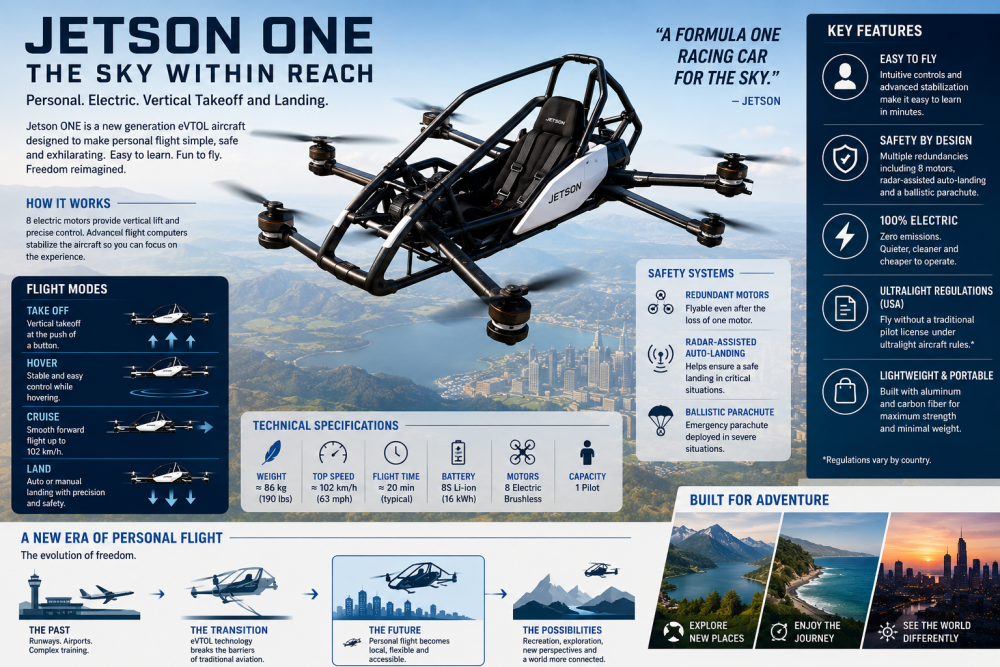
66/2026
For more than half a century, the dream of personal flying vehicles has lingered between science fiction and technological fantasy. From the animated optimism of The Jetsons to futuristic concept sketches at aviation expos, the idea of ordinary people taking to the skies in compact aircraft has fascinated humanity. Today, however, that vision is moving from imagination to reality, as companies such as Jetson, with its flagship aircraft, the Jetson ONE, bring it closer to reality.
The Jetson ONE is neither a conventional airplane nor a helicopter. It is part of a new generation of electric vertical takeoff and landing aircraft, commonly known as eVTOLs. Unlike traditional aircraft, these machines can take off vertically, hover, and maneuver with remarkable agility, relying entirely on electric propulsion.
At first glance, the Jetson ONE seems almost unreal, a lightweight, open-frame cockpit with eight rotors that resembles a fusion of a racing drone and a Formula One vehicle. Yet behind its futuristic appearance lies a serious engineering effort to simplify personal aviation. The company describes it as “a Formula One racing car for the sky,” emphasizing accessibility, ease of use, and recreational flight rather than commercial transportation.
One of the most striking aspects of Jetson ONE is its effort to democratize flight. In the United States, the aircraft is being positioned under ultralight aviation regulations, which may mean operators do not need a traditional pilot’s license. That single regulatory distinction has enormous implications. Aviation has historically been limited to trained pilots because of complex licensing systems, expensive aircraft, and demanding operational requirements. Jetson seeks to reduce those barriers by creating an aircraft that, according to the company, can be learned in minutes rather than months.
Technologically, the aircraft marks an important milestone in electric aviation. Constructed from aluminum and carbon fiber, the Jetson ONE weighs approximately 86 kilograms and is powered by eight electric motors. It offers a top speed of about 102 kilometers per hour and a flight duration of about 20 minutes. While those figures may seem modest compared to conventional helicopters, they are significant in the context of lightweight personal electric aviation, where battery limitations remain one of the industry’s greatest engineering challenges.
Safety, understandably, remains the central question in personal aerial mobility. Jetson has sought to address this concern with multiple redundancies, including maintaining controlled flight even after the loss of one motor, radar-assisted auto-landing systems, and a ballistic parachute for emergency deployment. These features reflect a broader trend in the eVTOL industry: replacing pilot complexity with automation and intelligent stabilization systems.
Yet enthusiasm should not overshadow realism. The Jetson ONE is not, at least for now, a mass transportation solution. Its short flight duration and single-passenger design make it primarily a recreational aircraft rather than a practical urban commuting tool. Weather sensitivity, battery endurance, airspace regulation, and noise management remain unresolved challenges for the broader eVTOL sector. Moreover, the prospect of thousands of personal aircraft sharing urban skies raises profound questions about traffic control, safety protocols, insurance, and environmental regulation.
There is also the issue of accessibility. Although marketed as an “affordable” eVTOL, the Jetson ONE remains far beyond the reach of ordinary consumers. Earlier models were priced at around $92,000, while more recent reports suggest prices closer to $128,000. These costs place personal aerial vehicles in the luxury technology category rather than in mainstream transportation.
Nevertheless, dismissing Jetson as merely an expensive novelty would be shortsighted. Historically, transformative technologies often start as elite products before becoming widespread. Early automobiles, personal computers, and mobile phones were initially inaccessible to the average citizen. Over time, mass production, technological refinement, and regulatory adaptation dramatically reduced costs. The same trajectory may eventually apply to electric aerial mobility.
Jetson’s broader significance lies in what it symbolizes: the gradual decentralization of aviation. Traditional flights have long relied on airports, runways, and highly specialized infrastructure. eVTOL systems challenge that model by envisioning a future in which aviation becomes localized, flexible, and personal. Whether that future arrives in ten or fifty years, companies like Jetson are compelling governments, engineers, and urban planners to take the possibility seriously.
The rise of eVTOL technology also reflects shifting societal priorities. Electric propulsion aligns with global pressure to adopt cleaner transportation systems, while autonomous flight technologies intersect with advances in artificial intelligence and smart mobility networks. In many ways, Jetson ONE sits at the crossroads of aviation, robotics, sustainability, and consumer technology.
Importantly, the race toward personal flight is no longer limited to a single company. Firms such as Joby Aviation, Archer Aviation, and several European and Asian startups are investing billions in advanced air mobility systems. While many competitors focus on air taxis and commercial urban transport, Jetson occupies a unique niche by emphasizing individual ownership and recreational freedom.
Jetson ONE’s symbolic power may ultimately outweigh its immediate commercial utility. It embodies humanity’s enduring aspiration to transcend physical limitations and reclaim the skies as a personal domain. The aircraft evokes the same sense of wonder once inspired by the first automobiles and early airplane technologies, which seemed impractical yet reshaped civilization.
Whether personal aerial vehicles become commonplace or remain specialized recreational machines, the emergence of aircraft such as the Jetson ONE marks a historic transition. The conversation has shifted from “Can humans build personal flying vehicles?” to “How should society adapt when they arrive?”
The age of personal aviation may still be in its infancy, but it has begun.