Are We Losing Ourselves to AI? The Fight for Human Identity
Posted 6 months ago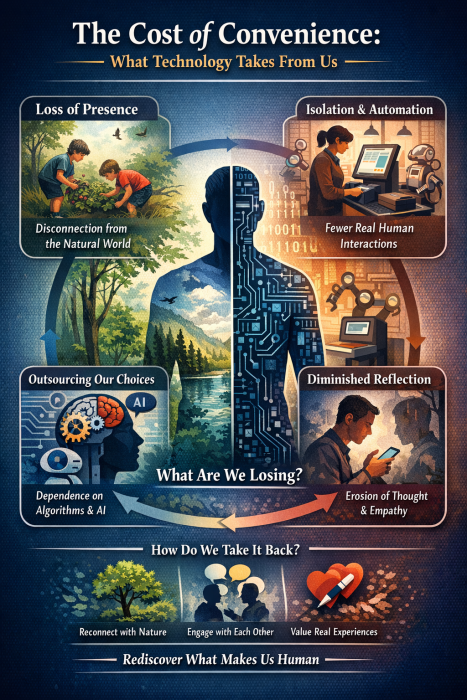
28/2026
For decades, we’ve been told that digital tools and artificial intelligence will make life easier, save us time, boost productivity, and offer unmatched convenience. But behind the promise of efficiency, there’s a quiet erosion of something more fundamental: our sense of connection, presence, and control, which directly influence our individual identity and social bonds.
According to a recent article, everyday physical activities like gardening or walking through nature foster something vital: patience, presence, and embodied joy. However, today, we are increasingly encouraged to delegate even small decisions to digital assistants, from what to cook to how to socialize.
How Efficiency Became Isolation
The principles behind much of modern technology, such as convenience, quick satisfaction, and measurable results, also change how we interact with the world and each other.
In many cities, even the simple act of buying coffee or socks no longer involves human interaction. Automated kiosks and self-serve screens replace friendly cashiers, reducing opportunities for casual conversation and weakening the social bonds that connect communities.
The above-mentioned article stresses fostering a sense of community, helping us feel connected to others, and supporting the social fabric of society.
When Technology Replaces Thinking
Artificial intelligence and smart devices promise to make our lives easier, but at what cost? An important question is what happens when we give up even basic decision-making to algorithms, whether it’s choosing if a piece of fruit is ripe or letting a chatbot draft a personal message to a loved one. Over time, outsourcing thought and agency to AI doesn’t just change how we live; it diminishes who we are.
The risk isn’t just convenience, it’s erosion. A world where we rarely engage mindfully with the physical world, strangers, or even with our own beliefs can dull empathy, hinder imagination, and weaken our ability for genuine human connection.
The Human Alternatives That Technology Can’t Replace
The above notion isn’t a rejection of all technology, but a reminder: machines can’t replicate the depth of real human relationships, shared experiences, or emotional connection. A poem from a chatbot isn’t the same as one from the heart, and digital companionship cannot replace genuine empathy and understanding.
The Guardian article urges a rediscovery of what truly matters: presence with one another, engagement with the natural world, and the mindful pursuit of activities that deepen our sense of self and community. It’s about valuing the process, the messy, slow, imperfect journeys over sheer efficiency.
Toward a More Balanced Future
The first step in reclaiming our attention and agency is awareness. Recognizing that technology shapes our habits and often narrows our world is crucial. From there, it will be good if we intentionally cultivate spaces and experiences that resist total convenience: engaging in mindful conversations, spending time in nature without devices, and participating in community activities that foster genuine human interaction.
Reclaiming our humanity won’t happen overnight, and it doesn’t require rejecting technology outright. Rather, it calls for a collective effort to set boundaries, elevate human priorities, and build digital and physical ecosystems that reflect who we want to be, not just what’s efficient or profitable.
According to Prof. Dr. Muhammad Mukhtar, Editor-in-Chief of HunarNama, the above reflections are deeply humane and reflect a fundamental truth: humans are naturally social. No technological progress, no matter how advanced, can replace the emotional warmth, trust, and sense of belonging that come from genuine human interaction. As digital systems increasingly mediate our communication, decision-making, and even emotional expression, the social bonds once formed naturally within families, neighborhoods, and workplaces are gradually eroding.
He emphasizes that technology itself is not the adversary; rather, the imbalance in its use is the real concern. When convenience begins to replace conversation, and automation substitutes empathy, society enters a subtle but profound transformation. If this trajectory continues unchecked, future generations may grow up in environments where face-to-face interaction becomes rare, deliberate, and perhaps even uncomfortable. What we today consider ordinary shared meals, spontaneous discussions, and collective celebrations could become perceived as luxuries, valued precisely because they are scarce.
Prof. Mukhtar warns that such a shift may carry psychological consequences. A world dominated by screens and algorithms may heighten stress, loneliness, and emotional fatigue. Without conscious efforts to maintain balance, young people may inherit a digitally efficient but socially fragile society. Recognizing these risks underscores the need for deliberate actions to nurture empathy and authentic human connections alongside technological advancement.
In his view, preserving social bonding is not nostalgia; it is a necessity for mental well-being, community resilience, and the moral fabric of civilization itself.
Title image created by ChatGPT5.2