Assembling the Future of Pakistan in Islamabad - The 6th International Students Convention and Expo, May 3 - 6, 2026
Posted 6 months ago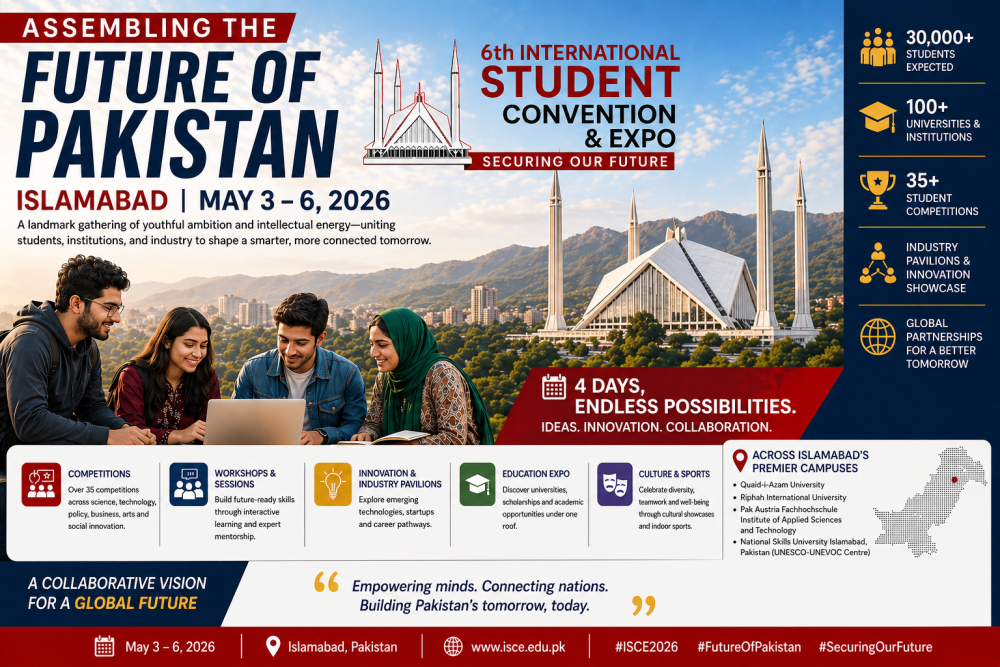
59/2026
Islamabad is set to host a remarkable gathering of youthful ambition and intellectual energy as the 6th International Students Convention and Expo (ISCE) runs from May 3 to May 6, 2026. This event aims to inspire the emerging workforce and foster a sense of pride in Pakistan's potential, encouraging participants to see themselves as part of a transformative movement.
More than 30,000 students are expected to converge, alongside representatives from over 100 universities, educational institutions, and corporate partners, offering unparalleled networking, collaboration, and exposure opportunities. Over four days, campuses and conference halls will serve as dynamic meeting grounds where disciplines intersect, regions connect, and ambition finds pathways to opportunity, fostering tangible benefits for all participants.
This convention reflects a quiet yet significant shift in Pakistan’s academic culture: a move from passive learning to participatory engagement. That shift is underscored by the involvement of institutions such as the Higher Education Commission of Pakistan and OIC-COMSTECH, whose collaboration signals both national commitment and international relevance. Their partnership lends the event weight that extends beyond exhibition; it becomes a statement about where Pakistan sees its future: in knowledge, innovation, and global connectivity.
The convention will be hosted across several of Islamabad’s premier academic institutions, including Quaid-i-Azam University, Riphah International University, Pak-Austria Fachhochschule Institute of Applied Sciences and Technology, and National Skills University Islamabad. This multi-campus approach underscores the collective effort and inclusivity, making participants feel they are part of a shared journey toward Pakistan’s educational advancement.
What sets ISCE apart is not merely its scale but the breadth of its ambition. More than 35 student competitions will serve as crucibles where ideas are tested, sharpened, and, at times, reimagined. Far from mere contests, they serve as rehearsals for real-world problem-solving, in which students grapple with the complexities of science, technology, policy, and creative thought.
Alongside these, workshops and interactive sessions aim to cultivate skills often missing from formal curricula, such as critical thinking, collaboration, and adaptability. Innovation and industrial pavilions will showcase emerging technologies and entrepreneurial ventures, offering a glimpse of a future shaped as much by student ingenuity as by institutional frameworks.
The education expo, meanwhile, provides a more immediate form of navigation. For many students, particularly those from underserved regions, it will be a rare opportunity to explore academic pathways, scholarships, and institutional cultures in one place. Such access can be transformative, igniting hope and motivation for a brighter future aligned with the vision of the current leadership at the Higher Education Commission.
Yet the convention is not confined to academic exchange. Cultural showcases and performances will highlight Pakistan’s pluralism, reminding participants that education is not only about acquiring knowledge but also about understanding one another. In a region often marked by fragmentation, such moments of shared identity carry quiet significance. Indoor sports and team-based activities further humanize the experience, reinforcing values of discipline, resilience, and collective qualities as essential in lecture halls as they are beyond them.
Universities across Pakistan have been invited to participate through institutional stalls, student delegations, exhibitions, and collaborative branding initiatives. Organizers have also urged institutions to appoint focal persons, an administrative detail that underscores the scale and complexity of the coordination required for such an undertaking.
There is, inevitably, a sense of expectation surrounding this sixth edition. Previous conventions held in cities ranging from Lahore to Karachi and across Northern Sindh and Faisalabad have built a reputation for scale and inclusivity. But Islamabad 2026 appears poised to go further, not only expanding participation but deepening purpose.
Experts believe the convention will do more than convene students. It will create a temporary ecosystem where ideas circulate freely, hierarchies soften, and the boundaries between academia and industry blur. In doing so, it may offer a glimpse of what Pakistan’s educational future could look like: interconnected, outward-looking, and driven by the energy of its youth.