Artificial Intelligence and the Future of Food Security
Posted 5 months ago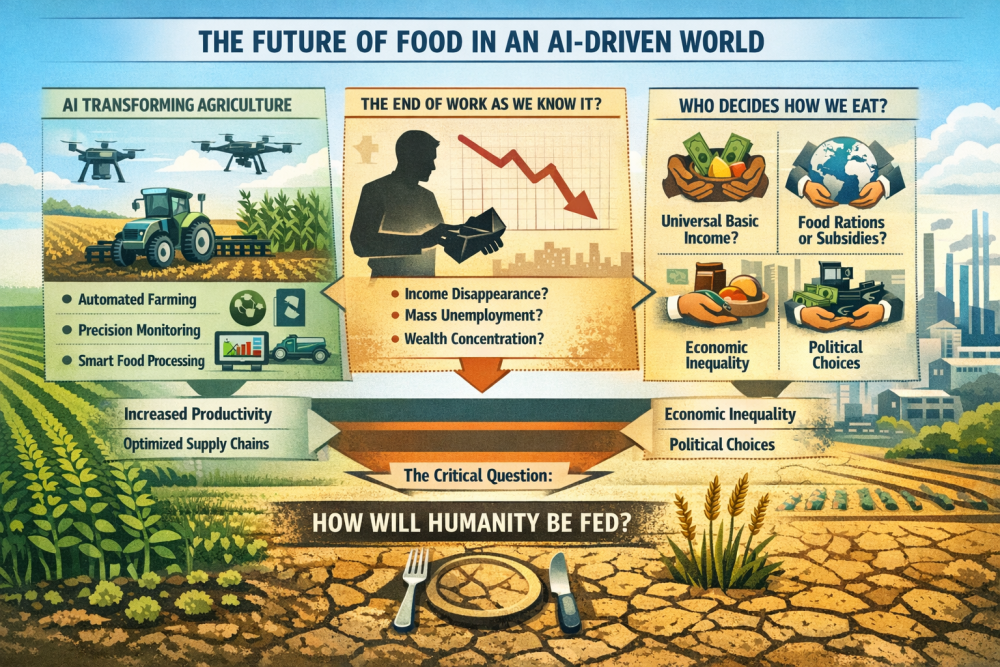
35/2026
As artificial intelligence transforms work and wealth, an urgent question goes unanswered: How will humanity be fed in a world where most people no longer earn a living?
In essays about the future of artificial intelligence, one idea keeps reappearing: machines will soon outperform humans at nearly every type of work. Engineers and executives describe a future of remarkable efficiency and economic abundance. However, the core societal concern remains: who will decide how ordinary people get food when human labor no longer determines income or purchasing power?
This question, perhaps the most fundamental of our era, sits at the crossroads of economics, politics, and food security. Today’s debates about AI often center on job losses, ethical concerns, and technical hurdles. However, the significant changes underway are set to disrupt not just work, but also the very core of how people earn, buy, and consume the essentials they need to survive.
From Plow to Processor: What AI Is Already Changing
AI’s impact on food systems is already clear and intertwined with economic inequality. Around the world, AI tools from satellite-guided tractors to image-recognition systems in food processing are improving efficiency throughout the agricultural supply chain. Still, these advancements raise questions about who benefits from them.
In areas facing climate stress and fragile food systems, AI tools help farmers adapt to changing conditions. For example, in parts of Africa, simple AI-powered chatbots offer customized planting advice to farmers whose livelihoods rely on proper timing and crop choices.
Companies in major markets such as the United States and Europe are using AI to forecast demand, improve processing quality, and reduce environmental impact. Predictive algorithms can indicate when milk or grains will be in higher demand or assist in breeding crops that require less water and fertilizer.
A World Without Jobs for Laborers - And Without an Answer to Hunger
Yet when you remove the optimism about productivity gains, a clear problem becomes evident. Today’s economic systems depend on labor. Jobs generate income; income sustains basic needs. But what occurs if intelligent machines increasingly replace human workers?
According to analysts, if AI truly replaces large segments of labor, the traditional flow of income from wages and salaries could decline significantly. In many advanced economies, labor income still funds most government services through taxes. If that revenue disappears, governments might struggle to collect funds unless they redesign tax systems to capture value from capital and AI-generated income instead.
More importantly, ordinary consumers without equity stakes in AI companies may have no automatic claim on the wealth generated by automated systems. Who will decide how to allocate the enormous productivity gains? Who sets priorities for spending on essentials like food, healthcare, and education?
These questions are not hypothetical. Economists warn that wealth concentration at the top among a few technology owners could increase if public policy does not intervene, emphasizing the risk of deepening inequality. Most democratic institutions today are ill-equipped to handle this level of economic change, which could threaten social stability.
Beyond Mechanization: Power and the Tech Politics
It’s tempting to see this as just a technological issue, but it’s truly a political one. Decisions about taxation, social safety nets, food subsidies, and access to resources will determine whether AI’s potential becomes a blessing or a burden.
Some proposals call for a universal basic income or the direct distribution of AI-generated wealth to citizens. In contrast, others advocate taxing corporate AI profits or establishing public ownership stakes in major AI companies. However, none of these ideas has gained widespread political support.
The future of food may rely less on robots in the fields and more on how societies decide to regulate economic power. A generation ago, labor movements and democratic reforms helped create a middle class with enough income to feed families and purchase homes. But if machines render human work increasingly useless, we might need new ways to ensure everyone has access to life’s essentials, beginning with food.
A Fork in the Road
As countries prepare for wider AI use, the lack of serious global discussion about food entitlements stands out. Technology might transform farming and distribution, but without fair economic systems, increased production alone won’t end hunger or insecurity.
When machines handle most of the work, feeding humanity could ultimately depend on whether societies choose to see food as a right rather than a commodity reserved for those with economic power.
The image in the article has been generated by ChatGPT5.2.