AI at the Gates of the University: Promise, Power, and the Peril of Losing Our Way
Posted 7 months ago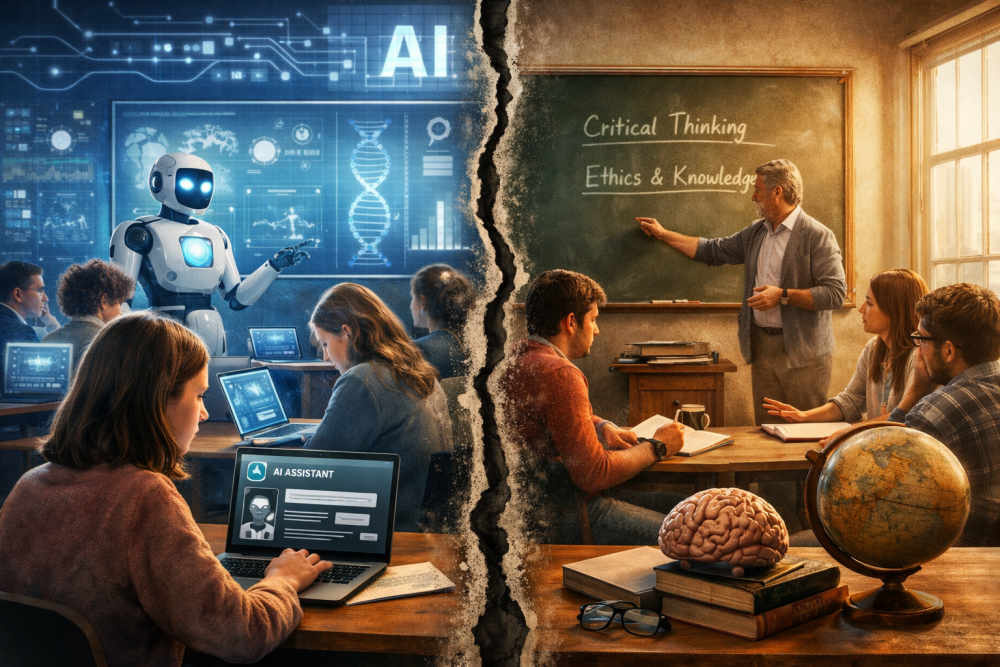
10/26
Artificial Intelligence, or simply AI, has rapidly arrived at universities. What once seemed like science fiction now quietly appears on students’ laptops and phones, writing text, summarizing books, analyzing data, and even answering exam-style questions. The main question for universities today is no longer whether AI will be used, but how it should be used and at what cost.
At its best, AI acts as a powerful partner. It can help students learn faster, assist researchers in making discoveries, and support teachers overwhelmed by larger classes and administrative duties. For many, especially in low-resource areas, AI can level the playing field by providing instant access to knowledge, language support, and academic guidance that was once available only to a privileged few.
But beneath this promise, there is a deeper unease. Universities are not factories for producing answers; they are places for shaping minds. When AI begins to think, write, and even “reason” on behalf of students, we must ask: What remains uniquely human in education?
AI Is Changing Learning — Not Always for the Better
AI can quickly draft essays, solve complex equations, and explain concepts with impressive fluency. While this seems like progress, it risks fostering a shortcut culture in learning. If students depend on AI to do the thinking, they may earn credentials — but lack true competence.
Education is not just about getting the right answers. It involves struggle, reflection, failure, and growth. These are essential human experiences. When AI replaces effort with efficiency, learning becomes shallow. The real danger isn’t students using AI, it’s them stopping to think.
From Teachers to Guides in the Age of AI
AI has also prompted a reckoning for educators. The traditional role of the teacher as the sole source of knowledge is fading. In an AI-rich world, facts are cheap and instantly accessible. What matters now is judgment, ethics, interpretation, and wisdom.
This is where universities need to evolve. Teachers must become mentors and critical thinkers, helping students question AI outputs instead of blindly accepting them. Assignments should reward insight, originality, and reasoning, not just polished language that a machine can easily generate.
The Ethical Shadow of AI
Beyond classrooms, AI raises serious ethical questions. Most AI systems are trained on data mostly from wealthy, English-speaking societies. This means AI often mirrors their values, biases, and assumptions — while ignoring perspectives from the entire globe.
If universities adopt AI without critical evaluation, they risk worsening global inequality, erasing cultures, and increasing intellectual dependence. Higher education institutions have a moral responsibility to challenge these issues instead of making them worse.
The True Test: Remaining Human in a World of AI
The real challenge isn't technical; it's philosophical. Universities are meant to foster independent thinkers, responsible citizens, and ethical leaders. If AI replaces thinking rather than enhances it, education loses its spirit.
AI should support curiosity, not supplant it. It should enhance minds, not diminish them. And foremost, it should uphold human values, not quietly redefine them.
A Call for Wise Leadership
Universities now face a historic crossroads. Embracing AI without careful reflection risks undermining education. Rejecting it completely would be just as unwise. The way forward requires wisdom, courage, and leadership.
AI is here to stay. The question is whether universities will shape AI to benefit humanity — or let humanity be reshaped by AI.
According to the Editor in Chief of HunarNama “The future of education depends on getting this balance right.”