When Water Becomes a Question of Survival, Universities Must Help Lead the Way
Posted 2 months ago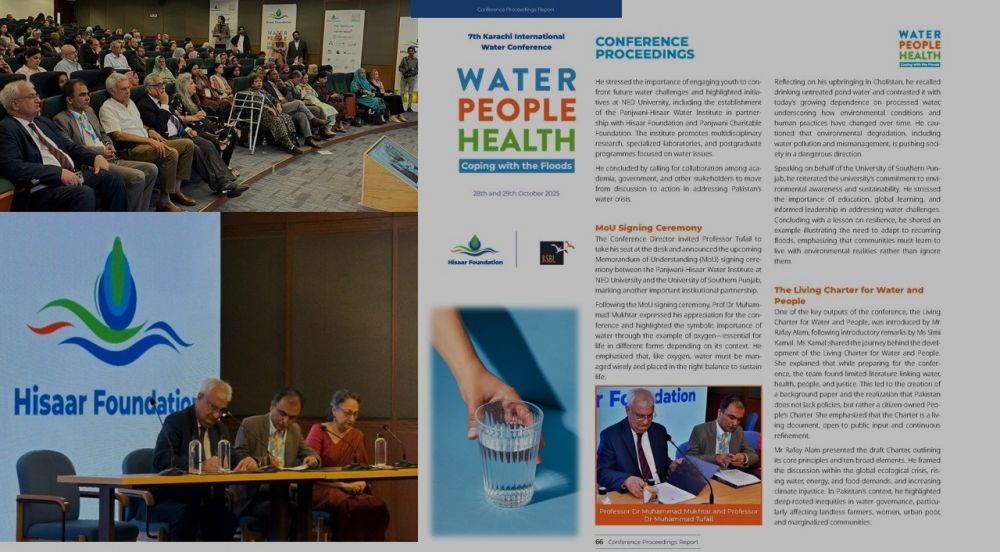
178/2026
Rector of the University of Southern Punjab calls for a new culture of water stewardship at the 7th Karachi International Water Conference.
Water is often discussed in terms of scarcity, infrastructure and climate. But at the 7th Karachi International Water Conference, the conversation took on a more human dimension: water as a question of health, justice, resilience and the future of communities.
Among the prominent voices at the conference was Prof. Dr. Muhammad Mukhtar, Rector of the University of Southern Punjab (USP) in Multan, who argued that Pakistan’s water crisis cannot be solved by government or technology alone. It requires universities, communities, policymakers, and citizens to work together and to rethink how the country values one of its most fundamental resources.
Held on October 28 and 29, 2025, under the theme “Water, People, Health: Coping with the Floods,” the conference brought together perspectives on the increasingly complex relationship among water, human well-being, and environmental change.
A particularly significant moment came with the signing of a Memorandum of Understanding between the Panjwani-Hisaar Water Institute at NED University and the University of Southern Punjab, establishing a new institutional partnership focused on water research, education, and sustainability.
Following the signing, Prof. Dr. Mukhtar reflected on the deceptively simple chemistry of life: oxygen. Its value, he noted, depends on context and balance. Water, too, must be managed wisely and kept in balance to continue sustaining life and communities.
His remarks carried personal resonance. Recalling his upbringing in Cholistan, he described a time when drinking untreated pond water was part of everyday life, contrasting it with today's growing dependence on processed and packaged water. The transformation, he suggested, is more than a lifestyle change; it is a warning that environmental degradation and human practices are reshaping the relationship between people and their natural surroundings.
For Prof. Dr. Mukhtar, the lesson is not simply that Pakistan needs more water infrastructure. It also needs greater environmental awareness, better education, informed leadership, and a culture of sustainability.
He also offered a powerful message about floods. Communities, he said, must learn to adapt to recurring environmental realities rather than try to ignore them. Resilience, in this sense, is not merely the ability to recover after a disaster; it is the ability to understand changing conditions and prepare intelligently for what comes next.
From conversation to collective action
The conference also made an important intellectual contribution: the Living Charter for Water and People.
The Charter, introduced during the proceedings, emerged from an effort led by Ms. Simi Kamal and her colleagues to connect water, health, people, and justice. The initiative recognizes that Pakistan's challenge is not necessarily a lack of policies but the need for stronger public ownership and participation in shaping and implementing them.
The draft Charter places water within the broader global ecological crisis, in which rising demands for water, energy, and food intersect with climate change and growing inequality. In Pakistan, the discussion draws particular attention to the vulnerabilities of landless farmers, women, the urban poor, and marginalized communities.
Its conception as a living document open to public input, discussion, and ongoing refinement marks an important departure from policy documents that remain confined to institutions. It seeks instead to make water governance a conversation in which citizens have a meaningful stake.
The university as a bridge
Prof. Dr. Mukhtar's participation underscored a broader role for universities in Pakistan's environmental future: not merely as places where knowledge is produced, but as bridges linking research, policy and communities.
According to Prof. Mukhtar, a special note of appreciation is for Mr. Zohair Ashir, whose visionary support has advanced the establishment of the Panjwani-Hisaar Water Institute at NED University. His commitment to bringing together academic expertise, institutional partnerships, and a sustained focus on Pakistan’s growing water challenges has helped turn an important idea into a platform for research, education, and action.
The partnership between NED University's Panjwani-Hisaar Water Institute and the University of Southern Punjab is one such bridge. By fostering multidisciplinary research, specialized laboratories, postgraduate education, and collaboration, such initiatives can help move the country's water debate beyond conferences and into laboratories, classrooms, and communities.
A report that preserves an important conversation
The publication of the 7th Karachi International Water Conference Proceedings Report deserves special recognition. By documenting the discussions, interventions, partnerships, and emerging ideas, the report transforms a two-day gathering into a lasting resource for researchers, policymakers, educators, and citizens.
Ms. Simi Kamal, Mr. Zohair Ashir, and their dedicated team deserve sincere appreciation for bringing this important record to the public domain. Their effort ensures that the ideas exchanged at the conference do not fade when the conference hall falls silent. Instead, they become part of Pakistan's ongoing conversation about water, health, climate resilience, and social justice.
For the University of Southern Punjab, the conference was more than an occasion for institutional representation. It was an opportunity to affirm a philosophy: that the country's universities must increasingly engage with society's defining challenges, and that among them, few are more fundamental than water.
In a country repeatedly confronted by floods, droughts, contamination, and unequal access to safe water, the central question is no longer simply how much water Pakistan has.