What Is Layer Prompting in AI for Developing Teaching Material?
Posted 1 day ago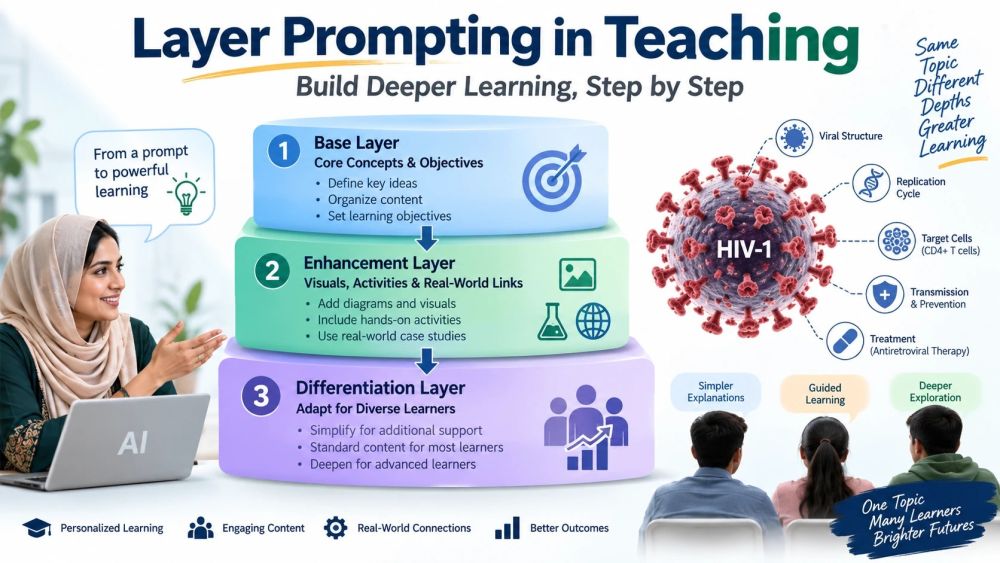
210/2026
Layer prompting uses generative AI to build teaching materials incrementally, rather than asking AI to produce an entire lesson in one large prompt. Each layer adds a specific educational purpose while preserving what the previous layer produced.
In simple terms:
Start with the essential knowledge → enrich it with learning resources → differentiate it for different learners.
This approach is particularly useful for complex scientific topics because the teacher can control what is taught, how it is presented, and how deeply different learners explore it.
A Three-Layer Model in Developing Teaching Material
The approach described in your material can be organized into three main layers:
|
Layer |
Main Purpose |
Question it answers |
|
1. Base Layer |
Core concepts and objectives |
What must students learn? |
|
2. Enhancement Layer |
Visuals, examples, activities, and real-world connections |
How can students understand it better? |
|
3. Differentiation Layer |
Adaptation to learner needs and levels |
How can different students learn it successfully? |
Let us see how this works for Human Immunodeficiency Virus type 1 (HIV-1).
Layer 1: Build the Foundation
Suppose a teacher wants to teach undergraduate students about HIV-1. Instead of immediately asking AI to "create a complete lesson on HIV," the teacher first defines the content architecture.
A base-layer prompt might be:
"Create a structured lesson outline on Human Immunodeficiency Virus type 1 (HIV-1) for undergraduate biology students. Cover its structure, genome, target cells, entry into host cells, replication cycle, transmission, effects on the immune system, diagnosis, treatment, and prevention. Define three to five measurable learning objectives and arrange the concepts from basic to advanced.
The AI-generated material at this stage establishes the intellectual skeleton of the lesson.
For example, students might first learn:
HIV-1 → virus structure → CD4+ T cells → viral entry → reverse transcription → integration → viral replication → immune-system decline → clinical consequences → diagnosis → antiretroviral therapy.
The key point is that the teacher has not yet requested videos, activities, differentiation, or assessments. The first layer establishes what students need to know.
Layer 2: Enhance the Learning Experience
Once the foundation is satisfactory, the teacher adds a second prompt or instruction.
For example:
"Using the lesson structure above, enhance the HIV-1 lesson with visual and experiential learning elements. Suggest a labeled diagram of the HIV-1 structure, a step-by-step visual representation of the viral replication cycle, a classroom activity that demonstrates how HIV targets CD4+ T cells, a case study that highlights the importance of antiretroviral therapy, and five questions that connect the topic to real-world public health."
Now the same content becomes much richer.
Instead of merely telling students:
"HIV-1 enters CD4+ T cells and uses reverse transcriptase to convert its RNA into DNA."
The teacher can ask AI to create a visual sequence:
HIV-1 attaches to CD4 receptor → enters cell → releases RNA → reverse transcription → viral DNA formation → integration into host genome → production of viral components → assembly → budding.
The enhancement layer therefore answers:
"How can I make the concept easier to see, experience, and relate to the real world?"
It could incorporate:
- diagrams
- animations
- short videos
- concept maps
- clinical cases
- simulations
- laboratory-style activities
- real-world examples
- formative questions
The teacher builds on the same foundational content rather than starting over.
Layer 3: Differentiate the Content
This is where layer prompting becomes particularly powerful for personalized learning.
A classroom may contain students with very different levels of prior knowledge. Therefore, the teacher can add a differentiation layer.
For example:
"Differentiate this HIV-1 lesson for three groups. For students who need additional support, simplify the explanation, provide a glossary, and use analogies. For students at the expected level, provide guided questions and a standard case study. For advanced students, introduce the molecular mechanisms of reverse transcription, viral integration, immune evasion, and drug resistance, as well as the mechanisms of action of major antiretroviral drug classes. Keep all groups working toward the core learning objectives."
Now the same lesson branches into different learning pathways.
Learner A — Needs More Support
The AI might explain:
HIV-1 is a virus that attacks certain cells important for the immune system, particularly CD4+ T cells. Over time, untreated infection can weaken the body's ability to fight infections.
A glossary could define:
- Virus
- Immune system
- CD4+ T cell
- RNA
- DNA
- Reverse transcriptase
- Antiretroviral therapy
An analogy might compare viral replication to a hacker inserting instructions into a computer system, with an explicit reminder that the analogy is only to help understand the concept.
Learner B — Expected Level
The learner could receive:
- the HIV-1 replication cycle
- interpretation questions
- a clinical case
- transmission and prevention scenarios
- Questions about why antiretroviral treatment suppresses viral replication
Learner C — Advanced Learner
The material could go deeper into:
- reverse transcriptase
- integrase
- protease
- viral integration
- immune evasion
- viral mutation
- drug resistance
- mechanisms of antiretroviral drug classes
- interpretation of viral-load and CD4-related data
Thus, the destination remains the same, but the route and depth can vary according to learner needs.
Why Is This Better Than One Large Prompt?
Consider these two approaches.
One-shot approach
A teacher might write:
"Create a complete lesson on HIV-1 including explanations, diagrams, activities, differentiation, assessment, videos and advanced material."
The AI may produce a very long response that includes everything at once. Some content may be unnecessary, some important concepts may receive insufficient attention, and the teacher has less control over the instructional sequence.
Layered approach
The teacher instead proceeds:
Prompt 1 — Foundation
What should students learn?
↓
Prompt 2 — Enhancement
How can students understand and experience it?
↓
Prompt 3 — Differentiation
How should the material change for different learners?
↓
Prompt 4 — Assessment
How will I determine whether they learned it?
↓
Prompt 5 — Refinement
Does the final material meet the learning objectives?
This makes AI function less like a one-time content generator and more like an instructional design assistant.
Layer Prompting Is Not Simply "More Prompting"
This distinction is important.
Layer prompting does not mean writing an increasingly long prompt. It means adding instructional requirements in purposeful stages.
For HIV-1, the progression might look like:
Core knowledge
What is HIV-1, and how does it replicate?
↓
Learning enhancement
Show the replication process visually and connect it to a clinical case.
↓
Differentiation
Simplify it for beginners and deepen it for advanced students.
↓
Assessment
Develop questions that test understanding, not memorization.
↓
Quality refinement
Check the material for scientific accuracy, misconceptions, age/level appropriateness, and alignment with the objectives.
That is the essence of layer prompting.
Layer Prompting and Chain-of-Thought Are Different
The two ideas in your source material should also be distinguished.
Chain-of-thought (CoT) concerns reasoning through a task in a sequence of steps.
Layer prompting concerns progressively adding dimensions of instructional design to an AI-generated resource.
For example:
CoT:
"Work through the scientific explanation step by step."
Layer prompting:
"First establish the core content; then add visuals and activities; then differentiate it for different learners."
So, while both approaches can make AI outputs more systematic, they solve different problems.
The Bigger Educational Value
The real strength of layer prompting is that it mirrors good instructional design.
For an HIV-1 lesson, the teacher does not begin by asking:
"What can AI generate?"
Instead, the teacher begins with:
"What should my students learn?"
Then ask:
- What is essential?
- How can I make it understandable?
- How can I make it engaging and authentic?
- How can I accommodate different levels of learners?
- How will I assess learning?
- How can I review and improve the AI-generated material?
This transforms generative AI from a content-production tool into a content-customization and instructional-design tool.
In short:
Layer prompting is the deliberate construction of AI-generated learning content in successive layers, namely foundation, enhancement, and differentiation, so that a common body of knowledge can become clearer, richer, more engaging, and more responsive to individual learners.
For a complex subject such as HIV-1, this means moving from "What is the virus?" to "How can students visualize its replication?" and finally to "How can I teach the same concept at different levels of complexity to diverse learners?"