USP Launches Seed Grants for Faculty Members to Turn Promising Ideas into Solutions for Society
Posted 14 hours ago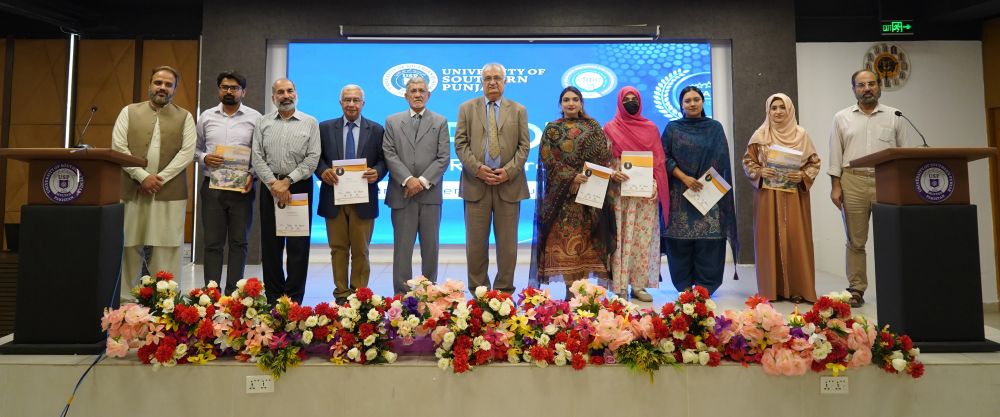
260/2026
The University of Southern Punjab (USP), Multan, has launched an internal research seed-grant initiative to encourage high-quality, socially relevant research aligned with contemporary technologies and to help promising academic ideas move toward practical applications.
Through its Directorate of Research, Innovation and Commercialization (ORIC), USP has awarded research grants to ten faculty-led projects after a competitive selection process. The approved funding will support investigations across public health, artificial intelligence, environmental and materials research, education, economic policy, literature, psychology, and campus safety.
Research that matters
The selected projects reflect the breadth of expertise across USP's academic departments and the growing importance of interdisciplinary research in addressing contemporary challenges.
In public health, Ali Haider of Allied Health Sciences is conducting a grant-supported study examining antimicrobial resistance, multidrug resistance, and extended-spectrum beta-lactamase-producing uropathogens among patients visiting diagnostic laboratories in South Punjab, Pakistan. The project addresses a key concern for healthcare professionals and public health researchers: the growing challenge of infections that are difficult to treat with commonly used antibiotics.
In mathematics, Dr. Ayyaz Ali has received a seed grant to investigate new analytic approaches to nonlinear partial differential equations, with applications in nerve fibers and materials. The project brings fundamental mathematical inquiry into conversation with problems relevant to scientific modeling.
Dr. Saadia Zia of Psychology has received a seed grant to study how Islamic counseling can reduce substance use and promote mental health among university students. The project explores an approach to student wellbeing that merits systematic investigation.
From economic stability to sustainable education
The grants also recognize research into the economic and social forces shaping Pakistan's future.
Ms. Sadia Mustafa of Economics will investigate hybrid AI–economics policy-nexus modeling for sustainable macroeconomic stability under exchange-rate dynamics, supported by Rs. 25,000. The project brings together economic policy and artificial intelligence to address economic uncertainty and stability.
In education, Ms. Azra Abdullah of Fashion Design has secured a seed grant to research how to integrate fiber practice and contemporary commodities into education. The project offers an opportunity to examine how practical, material-based learning can meet contemporary educational and creative needs.
Meanwhile, Prof. Dr. Zia Ahmed of English has received seed funding for Rewriting Narrative Authority: A Feminist Critique of Selected Pakistani Female Novelists. The study will examine literary representation and the ways women's voices and perspectives are shaped within narrative traditions.
In media studies, Professor Dr. Sajjad Ahmed Paracha is supported in research on media cultivation and marital-role perceptions, examining expectations among Generation Z consumers of Pakistani dramas. The project examines how media narratives may shape perceptions of marriage and social roles.
AI, literature and the future of knowledge
The university's research portfolio also extends to the transformation of scholarship through emerging technologies.
Ms. Rao Aisha Sadiq of English has received funding for LitViva-AI: Transforming Anglophone Literary Studies through AI-Assisted Literary Analytics. The project explores using artificial intelligence to support literary analysis, opening a pathway to examine how digital tools may complement established methods of studying literature.
Together, these projects demonstrate that socially relevant research extends beyond laboratories. It can inform healthcare, improve institutional systems, explore human behavior, strengthen education, and introduce new ways to understand culture and society.
Building a culture of research with purpose
According to the Chairman of the Board of Governors for USP, the seed-grant initiative represents an investment in both faculty development and the university's broader research mission. Its significance lies not only in the amount awarded but also in the institutional commitment to identifying promising ideas, supporting academic initiative, and encouraging research that responds to societal needs.
The Rector of the University of Southern Punjab, congratulating the awardee, said that as universities face growing expectations to contribute to economic development, public wellbeing, and technological advancement, mechanisms that connect research with practical challenges are becoming increasingly important. Of importance, the USP is at the forefront.
The ORIC Director says the next measure of success will be what these ten projects discover, develop, and deliver. If supported by rigorous methods, responsible implementation, and sustained institutional encouragement, today's modest seed grants could become the starting point for larger collaborations, stronger research proposals, and innovations with wider reach.
The ambition is clear: to make research more than an academic exercise—to make it a force for meaningful change in society.