University of Southern Punjab Multan Becomes Punjab's First Private University to Complete HEC's National Mentoring Program
Posted 2 months ago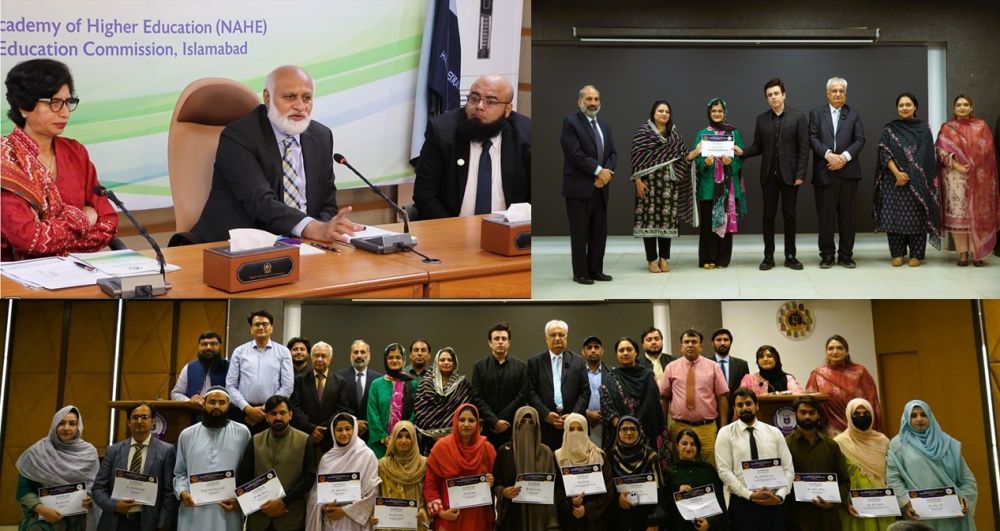
175/2026
In an era when universities are being challenged to cultivate not only knowledge but also resilient, ethical, and visionary leaders, the University of Southern Punjab (USP) Multan has become the first private-sector university in Punjab province to complete the Higher Education Commission's National Academy of Higher Education (NAHE) Mentoring Program, marking a milestone in the country's evolving higher education landscape.
Program Video
3. Mentor
4. Mentee
The concluding ceremony for certificate distribution was held at Jinnah Hall of the University of Southern Punjab and was celebrated far more than the distribution of certificates. It reflected the successful establishment of a culture where mentorship, leadership, and personal growth are becoming integral to the university ecosystem.
The event was honored by Dr. Noor Amna Malik, Managing Director of the National Academy of Higher Education (NAHE) at the Higher Education Commission of Pakistan, who served as the Chief Guest. She was accompanied by Dr. Sadia Bukhari, Deputy Director at NAHE, whose presence underscored HEC's commitment to institutional capacity building across Pakistan's universities.
The distinguished guests were warmly received by Prof. Dr. Muhammad Mukhtar, Rector of the University of Southern Punjab, and Mr. Saqib Nazir, Director General, who reaffirmed the University's unwavering commitment to academic excellence, quality improvement, leadership development, and institutional transformation.
The NAHE Mentoring Program was launched in November 2024 for 18 women's universities and expanded in March 2026 to approximately 280 universities across Pakistan under the leadership of Prof. Dr. Niaz Ahmad Akhtar, the current Chairperson of the HEC. Inspired by the University of Cambridge's mentoring culture, the initiative was designed to establish structured mentoring systems across universities, enabling faculty and staff to seek guidance from trained mentors within their institutions on professional development, leadership challenges, workplace relationships, and personal growth.
Speaking of the initiative's significance, Dr. Noor Amna Malik emphasized that mentoring should become a permanent part of every university's ecosystem.
"If someone encounters barriers in their professional or personal journey, the solution should be found within the university. Mentoring is about building institutional capacity and empowering individuals to succeed."
At the University of Southern Punjab, that vision has already begun to take shape.
Eight certified mentors guided 37 mentees through an intensive mentoring program covering conflict resolution, ethics and integrity, leadership development, digital and artificial intelligence tools, communication skills, and problem-solving strategies. Participants described the experience as transformational, noting that seemingly minor personal or professional challenges, often overlooked in daily life, can become significant obstacles if left unaddressed.
Several mentees shared moving testimonials, explaining that the mentoring relationship had fundamentally changed the way they approached leadership, workplace communication, and personal development. Their stories illustrated that structured mentoring is not merely an academic exercise but a powerful catalyst for confidence, resilience, and institutional excellence.
Congratulations to the University's leadership. Mr. Asim Nazir Ahmad, Chairman of the Board of Governors, praised the collective efforts of the faculty, mentors, administrators, and management team in achieving this landmark distinction. He encouraged the University community to remain compliant with evolving national standards while staying at the forefront of innovation in an increasingly dynamic, technology-driven world.
The University of Southern Punjab's accomplishment demonstrates how purposeful mentoring can strengthen institutions from within. As higher education faces unprecedented technological, social, and leadership challenges, the University's pioneering role signals that investing in people may be one of the most transformative strategies for building the universities of the future.
With the successful completion of the HEC-NAHE Mentoring Program, the University of Southern Punjab has not only celebrated an institutional achievement. It has also established a model of professional development that other universities across Pakistan may soon seek to emulate.