The Science of Skill-Based Resilience: A Powerful Safety Net for Well-Being
Posted 1 month ago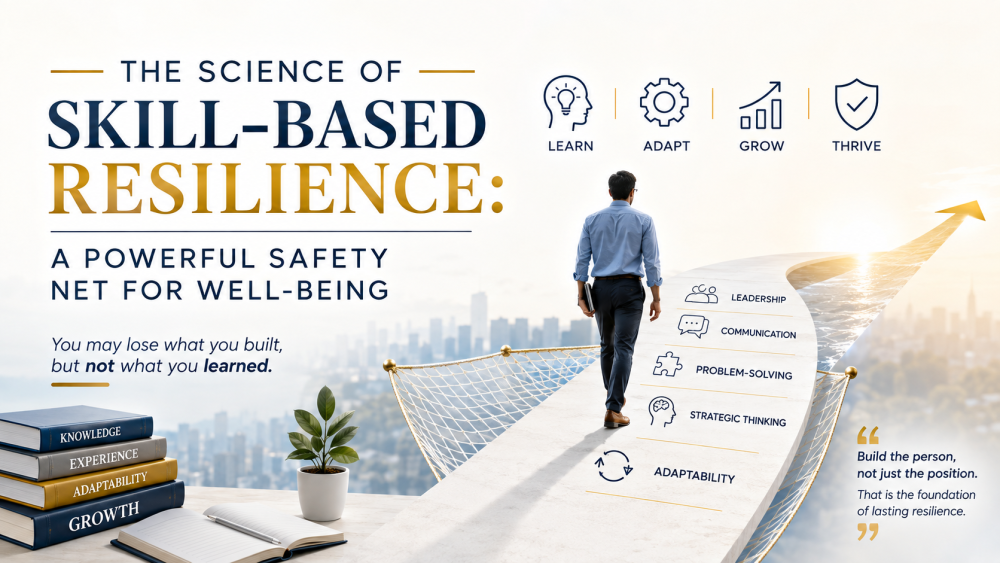
199/2026
What happens when everything you have built suddenly begins to fall apart?
A business loses its market. A career takes an unexpected turn. A promising project fails. Technology renders yesterday’s expertise less valuable. For many people, such moments feel like the end of the road.
But there is another way to look at failure.
You may lose a position, a business, an opportunity, or even an entire career, but you do not necessarily lose what you have learned.
That idea lies at the heart of skill-based resilience: the ability to apply knowledge, experience, and transferable skills to adapt when circumstances change.
Dzigbordi Kwaku-Dosoo, a Ghanaian business leader and entrepreneur, argues that while businesses may fail, the skills developed while building them remain an important personal asset. Her experience across banking, consulting, entrepreneurship, and other industries illustrates a powerful principle: what you build can disappear, but what you learn can travel with you.
Resilience Is More Than Simply “Bouncing Back”
We often describe a resilient person as someone who refuses to give up. That is certainly part of resilience, but it is incomplete.
Imagine two people losing their jobs.
One waits for another opportunity. The other asks: What did I learn from my previous work? What can I do that remains valuable? What new skill should I add? Where else can I apply these abilities?
The second person is not merely enduring adversity. They are transforming experience into future capability.
This distinction matters because modern careers rarely follow a straight path. Industries shift, technologies evolve, and automation and artificial intelligence can transform entire professions.
In such an environment, resilience cannot depend solely on persistence. It must also depend on adaptability.
The Skills That Travel With You
Some skills are closely tied to a particular job, while others travel remarkably well from one environment to another.
Examples include strategic thinking, communication, leadership, financial understanding, problem-solving, decision-making, and emotional intelligence.
A person who knows how to analyze a difficult problem can apply that ability in banking, education, healthcare, or entrepreneurship. Someone who understands how to lead people can carry that skill from one organization to another.
These abilities are valuable precisely because they are not tied to a particular company or job title.
The World Economic Forum's Future of Jobs work similarly emphasizes abilities such as analytical thinking, resilience, flexibility, and agility as important skills for a changing world.
In other words, the safest career may not be the one that never changes. It may be the one in which you remain able to change.
Failure Can Become a Laboratory for Learning
Failure is painful because it often feels personal. A failed business can make an entrepreneur think, "I am a failure." But a more useful question is: What failed, and what did I learn?
Perhaps the business model was flawed. Perhaps costs were underestimated. Perhaps the market has shifted. Perhaps the team was poorly managed. Perhaps the leader lacked a specific skill.
Separating the failure of an outcome from the value of the person who experienced it can change everything.
Failure then becomes a laboratory.
It provides information that success sometimes hides.
After an important setback, asking three simple questions can be powerful:
What worked? What did not work? What capability do I need next?
This turns experience into knowledge and knowledge into resilience.
Skills Need Exercise Too
Another important lesson: skills deteriorate when neglected. A person cannot learn leadership once and assume that the ability will remain perfect forever. Communication must be practiced. Technology must be updated. Decision-making improves through experience. Emotional intelligence develops through reflection and interaction with others.
Kwaku-Dosoo proposes several practical ways of strengthening this personal “safety net,” including continuous reskilling, deliberately testing skills in unfamiliar situations, teaching others, and conducting a structured review after major successes or failures.
This resembles physical fitness.
You do not become physically strong by owning a gym membership. Strength comes from repeated use.
The same is true of professional capability.
The Hidden Power of Teaching
One of the simplest ways to strengthen a skill is to teach it.
When we explain something to someone, we discover whether we truly understand it. Teaching forces us to organize our thoughts, identify gaps, and communicate clearly. That is why mentoring can benefit both the learner and the mentor. A leader who teaches younger colleagues is not simply giving knowledge away. They are often sharpening their own knowledge in the process.
Knowledge becomes stronger when it is shared.
Build the Person, Not Just the Position
Perhaps the deepest lesson of skill-based resilience is that people should invest in themselves rather than in only the positions they currently hold.
- A job title can disappear.
- A company can close.
- A market can collapse.
- Technology can become obsolete.
But the ability to think clearly, solve problems, communicate, lead people, learn quickly, and adapt can remain and become the foundation for the next chapter. The goal, therefore, should not be to construct a career that is completely protected from disruption. That may be impossible.
The smarter goal is to build a person who can navigate disruption.
Because resilience is not simply the strength to stand after falling.
It is the ability to learn from the fall, strengthen your capabilities, and use what you have learned to rise in a new direction.
- Your business may fail.
- Your plan may fail.
- Your job may disappear.
- But if you keep investing in your skills, you don't have to start from zero.
You start from experience.