When Code Becomes a Colleague: The Rise of the Digital Employee
Posted 1 month ago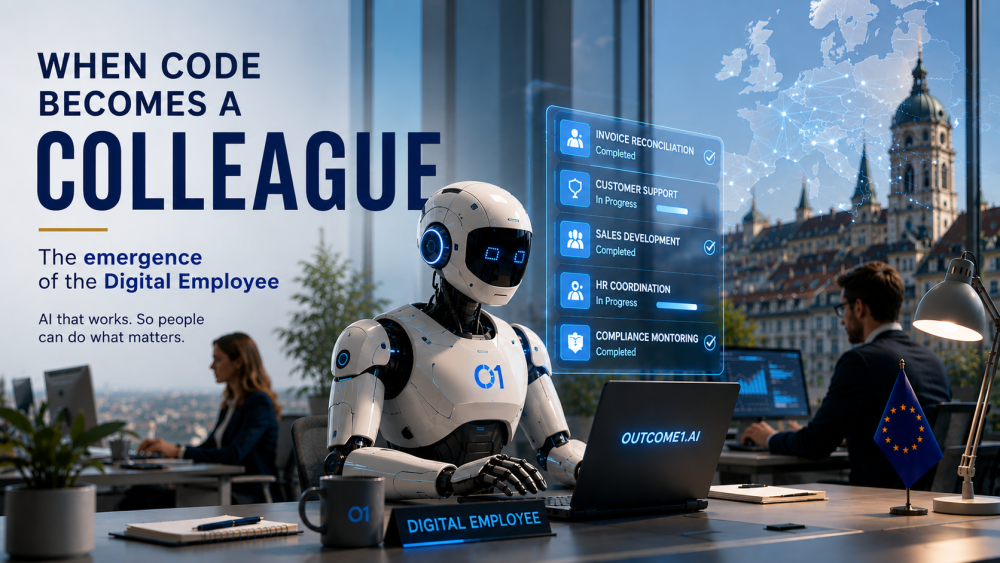
190/2026
For decades, computers have helped people do their jobs. Now, a new generation of artificial intelligence is attempting something more ambitious: doing the job itself as a digital employee. You sleep, and your digital employee colleague keeps working all night without getting tired.
That is the idea behind Outcome1.AI, a Romanian-founded technology company developing what it calls “Digital Employees” for Europe’s small and medium-sized businesses (SMEs). Rather than selling another software dashboard, the company is building AI systems that assume defined business roles, ranging from accounts payable and customer support to sales development, HR coordination, and compliance.
The distinction is important. A conventional software program waits for instructions. A Digital Employee is designed to assume a role, access the information and systems it needs, perform a sequence of tasks, and escalate matters when human judgment is required. Outcome1.AI describes its platform as combining workflows, company knowledge, memory, integrations, security, and human oversight so work can move from assignment to completion.
An AI workforce for the companies left behind
Technology arrives at a particularly interesting moment for European SMEs. Large corporations have the resources and technical staff to experiment with advanced AI. Smaller companies often face a different problem: they have plenty of work but cannot easily find, afford, or retain enough people to do it.
Outcome1.AI argues that this is where digital labor could have its greatest impact. Its founders envision AI not primarily as a replacement for existing employees, but as additional capacity to handle repetitive operational work, allowing people to focus on relationships, creativity, and decisions that require judgment.
Imagine an accounts-payable employee who works continuously, matching invoices and identifying exceptions. Or a sales assistant who qualifies leads and prepares meetings. Or an AI compliance analyst who tracks regulatory developments and prepares documentation. These are precisely the kinds of roles Outcome1.AI says its platform is designed to support.
Promise and caution
The potential benefits are considerable. AI employees could help smaller companies increase capacity without waiting months for recruitment, operate across languages, reduce administrative backlogs, and provide more consistent execution. Outcome1.AI also emphasizes controlled permissions, traceable actions, privacy, and human escalation important safeguards as AI systems begin operating within real businesses.
But calling an AI system an “employee” or “digital employee” should not obscure its limitations.
Human workers understand context in ways machines still struggle to replicate. They recognize unusual circumstances, navigate ambiguity, and take responsibility for consequences. An AI system can also make errors at remarkable speed. The more authority it receives, the more important reliable auditing, cybersecurity, data protection, and human supervision become.
Outcome1. AI therefore presents its model not as unrestricted autonomy, but as governed digital work: the AI performs within defined boundaries, while consequential decisions can return to humans.
A European experiment with global implications
Whether Digital Employees becomes a transformative new category or simply another stage in the evolution of automation remains to be seen. However, the underlying shift is profound.
The next generation of workplace technology may not merely give employees better tools. It may also give companies entirely new kinds of colleagues.
The real question, then, is not whether machines can work.
It is which work we will choose to give them and what we will ask humans to do with the time they give back.