The Fourth Wave of Technology: When Artificial Intelligence Begins to Challenge Human Judgment
Posted 13 hours ago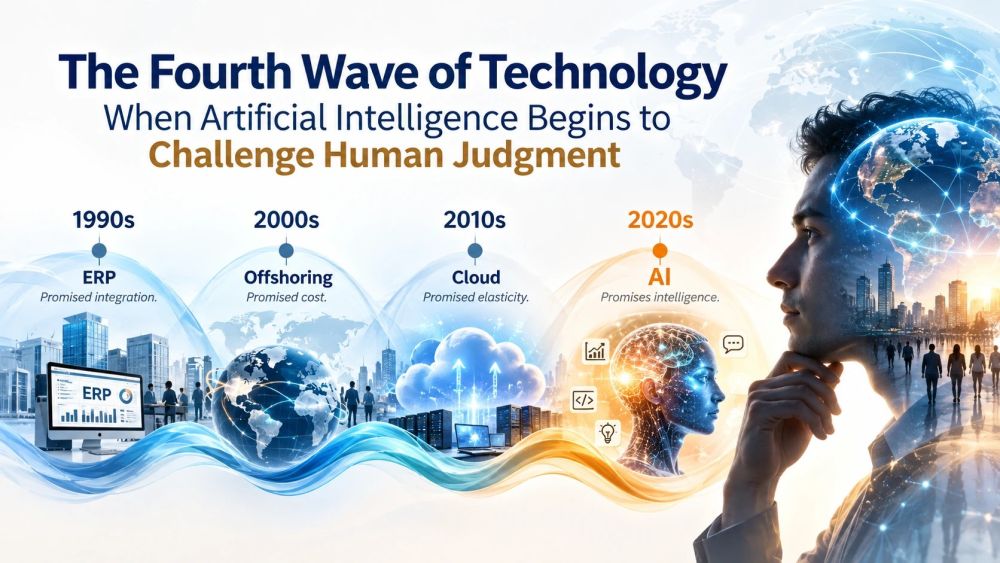
258/2026
Every technological revolution has promised greater efficiency. But as artificial intelligence advances, the world faces a more profound question: are we becoming more capable, or simply more dependent on the machines we build?
Every generation witnesses a technological revolution that reshapes how the world works. Businesses move faster, industries become more efficient, and possibilities expand beyond what once seemed achievable. Yet beneath every promise of progress lies a question we rarely ask: what might we lose in exchange for what technology gives us?
The evolution of modern technology reveals four defining waves, each driven by a compelling promise and each carrying consequences that extend beyond efficiency. An impressive presentation from the National University of Singapore captures this transformation through four technological waves,
The first wave, in the 1990s, was Enterprise Resource Planning (ERP). Its promise was integration: unifying departments, information, and business processes within unified systems. Organizations achieved greater coordination and consistency, but much of their operational knowledge became embedded in software configurations. Over time, people could become dependent on systems designed to guide their work.
The second wave, in the 2000s, was offshoring. The promise was cost efficiency and access to global talent. Work crossed borders, businesses expanded their reach, and international collaboration flourished. Yet when responsibilities were distributed to external providers, organizations sometimes weakened their capacity to specify requirements, evaluate quality, and retain ownership of essential expertise.
The third wave, during the 2010s, was cloud computing. Its promise was elasticity, the ability to access computing power and digital infrastructure whenever needed. Organizations could innovate without maintaining every technical resource themselves. But convenience also created new dependencies, with some institutions losing direct control over the infrastructure and technical capabilities supporting their operations.
Now the world is experiencing the fourth wave: artificial intelligence. This time, the stakes may be fundamentally different.
AI promises intelligence. It can analyze information, generate ideas, draft documents, write computer code, and recommend solutions to complex problems. Unlike earlier technologies, which primarily transformed processes, labor arrangements, or infrastructure, AI is increasingly entering the domain of human reasoning itself.
This is where the central challenge emerges: AI may not simply automate what we do; it may gradually influence how we think, judge, and decide.
When people rely on AI without questioning its answers, they risk trading understanding for convenience. When organizations accept algorithmic recommendations without examining the evidence, they may mistake speed for wisdom. When students use intelligent tools without engaging in independent thought, they may complete their assignments while missing the very learning those assignments were meant to foster.
According to Prof. Emeritus Dr. Muhammad Mukhtar, Rector of the University of Southern Punjab, Multan, Pakistan, the danger is not that machines will necessarily become more intelligent than humans in every respect. Rather, humans may stop exercising the intellectual abilities essential to responsible decision-making, including curiosity, critical thinking, ethical reasoning, creativity, and sound judgment.
Nevertheless, rejecting AI would be equally short-sighted. When properly applied, it can accelerate scientific discovery, improve healthcare, personalize education, expand access to expertise, and help societies address complex challenges. The goal should not be to choose between human and artificial intelligence, but to make them complementary, says Prof. Mukhtar.
This requires a fundamental shift in how we educate, lead, and manage institutions. Universities must teach students to question AI-generated answers rather than simply producing them. Organizations must preserve the expertise needed to evaluate automated decisions. Leaders must recognize that accountability cannot be delegated to an algorithm.
Ultimately, we should measure technological progress not only by productivity, speed, or cost savings, but also by whether it strengthens human capability, preserves independent thought, and improves the quality of our decisions.
The first three technological waves transformed how we organize work, where we perform it, and how we access the infrastructure that supports it. The fourth reaches closer to the heart of human agency: our capacity to think for ourselves.
The greatest achievement of the AI age will not be building machines that can think for us. It will be using machines intelligently while ensuring we never surrender our ability to think.