Is Social Media Really Addictive? The Science Says It’s Complicated
Posted 6 months ago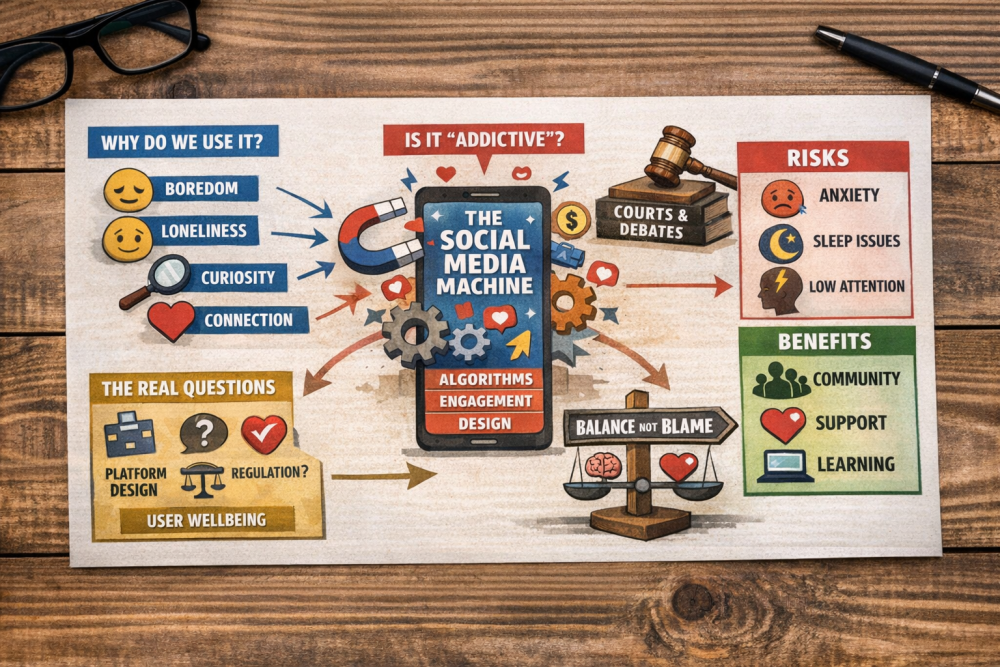
48/2026
There is something deeply alluring about the idea that social media is addictive. It provides a simple explanation for restless teenagers, distracted adults, and a society that seems constantly glued to glowing screens. But what if this framing, so common in headlines, courtrooms, and dinner-table debates, is not only incomplete but also dangerously misleading?
A recent analysis in Nature Journal asks this question precisely: Is social media truly addictive, or are we forcing complex human behavior into a convenient medical box?
The answer is far from simple.
A diagnosis in search of evidence
Addiction, in a clinical context, is not merely a casual term. It represents a specific disorder that alters brain function, drives compulsive behaviors, and persists despite negative consequences. Consider substances like nicotine or alcohol.
Social media's influence remains debated because researchers cannot agree on whether excessive use constitutes a formal medical diagnosis, underscoring the need to understand its complex nature to keep readers engaged.
Recognizing that the issue is complex helps policymakers, educators, and mental health professionals feel confident in approaching social media's impact with nuanced strategies rather than oversimplified labels.
When complexity becomes convenient
Describing social media as addictive may seem obvious, but it risks oversimplifying a complex issue. Human behavior is rarely caused by just one factor. People scroll not only because platforms are designed to hook them, but also because they are bored, lonely, curious, anxious, or seeking connection.
Describing this addiction” is like labeling hunger as a disease.
The truth is more troubling: social media exists at the crossroads of psychology, economics, technology, and culture. Platforms are designed to grab attention, but they also mirror the societies that created them. They heighten our desires, fears, and need to belong.
And unlike substances, they are woven into the fabric of modern life, used for work, education, activism, and relationships.
The debate has expanded beyond academic journals. Courts, especially in the United States, are now considering whether social media harms young people in ways similar to addictive substances.
But science doesn't easily conform to legal complexities.
When judges decide on uncertain scientific issues, the risk is that policies are driven more by public concern and, potentially, moral panic than by solid, well-proven scientific evidence.
History provides the answers. From television to video games, every new medium has been accused of corrupting youth. Some concerns proved valid; many did not. The lesson is not to become complacent but to stay cautious.
What science does tell us?
If social media is not yet proven to be addictive in the clinical sense, that does not mean it is harmless.
There is increasing evidence connecting excessive use to anxiety, sleep problems, and shorter attention spans. The mechanisms may not be the same as addiction, but the effects can still be concerning.
More importantly, the impact varies. Teenagers, whose brains are still developing, may be especially vulnerable. The structure of likes, shares, and endless scrolling can significantly influence self-esteem and social comparison.
But here again, the story defies simplicity. Not all use is harmful. For many, social media is a lifeline, especially for those who feel isolated in the offline world.
A better question
We may be asking the wrong question.
Instead of “Is social media addictive?”, we might ask: What kind of digital environment are we creating and for whom?
This shift is important because it transfers responsibility from individuals to systems. It encourages examination of design choices, business models, and regulatory frameworks.
Why are platforms optimized for engagement instead of well-being?
Why is attention treated as a commodity rather than a cognitive resource?
And why do we expect users, especially young ones, to navigate this landscape alone?
Beyond blame, towards balance
The appeal of the “addiction” label is that it provides clarity. It identifies who is responsible and what actions are needed.
But reality is more complex and more humane.
Social media isn't a drug in the traditional way. It acts as a mirror, a marketplace, and a megaphone. It shows both the best and worst parts of us, often at the same time.
Our challenge is to reshape social media into a space that respects attention and promotes digital literacy, inspiring policymakers, educators, and mental health professionals to lead this transformation.
Recognizing that this debate extends beyond science to societal values underscores the importance of collective choices in shaping social media's future and keeps readers invested in the discussion.