Robots as Your Employees: What Happens When Machines Do the Jobs?
Posted 7 months ago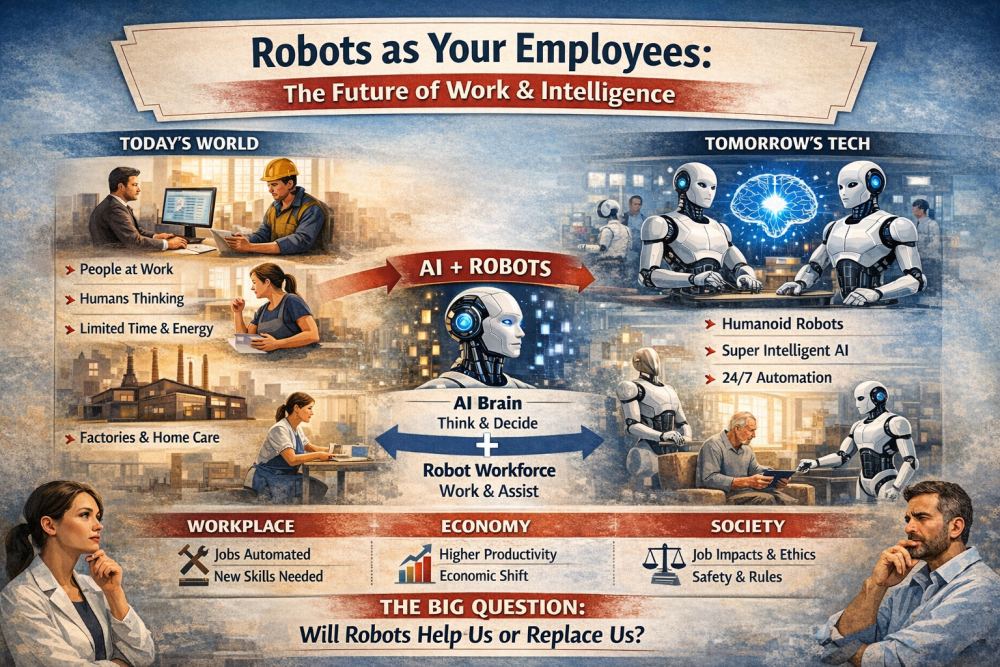
14/2026
Technology has always shaped human life, but never before has it advanced at such speed or carried such immense impact. From smartphones in our pockets to algorithms deciding what we watch, read, and buy, digital intelligence quietly shapes daily life. What once took decades to develop now changes in months. In this fast-moving world of technology, Elon Musk has once again made predictions that are simultaneously dramatic, unsettling, and fascinating.
Recently, Musk suggested that artificial intelligence is approaching a point where it might surpass human intelligence much sooner than most people expect. According to him, AI systems could become smarter than individual humans within the next year or two. In simple terms, machines might soon be able to learn faster, analyze more deeply, and make decisions more efficiently than any person or even groups of people ever could.
Along with the rise of superintelligent software, Musk envisions a bright future for humanoid robots that look and move like humans. He believes these robots won't stay confined to factories or research labs. Instead, they could be mass-produced and sold in large quantities, becoming as common as cars or smartphones. Powered by advanced AI, these robots might one day perform physical work, assist in homes, help the elderly, and carry out tasks that are tiring, dangerous, or repetitive for people.
Musk claims that combining AI brains with robotic bodies could revolutionize the global economy. If machines can operate nonstop without getting tired, productivity could reach unprecedented levels. Goods and services might become more affordable and plentiful, altering the way wealth is created and shared. From his perspective, the world could move toward an era in which meeting basic needs is easier, as machines handle much of the heavy work.
At the same time, these predictions raise serious questions. If robots and AI can perform many human jobs more efficiently, what will happen to workers? How will societies adapt when machines take over roles once seen as uniquely human? Musk himself has often warned that AI could become dangerous if not carefully managed. While he remains optimistic about technological advances, he also emphasizes the importance of caution, regulation, and responsible development to ensure a safe future for all.
Not everyone agrees with Musk’s timelines or confidence. Many experts believe that genuine human-level intelligence in machines is still distant, and that building safe, reliable humanoid robots on a large scale is much harder than it seems. Even skeptics agree on one thing: AI and robotics are advancing rapidly, and their influence on daily life is unavoidable.
For a layman, this future might arrive quietly rather than suddenly. AI assistants, automated services, and smart machines will gradually integrate into homes, offices, hospitals, and schools. Some jobs will disappear, new ones will emerge, and skills will need to evolve. Emphasizing the importance of education, adaptability, and understanding technology can help readers feel more prepared and confident about navigating change.
In simple terms, Musk’s message isn’t just about robots or smart machines. It’s about a pivotal moment in human history when intelligence is no longer limited to biological brains. Whether this results in more prosperity, greater inequality, or something in between will depend not only on the technology itself but also on how wisely humanity chooses to use it.
ADDITIONAL READING
Musk predicts humanoid sales, AI surpassing humanity