A Handshake with Tomorrow
Posted 1 month ago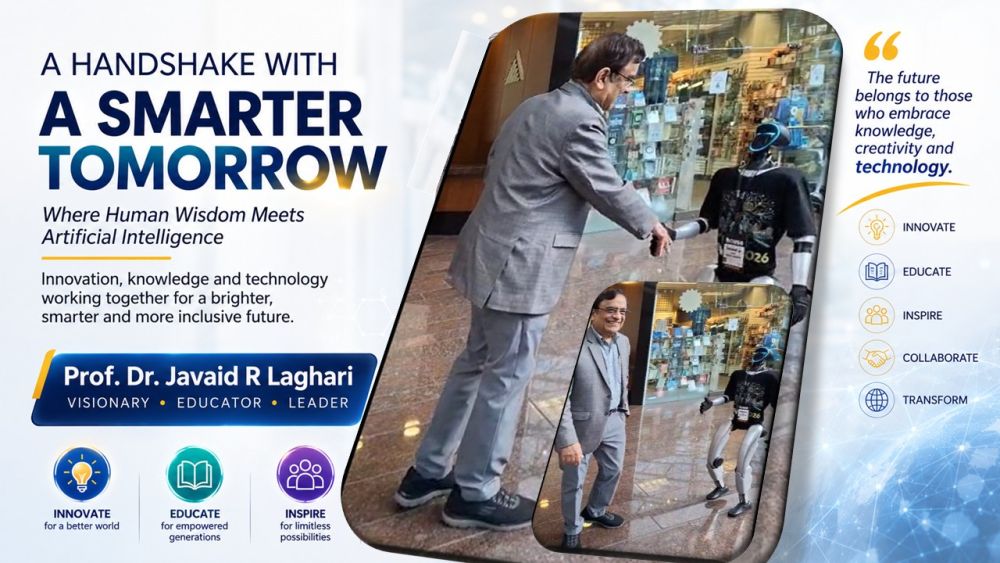
183/2026
The moment lasted only a few seconds.
Please see the historical moment HERE
Prof. Dr. Javaid R. Laghari, a world-renowned educationist and former Chairperson of the Higher Education Commission of Pakistan, extended his hand. A robot extended its own. The two hands met in a handshake.
It was an ordinary human gesture performed in an extraordinary setting.
Yet that brief encounter captured something profound: the future of intelligence may no longer be confined to the human mind or a computer screen. It may have a body, a voice, eyes, hands, and the ability to move through our physical world.
The robot was not merely a machine. It was a glimpse of what is coming.
For much of modern history, machines were designed to amplify human muscle power. Engines made us stronger. Vehicles made us faster. Computers made us better at calculation.
Robotics is taking the next step.
Machines are beginning to acquire physical agency.
Powered by artificial intelligence, computer vision, sophisticated sensors, and increasingly capable algorithms, robots are evolving from programmable machines into systems that can perceive their surroundings, interpret information, and respond to situations.
This transformation could redefine the relationship between humans and technology.
From factories to classrooms
The first generation of industrial robots lived behind safety barriers.
They welded automobile bodies, moved heavy components, and performed repetitive tasks with extraordinary precision. They were powerful yet largely blind to the world around them. Their movements were carefully programmed.
Tomorrow's robots will be different.
A robot may enter a hospital and determine where equipment needs to be delivered. It may assist an older adult at home. It may work alongside technicians in a factory, recognize an unexpected obstacle, and adjust its movement. On a farm, autonomous machines could monitor crops, identify signs of disease, and perform highly targeted agricultural tasks.
The defining characteristic will not be mechanical strength alone. It will be adaptability, and perhaps nowhere will this transformation be more important than in education.
The university is about to change.
For generations, students have learned science by reading about it.
Robotics offers something different.
A student can build a machine and watch physics come to life. She can program a robot and see mathematics take shape as movement. He can train an artificial intelligence model and watch an algorithm learn to distinguish one object from another.
A robotics laboratory can therefore become a classroom where engineering, computer science, mathematics, artificial intelligence and creativity converge.
This is particularly important for Pakistan.
The country has a young population with enormous potential. But the jobs of the future will increasingly demand technological fluency, not simply the ability to operate technology, but the ability to understand, design, and improve it.
Universities must therefore move beyond teaching students how to use artificial intelligence. They must teach them how to build intelligent systems.
They must create laboratories where students can experiment with robotics, autonomous systems, computer vision, machine learning, and human–robot interaction.
The university of the future should not merely produce graduates who ask, “Where can I find a job?” It should produce graduates who ask,
“What problem can I solve?”
Will robots take our jobs?
The fear is understandable.
Every technological revolution creates anxiety about employment. Machines have replaced some forms of human labor throughout history. But robotics forces us to reconsider what we mean by work.
A robot may be able to lift something heavier than a human can, work through the night, or perform a repetitive task thousands of times without tiring.
But a machine does not automatically possess wisdom.
It does not experience compassion. It does not understand the meaning of a grieving family, the hopes of a student, or the ethical consequences of a difficult decision in the same way a human being does.
The greatest opportunity may therefore lie not in humans versus robots, but in humans working with robots.
- A surgeon assisted by intelligent machines may perform procedures with greater precision.
- A teacher supported by AI and robotics may provide more individualized learning.
- A farmer equipped with autonomous systems may produce more with fewer resources.
- A scientist working with intelligent machines may explore possibilities that would be impossible to investigate manually.
The future belongs neither entirely to humans nor entirely to machines. It belongs to human–machine collaboration.
And then there is the question of ethics
The more capable robots become, the more important human questions become.
- Who is responsible when an autonomous machine makes a mistake?
- How much decision-making should be delegated to an algorithm?
- How should robots protect human privacy?
- What happens when automation eliminates an occupation faster than society can create new opportunities?
These are not merely engineering questions. They are questions of philosophy, law, economics, education and human values. The robotic revolution will therefore require not only better engineers but also better thinkers.
The handshake
Perhaps this is why the image of Prof. Dr. Javaid Laghari shaking hands with a robot is so compelling.
The photograph can be interpreted as a meeting between two forms of intelligence.
One is biological.
The other is engineered.
One evolved through billions of years of natural history.
The other emerged from centuries of human curiosity, mathematics and scientific discovery.
And yet the robot's hand exists because a human mind imagined it. That is the paradox of robotics.
The machine represents artificial intelligence—but its existence is itself evidence of human intelligence.
The handshake therefore becomes more than a photograph.
It becomes a symbol.
A symbol of the moment when humanity begins to share its physical world with machines that can increasingly see, learn, move and interact.
We should not fear that future.
We should prepare for it.
According to Prof. Dr. Muhammad Mukhtar, Rector of the University of Southern Punjab, Multan, and Founding Vice Chancellor of a pioneering skills university in the country, our universities must build robotics laboratories. Our schools must introduce students to computational thinking and engineering. Our industries must invest in automation and intelligent manufacturing. Our policymakers must develop ethical and regulatory frameworks. And our young people must be given the opportunity to become creators rather than mere consumers of technology.
The robot standing opposite Dr. Laghari may eventually become more capable than today's machines.
It may walk into a laboratory, help manufacture a product, assist a patient, explore a dangerous environment, or collaborate with a researcher.
But whatever form that future takes, one fact will remain fundamental:
The future of robotics will ultimately be determined not by how intelligent our machines become, but by how wisely human beings choose to use that intelligence.
The handshake lasted seconds. Its meaning may last for generations.