UN Establishes First Global AI Safety Panel to Guide Artificial Intelligence Governance Worldwide
Posted 7 months ago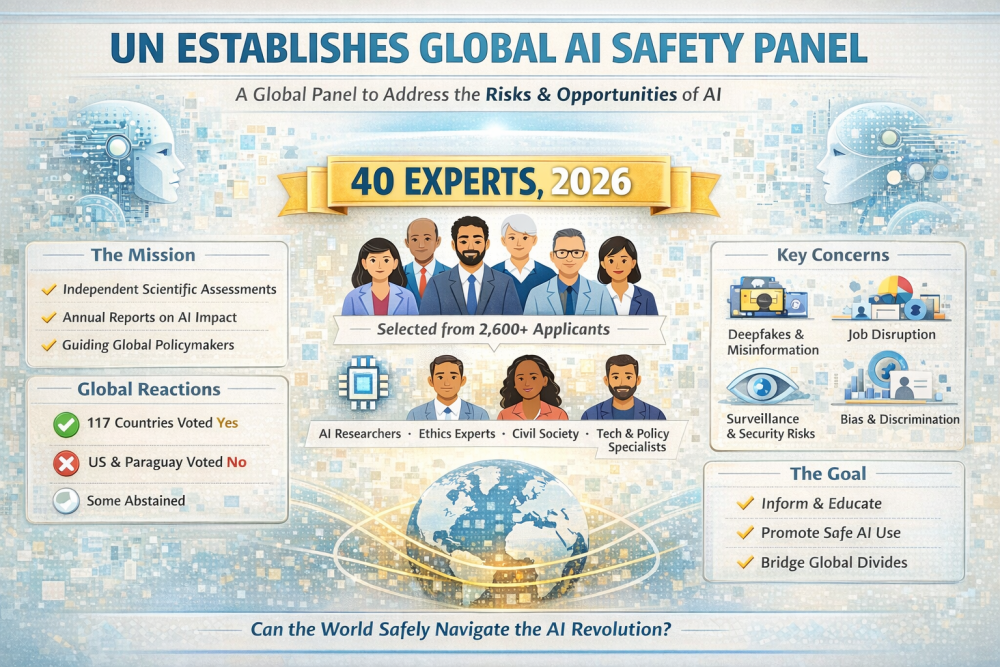
38/2026
As artificial intelligence continues to transform our lives, the United Nations has established a groundbreaking global scientific panel to guide AI governance worldwide, highlighting its critical role in shaping the future of technology.
On September 2, 2025, the UN General Assembly adopted a resolution to create a 40-member Independent International Scientific Panel on Artificial Intelligence, intended to operate similarly to the global panels that shape scientific understanding of climate change.
Then, in February 2026, the Assembly officially appointed experts from around the world to serve on the panel in its first real test of authority and potential.
🌍 Why the UN is stepping into AI
AI has long been promoted as a tool of endless potential, but along with that promise come real concerns. Critics highlight issues like deepfakes, bias, job disruptions, surveillance, and the potential for misuse in cyberattacks or political manipulation. An independent safety report has documented risks ranging from technical failures to broader societal harms.
The UN panel aims to provide a neutral, science-based assessment of AI, helping the global community feel included and reassured as they address societal risks.
UN Secretary-General António Guterres said the panel fills a “missing link,” providing rigorous, independent scientific insight that every country, rich or poor, can use to make informed decisions about the technology.
🧠 What the panel will do
Instead of creating laws, the panel’s main purpose is to provide scientific evaluation and insights into AI risks and opportunities to support informed decision-making.
- It will generate annual reports that compile evidence on AI’s risks and opportunities, translating technical research into accessible insights.
- These reports will assist policymakers, scholars, civil society, and the public in understanding the future of AI.
- The idea is like the Intergovernmental Panel on Climate Change (IPCC), independent, expert-driven, and trusted worldwide.
Unlike a treaty or a regulatory body, this panel won’t create laws; instead, it will highlight facts, clarify misinformation, and help countries with different technological levels make balanced decisions.
🌐 A truly global group
The panel’s 40 members were selected from over 2,600 applicants through an independent vetting process.
Its members represent:
- Academia, including AI researchers and ethics experts
- Civil society, bringing perspectives on human rights and equity
- Technologists and data governance experts
- Journalism and public policy experts
This diversity is intentional: AI impacts all areas of society, from healthcare and education to media, children’s rights, labor markets, and governance. A wide range of voices helps the panel capture that complexity.
⚖️ Few Disagree
The panel’s creation wasn’t without controversy. In the final vote, some critics believe that the UN should focus on its traditional duties: peace, security, and human rights, and leave technology regulation to states or regional arrangements. Others worry that global bodies may slow innovation or impose rules unfairly.
But supporters argue that AI doesn’t respect national borders, and without a shared understanding, global harm could outstrip local responses.
💡 Why this matters for everyone
AI isn’t just a technology topic for Silicon Valley or governments. Its impact affects real lives.
- Tools that influence employment, either positively or negatively
- Algorithms shaping news feeds and political discourse
- Systems affecting credit, justice, and healthcare decisions
- Misuse in cybercrime or discrimination
In many discussions, AI risks have outpaced scientific understanding, leading to confusion about what’s real and what’s hype. The panel’s role is to help distinguish fact from fear, providing clarity based on evidence rather than hype or rhetoric.
By serving as a global reference point, the panel aims to empower both citizens and leaders, helping us all answer a crucial question:
Can the world steer AI’s growth in ways that protect society while unlocking its benefits?
🔎 A step, not a finish line
Establishing this panel marks a meaningful step toward international cooperation, inspiring hope that global efforts can effectively address AI's challenges.
In a tech landscape where innovations develop faster than laws can keep up, a trusted scientific compass is now part of the global toolkit. How effectively the panel influences actual policy, protects societies, and helps bridge divides between countries, companies, and citizens remains to be seen.
But one thing is certain: the world has recognized that AI is too large to regulate on its own, and science must serve as a key guide for its future.
Note: The image used in this article has been created through ChatGPT5.2