The Industry-Integrated-PhD: Bridging Universities and Industry to Accelerate Innovation
Posted 2 months ago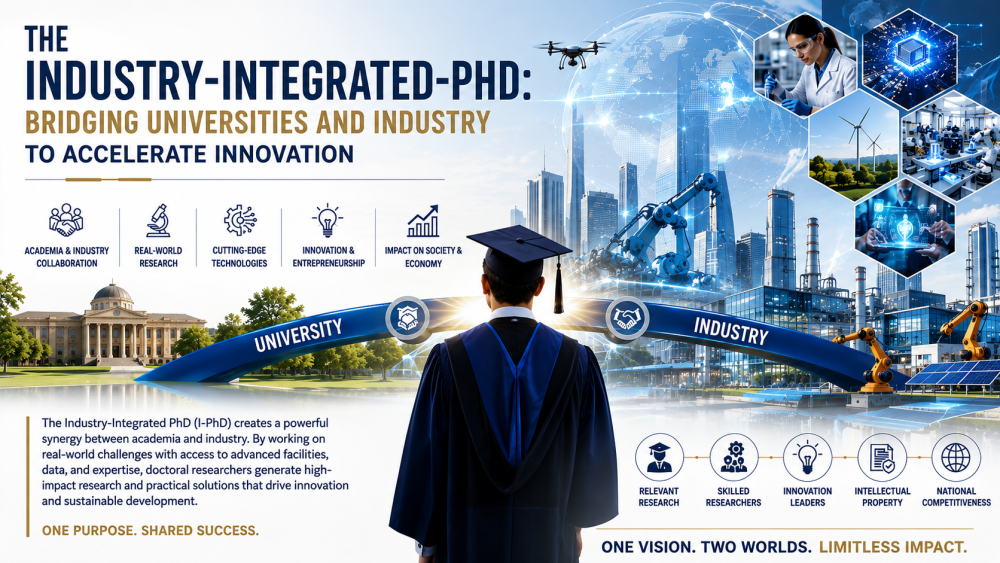
172/2026
For decades, doctoral education has been the engine of scientific discovery, yet many PhD graduates have found themselves disconnected from the industries where innovation ultimately transforms society. The Industry-Integrated PhD (I-PhD) aims to close this gap by embedding doctoral researchers in industrial ecosystems while preserving the rigor of academic scholarship.
Unlike conventional PhD programs, the I-PhD is built on co-creation. Universities, industry, and researchers jointly define research problems that address real-world challenges in technology, the environment, healthcare, and manufacturing. Doctoral candidates gain access to industrial laboratories, cutting-edge technologies, commercial datasets, and multidisciplinary teams, ensuring that their discoveries have both scientific significance and practical impact.
The model produces not only highly cited research but also cultivates innovation leaders who understand scientific inquiry, product development, entrepreneurship, intellectual property, and technology commercialization. Industry benefits from a pipeline of highly skilled researchers, while universities strengthen the societal relevance and economic impact of their research.
As nations compete in the knowledge economy, the I-PhD offers a new vision for doctoral education: one in which academic excellence and industrial innovation are not parallel pursuits but complementary forces. By uniting the curiosity of science with the urgency of industry, the Industry-Integrated PhD is redefining how knowledge is created, translated, and applied to benefit society.
Prof. Emeritus Dr. Muhammad Mukhtar, Rector of the University of Southern Punjab, Multan, highly appreciated the introduction of the I-PhD as a visionary step toward transforming doctoral education. He observed that the program marks a paradigm shift by forging meaningful partnerships between academia and industry, enabling research that is both scientifically rigorous and directly relevant to national and global challenges. He emphasized that the I-PhD model will nurture a new generation of researchers equipped with innovation, entrepreneurship, and problem-solving skills, while strengthening the country's research, technology, and industrial competitiveness.