Synthesia: Turning Ideas into Professional Videos with AI
Posted 10 hours ago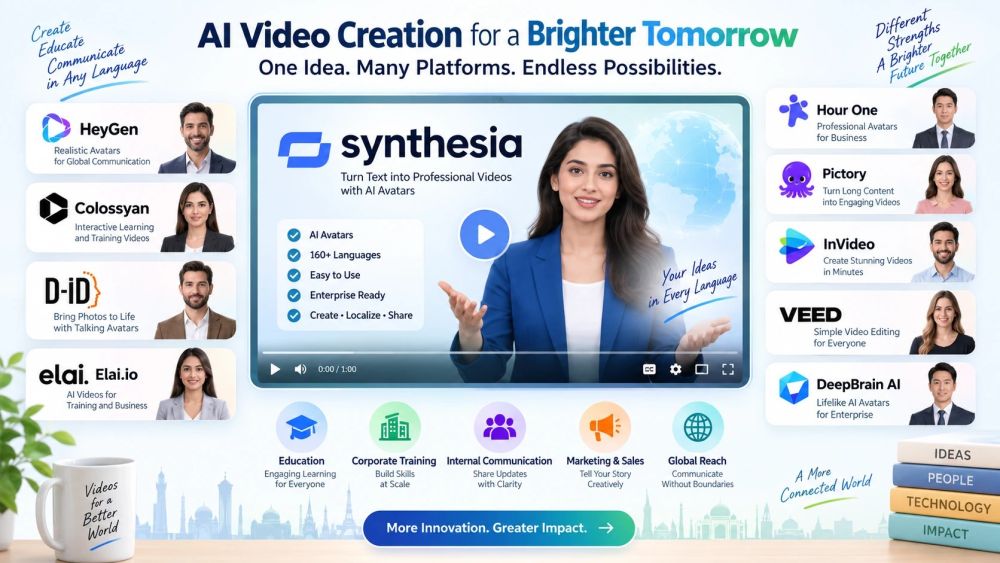
211/2026
Synthesia is a leading AI-powered video creation platform, designed for organizations that need to produce professional videos quickly. Rather than requiring cameras, studios, actors, voice-over artists, and extensive editing, Synthesia lets users turn a script, document, link, or idea into a polished video featuring an AI avatar and voice. The platform supports 160+ languages and positions itself as an end-to-end solution for creating, localizing, managing, and publishing AI videos.
Synthesia's simplicity makes it especially attractive. A user can select an avatar, enter a script, choose a language and voice, and generate a presentation-style video without specialized video-production skills. This has significant implications for higher education, corporate training, employee onboarding, marketing, sales, technical training, and internal communication. For example, a university could transform a lecturer's notes into multilingual instructional videos, while an organization could rapidly update compliance or employee-training materials whenever policies change.
One of Synthesia's strongest capabilities is multilingual communication. Its AI avatars can deliver content in more than 160 languages, and its translation tools can localize existing videos. This can substantially reduce the time and cost of producing separate versions of educational or corporate content for different linguistic audiences.
Another significant strength is its focus on enterprise use. Synthesia's website reports that more than 50,000 companies use the platform, and it highlights security and compliance credentials, including SOC 2 Type II, ISO 42001, and GDPR compliance. For institutions concerned about governance, consistency, and scalability, these features can be as important as the quality of the generated video itself.
A Competitive and Growing AI-Video Landscape
Synthesia operates in a rapidly evolving market, and it is important to recognize that several competitors are also delivering impressive innovations. HeyGen is particularly strong in realistic, expressive avatars, multilingual video, and marketing-oriented content. Colossyan has developed a compelling learning and development proposition, including interactive training, quizzes, branching scenarios, and SCORM-oriented workflows. D-ID offers an interesting approach to creating talking-avatar experiences from images, while Elai.io is another useful option for organizations seeking AI-generated presentations and training content. Synthesia itself lists these and several other platforms, including Hour One, Pictory, InVideo, VEED, and DeepBrain AI, as alternatives in the broader AI-video ecosystem.
This competition is ultimately good news for users. Each platform is developing distinct strengths rather than simply copying the same model: some emphasize enterprise training, avatar realism, marketing, interactive learning, content localization, or rapid social-media production.
The Bigger Picture
Synthesia is therefore more than an AI avatar generator. It marks a shift from video production as a specialized activity to video creation as an everyday knowledge-work capability. For educators, trainers, and organizational leaders, the real value lies not merely in producing attractive videos but in making high-quality visual communication faster, more scalable, and more accessible.
The rise of strong competitors such as HeyGen, Colossyan, D-ID, and Elai.io makes the field even more exciting. Rather than asking which platform will eliminate the others, it may be more useful to ask which platform best suits a particular communication or learning objective. In that rapidly evolving landscape, Synthesia has become an important benchmark, and its competitors are making the AI-video revolution increasingly capable and diverse.