Punjab Province of Pakistan Takes a Visionary Step Towards Skills-Led Development: Industry, Academia and Public Leadership Join Hands to Shape the Future of Youth
Posted 1 day ago
1 Likes, 30 views
276/2026
The Government of Punjab has taken an important step to strengthen the province's skills development and entrepreneurship ecosystem by nominating the Chairperson and members of the Punjab Skills Development and Entrepreneurship Authority for a three-year term.
According to a notification issued by the Punjab Skills Development and Entrepreneurship Department on November 27, 2026, the newly constituted Authority brings together public representatives, prominent industrialists, business leaders and academic experts, reflecting a collaborative approach to addressing the province's evolving skills and employment needs.
The Punjab Skills Development and Entrepreneurship Authority includes balanced representation from public officials, industrial leaders, and academic experts.
Commenting on the development, Prof. Emeritus Dr. Muhammad Mukhtar, Rector of the University of Southern Punjab, Multan, and former Founding Vice Chancellor of National Skills University, Islamabad, described the initiative as both commendable and visionary.
Drawing on his experience as Founding Vice Chancellor of Pakistan's first university dedicated exclusively to skills development, National Skills University, Islamabad, and his role in securing its recognition within the UNESCO-UNEVOC network, he emphasized that the future of skills education depends on strong partnerships among academia, industry, and public leadership.
According to Prof. Mukhtar:
"The inclusion of leading industrialists, business executives, academic experts, and public representatives in the Punjab Skills Development and Entrepreneurship Authority is a welcome development. It reflects an important understanding that educational institutions cannot shape our youth's future in isolation. Those who create industries, generate employment, introduce technologies, and understand market dynamics must become active partners in the skills development process."
He emphasized that Pakistan must move beyond conventional approaches to technical and vocational education and embrace a comprehensive model of human development.
"Empowering young people requires much more than imparting technical and vocational competencies. We must simultaneously cultivate social responsibility, ethical values, moral character, communication skills, adaptability, and leadership qualities. A skilled individual should not only be capable of earning a livelihood but should also become a responsible citizen, an innovative thinker, and a productive contributor to society."
Industry Participation is Essential in Skills Development
A significant aspect of the newly constituted Authority is the representation of leading industrial and business organizations. Their participation offers an opportunity to align skills training with actual industrial requirements, emerging technologies, and changing labor market demands.
Dr. Mukhtar advised that industry should not merely receive skilled graduates. It should actively participate in designing curricula, identifying emerging occupational needs, providing workplace learning opportunities, supporting apprenticeships, facilitating employment pathways, and developing competency-based training, industry-recognized certifications, entrepreneurship incubation, digital literacy, and emerging technology skills, particularly in artificial intelligence, automation, advanced manufacturing, renewable energy, and digital services.
Integrating Character Development with Skills Training
A central dimension of Dr. Mukhtar's perspective is that skills development must be seen as a broader instrument of nation-building.
He observed that technical competence without integrity, professional ethics and social responsibility cannot deliver the full promise of human development. Educational institutions must prepare young people not only for jobs but also for responsible citizenship, entrepreneurship, innovation and leadership.
He added that collaboration among universities, technical and vocational training institutions, industry, and government can create a sustainable ecosystem that empowers young people to translate their knowledge and abilities into economic opportunities.
Transforming Punjab's Skills Development Landscape
Establishing an inclusive Authority creates an opportunity to develop a coordinated provincial framework for skills development, entrepreneurship, and workforce readiness. Its effectiveness will depend on translating institutional representation into measurable outcomes.
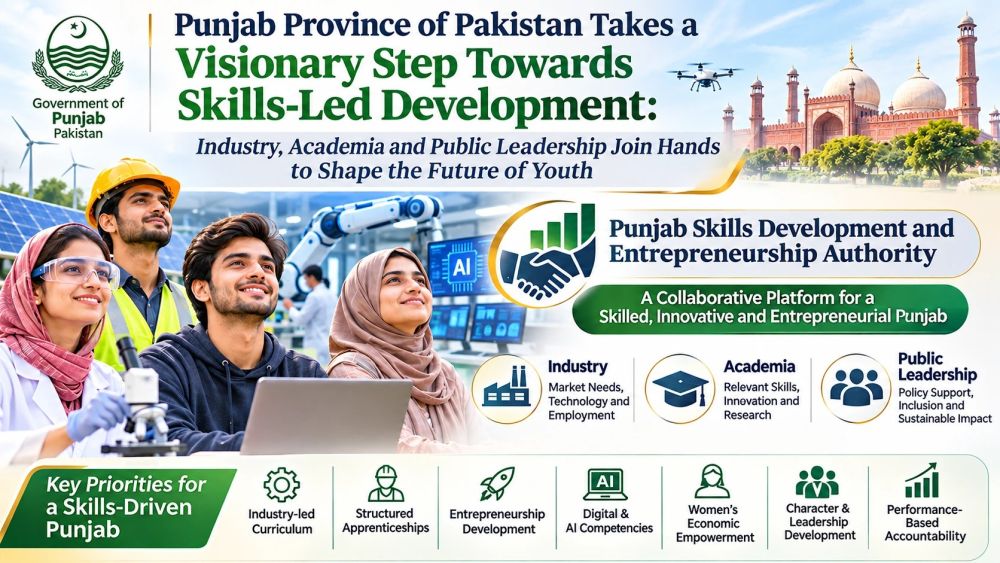
Some important priorities Prof. Mukhtar proposed:
- Industry-led curriculum development: Ensuring that training programs reflect actual and emerging market demands.
- Structured apprenticeships: Creating stronger pathways between technical education, industrial exposure, and employment.
- Entrepreneurship development: Supporting young people in transforming their skills and innovative ideas into viable businesses.
- Digital and AI competencies: Preparing the workforce for technological transformation and the emerging global digital economy.
- Women's economic empowerment: Expanding opportunities for women through digital livelihoods, flexible skills programs and entrepreneurship.
- Character and leadership development: Integrating ethics, communication, teamwork, discipline and social responsibility into skills education.
- Performance-based accountability: Establishing measurable indicators for training quality, employment outcomes, enterprise creation and industry partnerships.
The Authority can also serve as an effective platform for connecting provincial skills initiatives with national and international best practices, including the UNESCO-UNEVOC vision of transforming technical and vocational education and training for sustainable development.
Developing Capable Individuals and a Prosperous Society
Punjab's demographic potential offers an extraordinary opportunity. Transforming its young population into a productive economic force requires more than expanding training centers or increasing enrolments. It demands quality, relevance, inclusivity, innovation, and a strong connection with the world of work.
The newly constituted Punjab Skills Development and Entrepreneurship Authority represents an opportunity to bring these elements together through institutional collaboration and shared responsibility.
As Dr. Muhammad Mukhtar aptly emphasized, the ultimate objective of skills development should not be limited to producing employable individuals. It should be to nurture capable human beings who can create opportunities, demonstrate integrity, exercise leadership, and contribute meaningfully to society.
The future belongs to nations that invest not merely in educating their youth, but in equipping them with the skills, values, confidence, and character to lead. Punjab's new initiative offers an important opportunity to turn this vision into reality.