4. Learning Versus Teaching: Shifting the Focus from Content Delivery to Student Success
Posted 3 months ago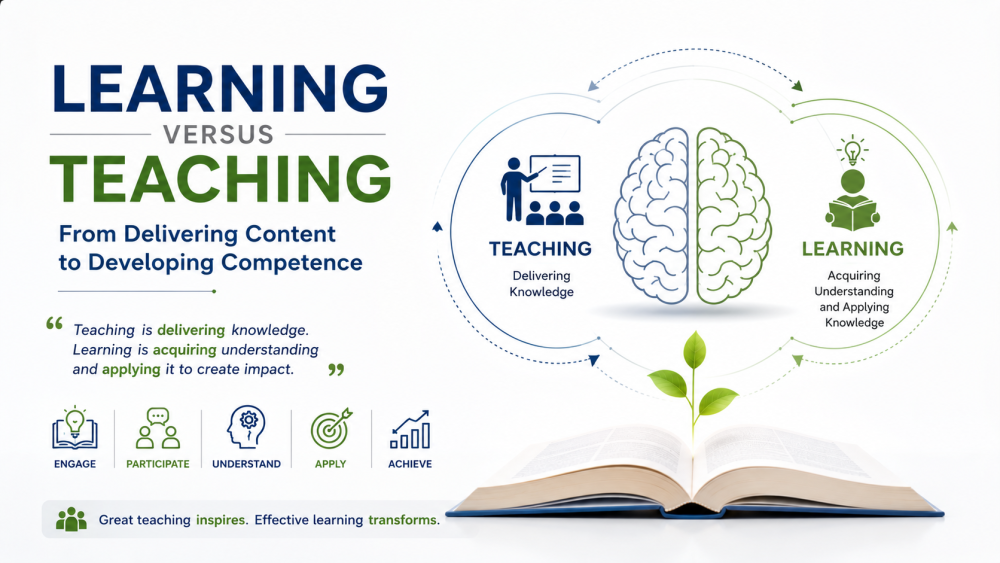
133/2026
Education has traditionally been viewed through the lens of instruction. Schools and universities invest considerable effort in designing curricula, preparing lectures, and ensuring that instructors follow prescribed syllabi. While these activities are essential, they often overshadow a far more important question: Are students learning?
This distinction between teaching and learning lies at the heart of modern educational reform and is a fundamental principle of Outcome-Based Education (OBE). Teaching is the process of delivering knowledge, whereas learning is the process of acquiring, understanding, applying, and transforming that knowledge into competence. Although closely related, these two concepts are not synonymous. Effective teaching should lead to meaningful learning, but teaching alone does not guarantee that learning has occurred.
Teaching Is an Input; Learning Is the Outcome
Teaching is an intentional act by educators to facilitate learning. It involves explaining concepts, organizing instructional materials, conducting classroom activities, and guiding students through educational experiences. However, teaching is only the input of the educational process.
Learning, by contrast, is the outcome. It occurs only when students internalize knowledge, develop understanding, apply concepts to real-life situations, think critically, and ultimately change their behavior, skills, or attitudes. A lecture may be expertly delivered, yet if students fail to understand or apply the material, meaningful learning has not occurred.
This distinction highlights a fundamental truth: excellent teaching is measured not by how much is taught but by how much is learned.
The Limitations of Content Coverage
In many educational institutions, teacher accountability is still largely measured by syllabus completion and classroom instruction. Teachers are frequently asked questions such as:
- Have you completed the prescribed course?
- How many lectures have you delivered?
- Have you covered all the required topics?
While these indicators measure instructional activity, they reveal little about educational effectiveness. Completing a syllabus shows that content has been delivered; it does not confirm that students have understood, retained, or can apply what they have been taught.
This emphasis on content coverage reflects a focus on educational output rather than on educational outcomes. Quantity supplants quality, and teaching becomes an end in itself rather than a means to student learning.
Outcome-Based Education challenges this mindset by shifting accountability from what teachers teach to what students learn.
Learning Requires Shared Responsibility
One of the most persistent misconceptions in education is that poor academic performance is solely the students' responsibility. When learners struggle, they are often criticized for lacking motivation, discipline, or ability. Parents may blame students, while teachers often attribute poor performance to inadequate preparation or limited aptitude.
Learning is a shared responsibility.
Students certainly have an obligation to engage actively in their education. However, educational institutions and teachers also share responsibility for creating learning environments that maximize understanding, participation, and success.
If significant numbers of students consistently fail to achieve intended learning outcomes, educators must ask an important question:
Is the issue with the learners, or with the learning process itself?
Outcome-Based Education encourages educators to examine teaching strategies, assessment methods, classroom engagement, curriculum alignment, and learning support before attributing failure solely to students.
Learning to Learn: The Most Important Competency
Perhaps one of the greatest omissions in many educational systems is the failure to teach students how to learn effectively.
Schools devote years to teaching mathematics, science, languages, and history, yet relatively little attention is paid to developing effective learning strategies. Students are rarely taught how memory works, how to organize knowledge, how to study efficiently, how to think critically, how to reflect on their understanding, or how to become lifelong independent learners.
Learning itself is a skill that can be developed.
Students benefit enormously from understanding techniques such as active reading, note-taking, retrieval practice, spaced repetition, concept mapping, collaborative learning, self-assessment, reflective thinking, and metacognition, which is the ability to think about one's own thinking.
When students learn how to learn, they become more independent, adaptable, and capable of acquiring new competencies throughout their lives.
Every Student Learns Differently
Just as every teacher has a unique teaching style, every student has a unique learning profile. Learners differ in prior knowledge, motivation, learning pace, interests, experiences, confidence, and cognitive strengths.
No single instructional method can effectively meet the needs of every learner.
Outcome-Based Education therefore promotes learner-centered teaching approaches that recognize individual differences. Effective educators continuously monitor student understanding, provide timely feedback, differentiate instruction as appropriate, and adapt teaching strategies to maximize learning for all students.
Rather than waiting for final examinations to reveal learning gaps, teachers should continuously assess learning throughout the educational process. Frequent formative assessment enables instructors to identify misunderstandings early and provide immediate support before difficulties become permanent.
Leadership Must Measure Learning, Not Just Teaching
Educational leadership also requires a fundamental shift in perspective.
School principals, department heads, deans, and university administrators often evaluate teaching by reviewing lesson plans, observing lectures, checking attendance records, or verifying syllabus completion. While these activities remain important, they offer only a partial picture of educational quality.
True academic leadership asks deeper questions:
- Are students achieving the intended learning outcomes?
- Can they apply what they have learned?
- Are graduates developing the competencies expected by employers and society?
- What evidence demonstrates meaningful learning?
Institutions committed to excellence measure success not merely by teaching activities but by the quality of student learning and graduates' competence.
Active Learning: Students at the Center of Education
Modern educational research consistently shows that students learn more effectively when they actively participate in the learning process.
Active learning encompasses a broad family of teaching approaches that shift classrooms from instructor-centered lectures to learner-centered engagement. Rather than passively listening, students analyze problems, discuss ideas, collaborate with peers, conduct investigations, complete projects, solve authentic cases, reflect on experiences, and apply concepts in practical contexts.
These activities transform students from passive recipients of information into active knowledge constructors.
Active learning fosters deeper understanding, stronger retention, improved critical thinking, greater motivation, and enhanced problem-solving skills. It also cultivates communication, teamwork, creativity, and lifelong learning skills that traditional lecture-based instruction often fails to develop.
The role of the teacher therefore evolves from being the primary source of information to serving as a facilitator who guides, challenges, mentors, and inspires meaningful learning experiences.
From Teaching to Learning: The Future of Education
The ultimate purpose of education is not merely to teach but to ensure that learning occurs. This requires a transformation in educational philosophy—from measuring instructional effort to measuring student achievement, from emphasizing syllabus completion to emphasizing competency development, and from teacher-centered instruction to student-centered learning.
Outcome-Based Education embodies this transformation by placing learning at the center of every educational decision. Curriculum design, teaching strategies, classroom activities, assessment methods, and institutional accountability are aligned with a single overarching objective: ensuring that students develop the knowledge, skills, attitudes, and competencies needed to succeed in an increasingly complex world.
Ultimately, teaching is valuable only when it leads to learning, and learning is meaningful only when it empowers individuals to think critically, solve problems, act ethically, and contribute positively to society. Educational excellence is therefore measured not by how much information is delivered in classrooms, but by how profoundly that knowledge transforms learners' lives.