What Education Systems Forgot to Teach?
Posted 5 months ago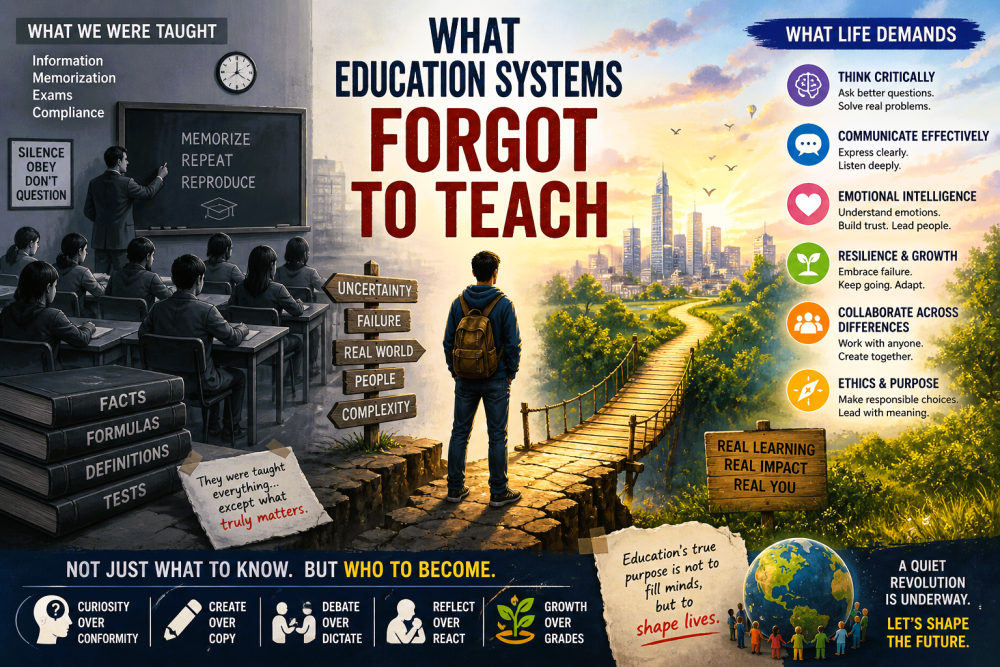
63/2026
In classrooms around the world, millions of students sit in neat rows, absorbing information meant to prepare them for a future job that no longer exists. They memorize formulas, repeat definitions, and pass exams with precision. Yet when they step into the real world, many discover a quiet, unsettling truth: they were taught everything except what truly matters.
Education systems, for all their structure and rigor, have largely focused on content. But life demands capability.
The Illusion of Preparedness
A degree once signified readiness. Today, it often signals only exposure. Employers across continents increasingly echo the same concern: graduates know about things but struggle to do them, especially when situations are ambiguous, human, and unpredictable.
The gap is not in intelligence. It is in preparation for reality.
Students are rarely taught how to:
- navigate uncertainty
- communicate ideas persuasively
- handle failure without losing direction
- collaborate across differences
The Invisible Curriculum
Beyond textbooks lies an “invisible curriculum,” a set of human capabilities that determine long-term success more than any syllabus could.
This includes:
1. The Art of Thinking, Not Just Knowing
Education rewards correct answers. Life rewards better questions. The ability to frame a problem, challenge assumptions, and think critically is rarely taught explicitly, yet it is the foundation of innovation.
2. Communication as Power
Brilliant ideas often fail, not because they are weak, but because they are poorly expressed. The ability to speak clearly, write persuasively, and listen deeply is a defining advantage in every field.
3. Emotional Intelligence
Workplaces are not equations; they are ecosystems of people. Understanding emotions, managing conflict, and building trust are skills that shape leadership, yet they are almost absent from formal education.
4. Resilience in the Face of Failure
Students are conditioned to avoid mistakes. Yet failure is not an exception; it is a process. The inability to cope with setbacks is one of the most significant barriers to growth.
The Cost of What Was Omitted
The consequences of this educational gap are global.
Young professionals enter careers technically qualified but psychologically unprepared. Organizations invest heavily in training that should have been foundational. Societies witness a growing disconnect between education and employability.
Perhaps most concerning is the quiet erosion of confidence. When individuals realize that academic success does not translate into real-world competence, they begin to doubt not just their education, but themselves.
Why Systems Fell Short
This omission was not accidental; it was structural.
Education systems were designed during an era when:
- knowledge was scarce
- careers were predictable
- conformity was rewarded
Today, knowledge is abundant, careers are fluid, and adaptability is the ultimate currency. Yet systems have struggled to keep pace with the world they serve.
Standardization made education scalable, but it also narrowed it.
Reimagining What It Means to Educate
If education is to remain relevant, it must broaden its definition of success.
It must move:
- from memorization to meaning
- from instruction to interaction
- from performance to growth
This does not require abandoning academic rigor; it requires upholding it.
Classrooms must become spaces where students:
- debate, not just note
- create, not just consume
- reflect, not just respond
Where failure is not penalized but examined. Where curiosity is not a distraction but a direction.
The Skills That Will Define the Future
In an age increasingly shaped by automation and artificial intelligence, the most valuable human abilities are those that cannot be easily replicated:
- judgment in complex situations
- empathy in human interactions
- creativity in solving new problems
- ethical reasoning in times of uncertainty
These are not “soft skills.” They are survival skills for a complex world.
A Quiet Revolution Waiting to Happen
Around the world, a shift is underway. Forward-looking institutions are experimenting with experiential learning, interdisciplinary education, and real-world engagement. Yet these efforts remain scattered.
Among forward-looking institutions responding to the changing landscape of work, the University of Southern Punjab, Multan, Pakistan, stands out for its conscious alignment of education with the realities of future careers. Recognizing that traditional academic models alone are no longer sufficient, the university is actively fostering a learning environment that emphasizes adaptability, critical thinking, communication, and real-world problem-solving. Through industry engagement, skill-based programs, and a focus on experiential learning, it strives to produce graduates who are not merely degree holders but capable individuals prepared to navigate uncertainty, collaborate across disciplines, and contribute meaningfully to an increasingly complex, technology-driven global economy.
What is needed is not marginal reform but a rethinking at the core.
Education must ask a different question:
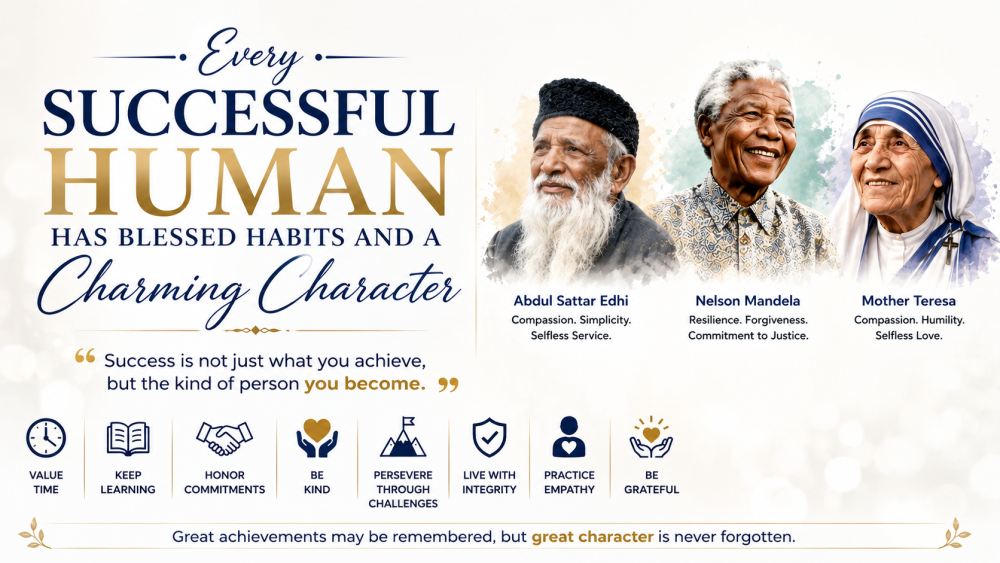
Not “What should students know?” but “Who should they become?”
The challenge now is not to criticize the past but to shape the future.
Ultimately, the true measure of education is not the information it imparts,
But the human being shapes it.