How the UK Is Becoming a Global Power in Artificial Intelligence Safety?
Posted 3 months ago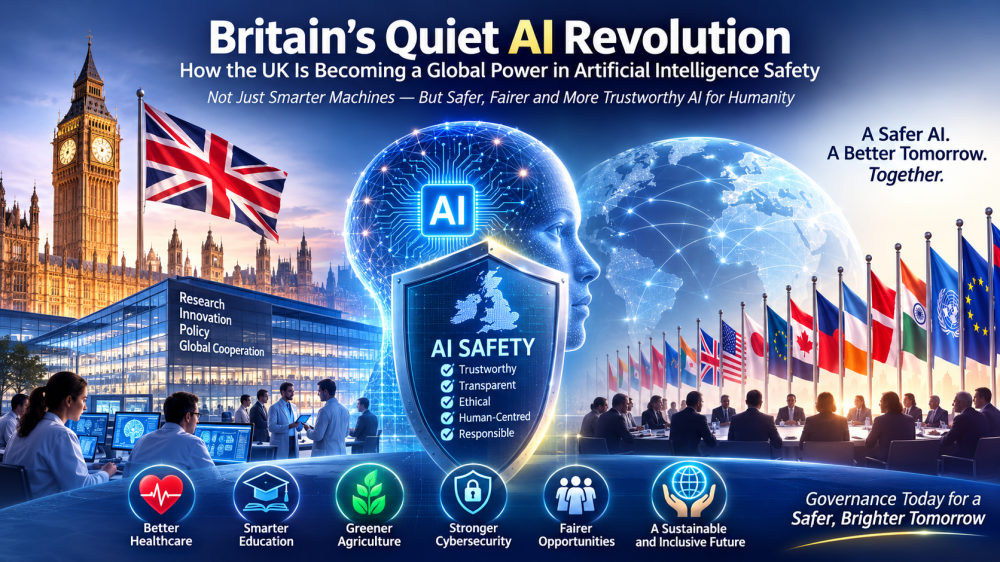
147/2026
For years, the global race in artificial intelligence (AI) seemed to have only two champions: the United States and China. Silicon Valley dominated the headlines with breakthrough technologies, while China invested heavily in AI research, manufacturing, and deployment. Yet another contender has been quietly building influence not by producing the biggest AI models, but by tackling one of the world's most urgent questions:
According to a recent Nature Journal analysis, Britain has rapidly emerged as one of the world's leading centers for AI safety research, policy, and international cooperation. Rather than competing solely on commercial AI products, the UK has carved out a unique role as a global hub where governments, scientists, technology companies, and policymakers work together to understand and reduce the risks posed by increasingly powerful artificial intelligence.
From Building AI to Governing AI
Artificial intelligence is advancing at breathtaking speed. Modern AI systems can write reports, generate images, assist doctors, design proteins, develop software, and even conduct scientific research. Future generations of AI may become significantly more capable.
But with greater capability comes greater responsibility.
Researchers worry about several challenges:
- AI systems generate convincing misinformation.
- Increasingly sophisticated cyberattacks.
- Bias and unfair decision-making.
- Loss of privacy.
- Autonomous systems behave unpredictably.
- Long-term risks from AI systems that exceed human capabilities in specific domains.
These concerns have created an entirely new scientific discipline: AI safety.
Instead of asking, "How can we make AI smarter?" AI safety researchers ask, "How can we make AI trustworthy, transparent, and aligned with human values?"
Unlike countries competing primarily for commercial dominance, the UK has invested heavily in becoming the world's meeting place for AI governance.
Government agencies, universities, independent research institutes, and technology companies have established a growing ecosystem devoted to evaluating advanced AI systems before they are widely deployed.
This ecosystem has attracted leading computer scientists, philosophers, mathematicians, social scientists, cybersecurity experts, and public-policy researchers, an unusual combination that reflects the multidisciplinary nature of AI safety.
Science Meets Public Policy
One reason Britain's influence has grown so quickly is its willingness to connect scientific research directly with government decision-making.
Traditional technology regulation often arrives years after innovations reach society. AI is moving too quickly for that approach.
Instead, researchers and policymakers increasingly work together to develop methods for:
- evaluating powerful AI models,
- identifying dangerous capabilities,
- creating technical safety standards,
- improving transparency,
- and encouraging responsible deployment.
This collaborative model has become a reference point for many governments seeking practical approaches to AI governance.
A Global Conversation
Artificial intelligence ignores national borders.
An AI model developed in one country can be downloaded, adapted, and used worldwide within days. That reality means no single nation can effectively manage AI risks alone.
Britain has therefore emphasized international cooperation, bringing together governments, technology companies, academic researchers, and civil society organizations to discuss shared safety standards.
The goal is not to slow innovation but to ensure that innovation remains beneficial.
Much as aviation relies on internationally accepted safety rules, many researchers believe advanced AI will eventually require globally recognized standards for testing, evaluation, and oversight.
Why This Matters to Everyone
For most people, AI safety may sound like an abstract concept. It affects everyday life.
Safer AI could mean:
- more reliable medical diagnoses,
- fewer online scams and deepfakes,
- stronger cybersecurity,
- fairer hiring systems,
- more trustworthy educational tools,
- and greater confidence in AI-powered public services.
Without careful oversight, however, the same technologies could amplify misinformation, discrimination, fraud, and security threats.
The challenge is to maximize AI's extraordinary benefits while minimizing unintended consequences.
The Future Will Depend on Trust
History shows that transformative technologies succeed only when society trusts them. Air travel became commonplace because rigorous engineering and safety regulations made flying remarkably safe. Modern medicines earn public confidence through years of testing and clinical trials. Artificial intelligence may require a similar foundation of evidence, transparency, and accountability.
That is precisely where Britain's growing influence lies, not merely in building smarter machines, but in helping the world build trustworthy ones.
As AI continues to reshape healthcare, education, finance, manufacturing, and scientific discovery, countries that lead in responsible governance may prove just as influential as those that build the largest models.
The next chapter of artificial intelligence may therefore be written not only in laboratories or corporate headquarters but also in the institutions dedicated to ensuring that this powerful technology serves humanity safely, fairly, and responsibly.
A Pakistani Academic Leader Welcomes the Global Focus on AI Safety
Prof. Dr. Muhammad Mukhtar, Rector of the University of Southern Punjab, Multan, and Chief Executive Officer of HunarNama, commented on Britain's growing leadership in artificial intelligence safety, describing the development as "a timely reminder that the true measure of technological progress is not how powerful our machines become, but how wisely humanity chooses to govern them."
"Artificial intelligence has the potential to revolutionize healthcare, education, agriculture, environmental protection, scientific research, and economic development," he said. "However, without robust ethical frameworks, transparent governance, and international collaboration, these advances could also pose significant societal risks."
Prof. Mukhtar emphasized that universities have a critical responsibility to prepare future generations for the AI era. "Higher education institutions must move beyond simply teaching students to use AI. We must educate innovators who understand its ethical implications, appreciate its societal impact, and possess the skills to develop technologies that are safe, inclusive, and beneficial for all."
He praised Britain's commitment to integrating scientific research with evidence-based policymaking, calling it "an inspiring model for nations seeking to harness AI responsibly." He added that countries such as Pakistan should actively increase their investments in AI education, interdisciplinary research, digital skills, and international partnerships to ensure they become contributors, not merely consumers, in the emerging AI economy.
"The future of artificial intelligence," Prof. Mukhtar concluded, "will not be determined solely by faster algorithms or larger computing power. Human values, scientific integrity, and global cooperation will shape it. If we succeed in aligning innovation with responsibility, AI can become one of humanity's greatest tools for advancing sustainable development, improving lives, and expanding opportunities for future generations."