The Evolution of Artificial Intelligence: How Machines Learned to Think?
Posted 8 months ago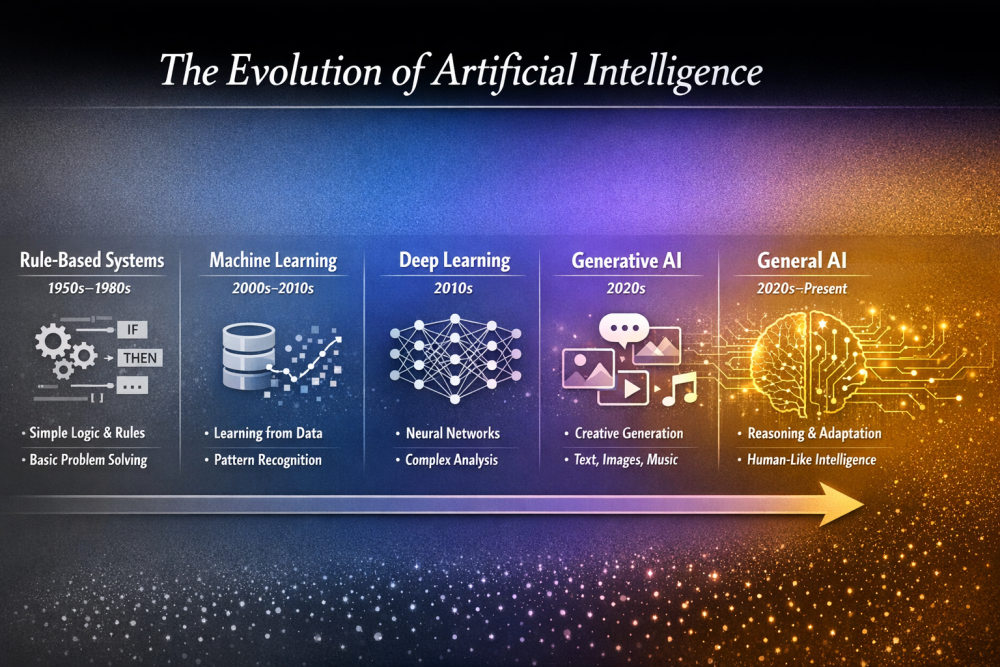
18/2026
In 1950, the British mathematician Alan Turing posed a deceptively simple question: Can machines think? His idea, now known as the Turing Test, questioned whether a machine could mimic human conversation so convincingly that a person couldn’t tell the difference. At the time, even imagining such a machine seemed daring.
In early 2025, a powerful AI program called GPT-4.5 was put to a classic test: could people tell whether they were talking to a human or a machine? Most of the time, they couldn’t. In fact, people mistook AI for a human in nearly three out of four conversations, even more often than they did with real people.
The surprise didn’t end there. When readers were asked to judge short pieces of writing, many preferred the texts made by AI over those created by experienced human writers. This showcases how AI now can mimic human conversation convincingly, evoking fascination and confidence in its capabilities.
How Did We Get Here? A Step-by-Step Evolution of Artificial Intelligence (AI)
Unlike biological evolution, which takes place over millions of years, AI has made rapid progress in a much shorter period. Here’s how the journey unfolded:
1. Early Engines and Simple Rules
The origin of AI dates back to the mid-20th century, when pioneering researchers created simple programs that could perform logical tasks and solve basic problems. At that time, “intelligence” meant executing predefined rules more quickly than a human could. Over the years, computers have become much faster and capable of handling increasingly complex instructions.
2. Machine Learning and Big Data
The real revolution began when systems were trained on large datasets rather than programmed manually. These machine learning systems learned patterns rather than rules, much like a child learning a language by listening to it spoken. This change allowed machines to recognize faces, transcribe speech, and translate languages.
3. Neural Networks and Deep Learning
Inspired loosely by how neurons in the brain fire and connect, scientists built neural networks with layered architectures that could process information in ways that mimicked, at a basic level, biological cognition. These networks became the driving force behind today’s most advanced AI tools.
4. Generative Models and Intelligence in Context
The latest wave of AI, including models that generate text, images, and even music on demand, marks a significant advance. They do not merely follow instructions but synthesize information from extensive patterns learned through training. Some experts now claim this generation meets the broad standards for human-level intelligence, not just performing specific tasks but demonstrating flexible reasoning and understanding across different contexts.
Not Just Fast Tools - Something Unique
What makes today’s AI unique is not just speed or memory but adaptability. Early computers were designed for specific calculations. Modern AI systems can generalize, they can answer questions they've never encountered before, and produce new outputs that humans often find innovative and convincing.
This is what makes them feel “alive” in conversation, and why scholars now contend that the dream of human-level machine intelligence has shifted from hypothesis to reality.
Arficial Intelligence Debate Continues
Despite the excitement, not every expert agrees on the implications. Some researchers warn that even if AI performs at a human level on many tasks, it doesn’t necessarily mean it thinks or understands the same way humans do. Other voices in the field suggest that focusing on a single benchmark, artificial general intelligence (AGI), may now be outdated, and the real challenge is understanding how AI integrates into society and affects human life.
What Comes Next?
The evolution of AI is likely to accelerate. As systems become more capable across science, design, and problem-solving, this raises important questions about societal roles and responsibilities, fostering a sense of cautious optimism and responsibility.
In simple terms, to sum up the discussion above, the message is clear and difficult to ignore: advanced AI is no longer a future concept — it is already part of our world. These systems are not just small tools made for a single task; they can think and adapt across many different situations. That means old methods of judging and regulating technology are no longer sufficient.
We also need to reconsider responsibility. Intelligence doesn't always mean independence, so determining who is accountable when AI systems make decisions is complex. The usual ideas about control and blame no longer fit neatly.
Finally, managing such powerful and adaptable technology will not be easy. Since AI can be used almost everywhere and for nearly anything, rules based on specific uses fall short. What this moment requires is thoughtful consideration, real-world evidence, and new strategies — because living alongside intelligent machines is no longer a question of if, but how.
Additional Reading
Does AI already have human-level intelligence? The evidence is clear