Designing the Connected Workplace of the Future
Posted 4 months ago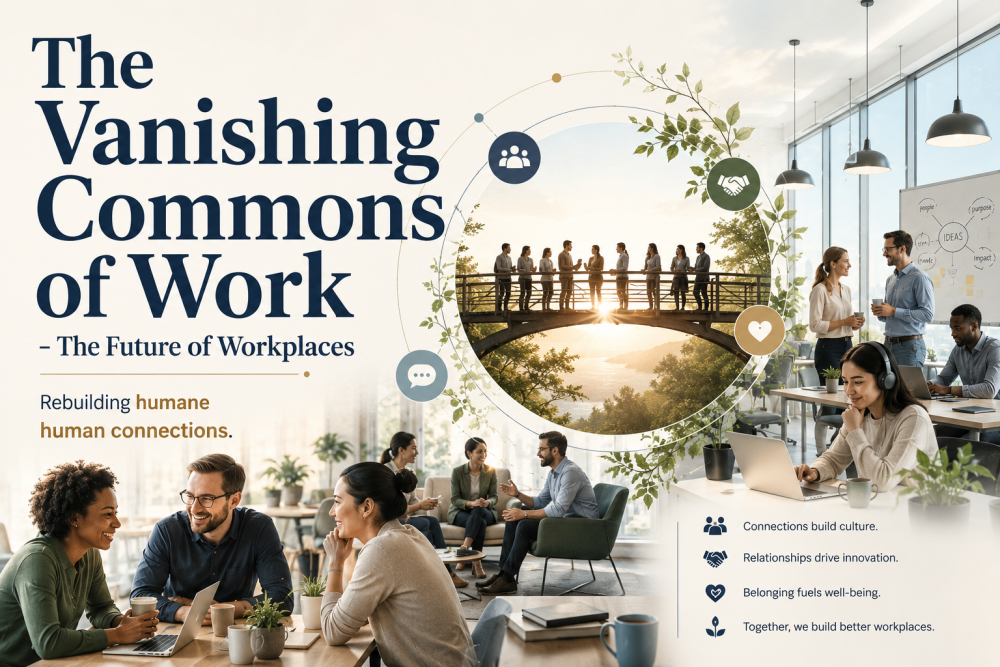
86/2026
The article “The Lost Social Infrastructure of Work” by Emma Zang and Rourke O'Brien, published in Science, examines a profound yet often overlooked consequence of the remote-work revolution: the erosion of the workplace as a vital source of human connection, social support, and collective identity. Drawing on emerging evidence linking remote work to increased isolation and mental distress, the authors argue that organizations must rethink work not only as a system for producing outputs but also as a social institution that sustains well-being and social cohesion.
For much of modern history, the workplace has been more than a place to earn a living. It has served as a social common, a setting where friendships form, ideas collide, mentorship flourishes, and individuals find a sense of belonging. Yet one of the most consequential transformations of the twenty-first century is unfolding quietly: the gradual disappearance of this social infrastructure.
The rise of remote and hybrid work is one of the largest social experiments in modern history. Accelerated by the COVID-19 pandemic and enabled by remarkable advances in digital technology, remote work has delivered undeniable benefits. Employees enjoy greater flexibility, less commuting time, improved work-life balance, and greater autonomy. Organizations benefit from broader talent pools and lower operational costs.
However, beneath these advantages lies a growing challenge that deserves far greater attention. As work becomes increasingly detached from physical workplaces, society may be losing one of its most important mechanisms for fostering social connection.
The scientific research published in Science highlights a troubling pattern. Workers in occupations that can be performed remotely are spending significantly more time alone and reporting higher levels of mental distress than those whose jobs require regular interaction. The increase in isolation appears particularly pronounced among individuals living alone, suggesting that work often serves as a critical source of daily human engagement.
This finding should not surprise us. Throughout history, workplaces have functioned as social ecosystems. Casual hallway conversations, spontaneous brainstorming sessions, shared lunches, informal mentoring, and collective celebrations create bonds that technology struggles to replicate. These seemingly minor interactions form what sociologists call social infrastructure, the networks and relationships that support emotional well-being, trust, creativity, and resilience.
The importance of such connections extends beyond individual happiness. Social interaction fuels innovation. Many breakthrough ideas arise not from scheduled meetings but from unexpected encounters and informal exchanges. Young professionals learn organizational culture through observation and interaction. New employees build confidence by being near experienced colleagues. Teams develop trust through shared experiences that screens cannot fully replicate.
The consequences of losing these interactions are increasingly evident. Mental health concerns have risen globally in recent years. While many factors contribute to this trend, researchers suggest that growing social isolation linked to remote work may be an important factor. Employees who spend entire days without meaningful human contact are more vulnerable to loneliness, anxiety, and reduced psychological well-being.
Yet the solution is not a simple return to traditional office models. Remote work offers substantial benefits that many employees are unwilling to give up. The challenge is therefore not whether remote work should exist but how it should be designed.
The future of work must move beyond the simplistic office-versus-home debate. Instead, organizations should focus on creating environments that balance flexibility with intentional opportunities for connection. Hybrid work models can succeed when employees coordinate schedules to ensure meaningful overlap. Offices should evolve from places of routine attendance into hubs for collaboration, mentoring, innovation, and community building.
Universities and educational institutions offer particularly valuable lessons. Learning is inherently social. Students benefit not only from lectures but also from peer interactions, faculty mentorship, collaborative projects, and informal discussions. As higher education adopts digital tools, institutions must preserve opportunities for face-to-face engagement that foster intellectual and emotional growth.
The implications also extend to public policy. Urban planners, employers, and governments should recognize social connections as a societal asset. Investments in community spaces, coworking hubs, professional networks, and civic organizations can help compensate for the social functions that traditional workplaces once provided.
Ultimately, the future workplace should be evaluated not only by productivity metrics but also by its capacity to strengthen human relationships. Technological progress has enabled unprecedented flexibility, but flexibility without connection risks creating a more isolated society.
The most successful organizations of the future will recognize that human beings are not merely workers performing tasks. They are social beings seeking purpose, belonging, and meaningful relationships. The challenge for leaders is therefore clear: preserve the efficiencies of digital work while rebuilding the social infrastructure that enables people to thrive.
Tomorrow’s workplace must be more than a platform for productivity. It must remain a community.
HunarNama Key Recommendations Emerging from the Article
- Treat social connection as part of job design, not as an optional benefit. Organizations should intentionally create opportunities for interaction and relationship-building.
- Coordinate hybrid schedules so colleagues are physically present on the same days, enabling meaningful collaboration rather than employees working alone in partially occupied offices.
- Support early-career employees and new hires through increased mentorship and face-to-face engagement, as they benefit most from workplace socialization.
- Provide structured opportunities for informal interaction, such as team gatherings, collaborative projects, learning communities, and professional networking events.
- Give special attention to fully remote employees by supporting coworking membership, periodic in-person retreats, and stronger team integration strategies.
- Measure employee well-being alongside productivity, recognizing that social isolation can undermine long-term organizational performance.
- Develop policies that balance flexibility and belonging, avoiding the false choice between complete remote work and mandatory office attendance.
Let’s keep in mind that technology can enhance work, but it cannot fully replace the social infrastructure that enables people and institutions to flourish.