AI Is Learning to Find What Science Got Wrong and to Spot Mistakes Our Mentors Missed
Posted 1 month ago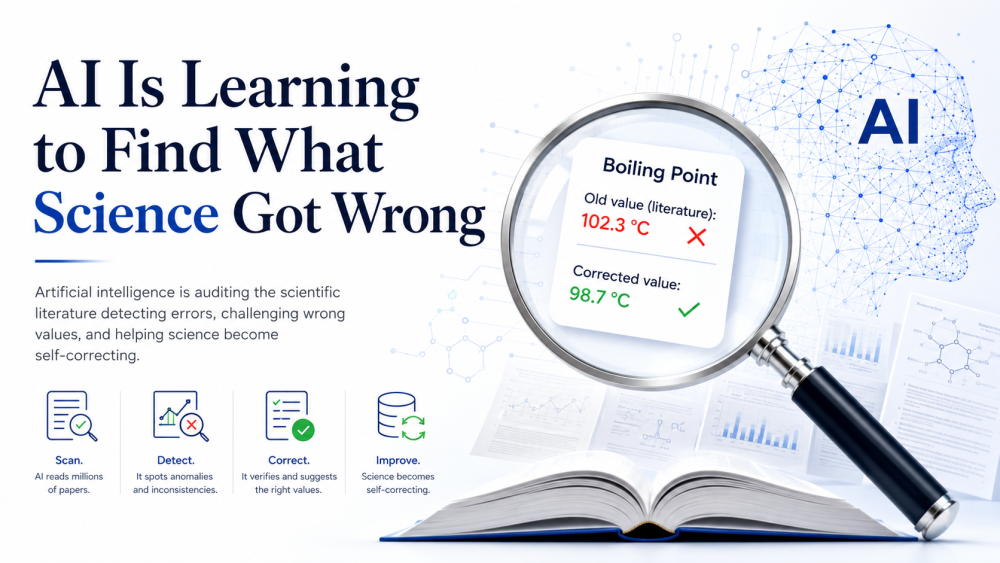
176/2026
Artificial intelligence is beginning to do something more consequential than generating answers: it is verifying the answers humanity has accumulated over centuries.
For much of its history, science has relied on an implicit bargain. Researchers measure the world, publish their observations, and expect subsequent generations to build on them. Errors are eventually corrected through replication, debate, peer review, and improved experiments.
But “eventually” can be a very long time.
A numerical error buried in a paper can be copied into another paper, then into a database, then into a handbook and eventually become accepted as a fact. Once a value acquires enough citations, challenging it can require more effort than accepting it.
Artificial intelligence may be changing that asymmetry.
A recent report in Nature Journal describes AI agents used to inspect scientific literature and reference databases, uncovering errors that have persisted for decades. In one striking example, chemists had long relied on handbook values for molecular boiling points. An AI system examining the underlying data found that some supposedly authoritative numbers were incorrect.
The significance extends far beyond chemistry.
It suggests that increasingly capable AI systems may evolve from producing scientific information to auditing scientific knowledge.
From Hallucinating Answers to Hunting Errors
The irony is difficult to miss.
In recent years, one of the biggest concerns about generative AI was its tendency to produce convincing but false statements, so-called hallucinations. Scientists worried that machines might contaminate the literature with fabricated references, incorrect calculations, and plausible-sounding nonsense.
Those concerns remain valid. Research has shown that large language models can still produce incorrect citations, and that AI-assisted literature retrieval requires careful verification.
But a different capability is emerging.
Give a sufficiently capable AI system access to scientific papers, databases, equations, experimental results, and external sources, and it can begin comparing pieces of knowledge. Instead of merely asking, “What does the literature say?”, the system can ask a more powerful question:
“Does what the literature says actually agree with the evidence?”
That is a fundamentally different role.
Science Has Always Contained Errors
Scientific knowledge is remarkably reliable, but it is not perfectly clean.
A paper may contain a misplaced decimal point. A formula may contain an algebraic error. A table may report a value inconsistent with the underlying calculation. A figure may have an incorrect label. A citation may not support the claim attributed to it.
Most such errors are not fraud. They are the ordinary imperfections of human knowledge production.
The scientific literature has grown so rapidly that no human reviewer can realistically recheck every equation, number, reference, and figure across millions of publications.
This is where AI has an unusual advantage.
A machine does not become tired after checking its thousandth equation. It can compare thousands of values, trace references across large networks of papers, and search for inconsistencies at a scale impossible for an individual scientist.
Recent work illustrates this potential. Researchers using a GPT-5-based “Paper Correctness Checker” examined objective errors in published AI research, including mistakes in formulas, derivations, calculations, and figures and tables. Human experts subsequently confirmed a substantial proportion of the errors the system identified, and the AI also proposed corrections for many of them.
The lesson is not that AI is infallible. It is that AI can become another layer of scientific quality control.
The Most Interesting Development: AI Can Challenge the “Standard Value”
Perhaps the most profound implication of the Nature report is the question of what happens when AI encounters a number that everyone already accepts.
Scientific databases often include “standard” or reference values. These values are extremely useful. Engineers use them to design systems. Chemists use them to identify substances. Researchers use them to calibrate experiments and interpret results.
But standard does not necessarily mean it is correct.
A value can become authoritative because it has been copied repeatedly rather than verified. An AI agent can approach the problem differently. It can gather measurements from multiple sources, compare them with physical relationships, examine the original literature, and identify values that appear anomalous.
The result is potentially transformative:
AI does not merely learn the scientific record. It can interrogate the record. That distinction may become one of the defining characteristics of the next generation of scientific AI.
The End of the “Citation Chain of Trust”?
There is another important consequence.
Science sometimes operates through a kind of citation inheritance.
Researcher A values reports.
Researcher B cites A.
Researcher C cites B.
Researcher D cites C.
After several decades, dozens of papers may appear to independently support the same number, even though the entire chain ultimately traces back to a single measurement.
AI could potentially expose these hidden dependencies.
It could follow a claim backward through the literature and ask:
How much independent evidence exists for this statement?
That could change the meaning of scientific consensus.
A thousand citations are not necessarily a thousand independent confirmations. AI may help distinguish citation volume from evidentiary strength.
Intelligence Is Becoming an Error-Correction System
This points toward a broader way of thinking about AI.
The most important measure of an intelligent system may not be how many answers it can generate.
It may be how effectively it can detect when an answer is wrong. Human intelligence is extraordinarily good at generating hypotheses. But humans are also susceptible to confirmation bias, authority bias, repetition and cognitive fatigue. AI systems have their own vulnerabilities, including hallucinations, bias and errors inherited from training data. The solution may therefore not be to choose between humans and machines.
It may be to create a scientific feedback loop.
Humans formulate hypotheses.
AI searches the accumulated evidence.
AI identifies inconsistencies.
Scientists investigate anomalies.
Experiments determine whether the anomaly is real.
The verified result enters the scientific record.
AI then learns from the corrected record.
The process repeats.
In that model, AI becomes something closer to a continuous error-correction layer for science.
But There Is a Dangerous Paradox
The prospect should not be romanticized.
An AI system trained in flawed scientific literature can inherit the very errors it is supposed to detect. A model may confidently identify a correct value as an anomaly or mistakenly “correct” a legitimate scientific outlier. This is particularly important because scientific anomalies are sometimes where discoveries begin. If every unusual result were automatically normalized toward the established value, science could become less innovative rather than more reliable. The goal, therefore, should not be automated conformity.
It should be automated scrutiny.
AI should say:
“This value deserves investigation.”
Not:
“I have decided this value is wrong.”
The distinction is fundamental.
From Generative AI to Corrective AI
The first phase of the AI revolution was largely generative. Machines learned to produce text, images, computer code, and increasingly sophisticated scientific explanations. The next phase may be corrective. AI systems could increasingly inspect papers before publication, examine existing literature after publication, cross-check databases and identify inconsistencies between experiments, models and established reference values. That could make scientific publishing less like a one-way pipeline and more like a continuously updated knowledge system.
The Nature Journal report offers an early glimpse of this future: AI agents are already being used to uncover faults in scientific papers and reference databases, including values that researchers had trusted for decades.
The larger message is profound.
The scientific record may no longer be something AI merely reads. It may become something AI helps repair.
AI - A New Scientific Instrument
The microscope expanded human vision.
The telescope expanded our view of the universe.
The computer expanded our capacity to calculate.
The internet expanded our ability to share knowledge.
AI may expand something different: our capacity to interrogate knowledge itself.
Its greatest contribution to science may ultimately not be the production of another million papers.
It may be helping scientists determine which of the millions that exist deserve to be trusted, questioned, corrected, or revisited.
That would represent a remarkable reversal.
For centuries, humans have accumulated scientific knowledge and asked machines to help process it. Now the machines are beginning to revisit that knowledge and ask whether we got it right. Perhaps that is one of the most promising signs that artificial intelligence is becoming genuinely useful to science: not that it makes fewer mistakes than humans, but that it is increasingly capable of finding the mistakes humans have left behind.