You Cannot Regulate Artificial Intelligence Without First Understanding It
Posted 3 months ago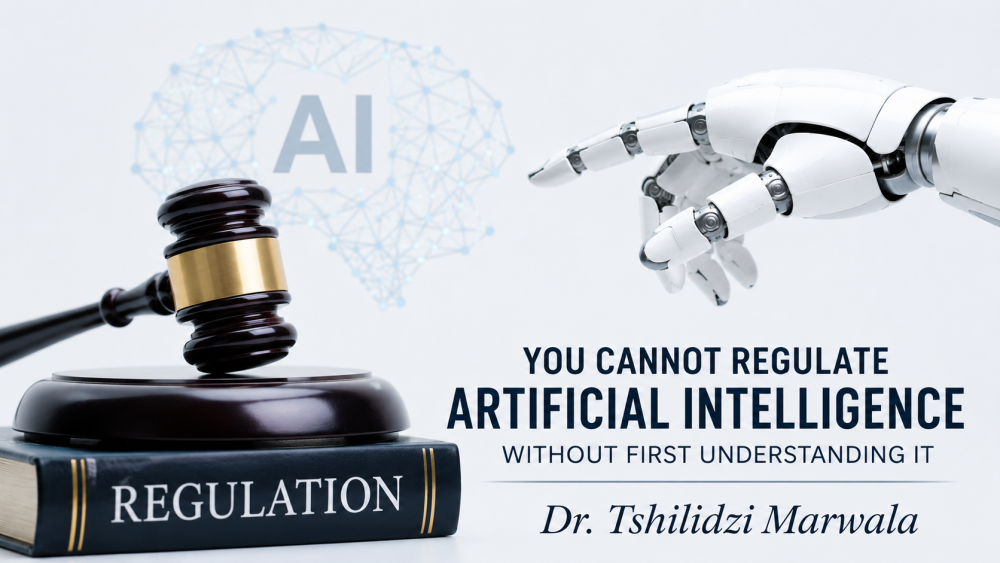
156/2026
The world is racing to regulate artificial intelligence. Yet there is a growing danger that governments, businesses, and even technology experts are writing rules for a technology they do not yet fully understand. Regulating AI without understanding its capabilities, limitations, and risks is like writing aviation laws before anyone has flown an airplane.
As Editor-in-Chief of the HunarNama Journal, I have encountered countless thought-provoking ideas, but few have resonated as deeply as a recent observation by Dr. Tshilidzi Marwala, the seventh Rector of the United Nations University: "You cannot regulate artificial intelligence without first understanding it." The statement lingered long after I read it, challenging the widely held assumption that legislation can keep pace with technological disruption. Curious about its deeper implications, I turned to ChatGPT to broaden my understanding. The more I examined the issue, the clearer it became that Dr. Marwala's insight is not merely persuasive; it is remarkably prescient. In an era when governments around the world are rushing to establish guardrails for artificial intelligence, his simple yet profound assertion captures an essential truth: meaningful regulation is impossible without meaningful understanding.
Artificial intelligence is no longer a futuristic concept. It writes reports, diagnose diseases, designs medicines, drives vehicles, detects financial fraud, generates software code, and increasingly influences decisions that affect millions of lives. As these systems become more powerful, calls for regulation have become louder and rightly so. AI has enormous potential to improve society, but it also carries significant risks.
The challenge, however, is that effective regulation demands knowledge. Laws created in the absence of deep technical understanding often become either too restrictive, stifling innovation, or too weak, leaving society vulnerable to unforeseen consequences.
History offers many lessons.
When the internet first emerged in the 1990s, many governments attempted to regulate it as though it were simply another form of broadcasting or telecommunications. Those early regulations quickly became obsolete because policymakers underestimated how rapidly the technology would evolve. Social media, cloud computing, online commerce, and digital currencies transformed the internet into something entirely different from what regulators had imagined.
Artificial intelligence is evolving even faster.
Unlike conventional software, modern AI systems continuously improve through training, learn patterns from enormous datasets, and sometimes produce outputs that even their creators struggle to explain. This "black box" nature makes regulation exceptionally challenging.
Learning Before Legislating
Good regulation begins with understanding.
Policymakers must distinguish among different forms of AI. A recommendation algorithm suggesting movies on a streaming platform poses entirely different risks than an AI system controlling military drones or assisting surgeons during complex operations. Treating all AI applications under a single regulatory framework would be both ineffective and unfair.
Similarly, regulators need to appreciate the difference between today's generative AI models, specialized industrial AI, autonomous agents, and emerging artificial general intelligence. Each raises unique ethical, legal, economic, and security questions.
Without that understanding, regulations may focus on yesterday's technology while tomorrow's innovations remain completely unaddressed.
Example 1: Self-Driving Cars
Imagine lawmakers requiring autonomous vehicles to eliminate every possible accident before being allowed on public roads.
At first glance, this sounds reasonable. But human drivers themselves are far from perfect, causing over a million road fatalities globally each year. If AI-powered vehicles ultimately prove significantly safer than humans, even if not flawlessly, rigid regulations could delay technology that saves thousands of lives.
Effective regulation requires understanding relative risk rather than demanding impossible perfection.
Example 2: AI in Healthcare
Suppose regulators prohibit hospitals from using AI to assist doctors in diagnosing cancer because they fear algorithmic mistakes.
Such caution may seem prudent. Yet AI systems have already demonstrated a remarkable ability to detect certain cancers, diabetic eye disease, and other conditions, with accuracy comparable to, and in some cases exceeding, that of experienced specialists.
The real question is not whether AI is perfect.
The question is how AI should be supervised, validated, and integrated with human expertise. Poorly informed regulation could deny patients life-saving technologies instead of making them safer.
The Knowledge Gap
One of today's greatest challenges is the widening gap between technological advancement and public policy.
Many legislators are accomplished lawyers, economists, or career public servants, yet relatively few have expertise in machine learning, data science, cybersecurity, or computational ethics. Meanwhile, AI capabilities continue to advance at an extraordinary pace.
Closing this gap requires continuous education rather than one-time consultations.
Governments should establish multidisciplinary advisory councils comprising AI researchers, engineers, ethicists, social scientists, legal scholars, educators, industry leaders, and civil society representatives. Regulations should evolve alongside scientific progress rather than remain fixed for years.
Principles Over Prescriptions
Because AI evolves rapidly, regulators should focus less on controlling specific technologies and more on governing outcomes.
Transparency, accountability, fairness, privacy, explainability, safety, and human oversight are enduring principles that remain relevant as AI systems evolve.
Flexible, principle-based regulation is more resilient than rigid technical rules that become outdated almost as soon as they are written.
Regulation as an Enabler
Contrary to popular belief, regulation should not exist merely to restrict innovation.
Its highest purpose is to build public trust.
When citizens know that AI systems are safe, transparent, and accountable, adoption accelerates. Businesses gain confidence to invest, researchers innovate responsibly, and society benefits from technological progress.
The objective is not to slow AI but to guide it wisely.
Global Responsibility
Artificial intelligence does not recognize national borders. A model developed in one country can influence healthcare, education, finance, journalism, and governance across the globe within days. Fragmented regulations create uncertainty for innovators and loopholes for bad actors.
International cooperation through shared standards, scientific collaboration, and ethical frameworks will become increasingly essential.
The Road Ahead
Artificial intelligence represents one of humanity's most transformative inventions, rivaling electricity, the internet, and the printing press in its potential impact.
But history also teaches that every revolutionary technology demands thoughtful governance.
The first responsibility of regulators is not to write rules.
First they must understand what they are regulating.
Only by combining scientific literacy with ethical responsibility can governments craft policies that protect society while allowing innovation to flourish. In the age of artificial intelligence, knowledge is not merely a prerequisite for regulation; it is the foundation for responsible regulation.