Why Europe Is Breaking from Big Tech: The New Race for Digital Sovereignty
Posted 3 months ago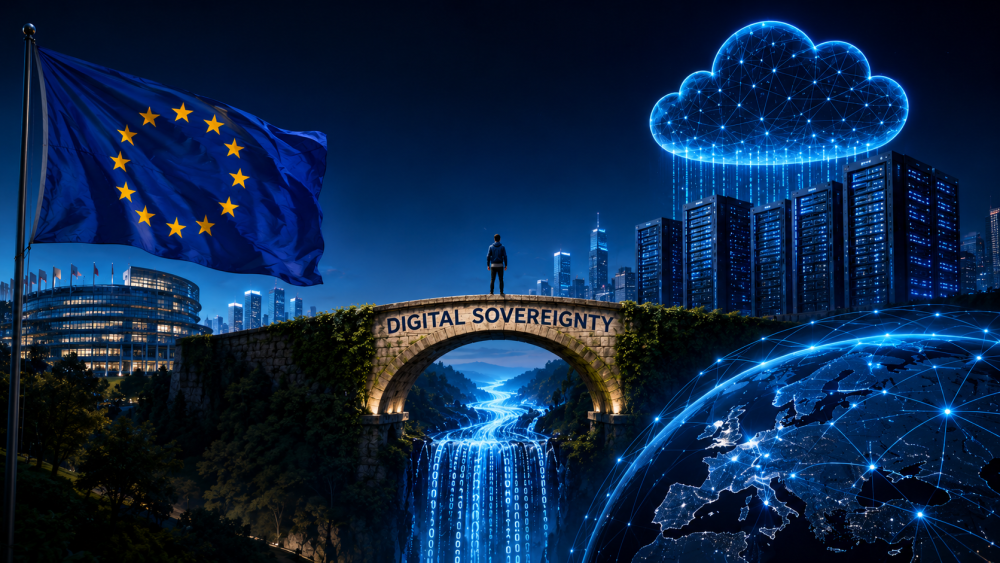
84/2026
A TikTok brief for the article is HERE
For decades, Europe’s digital life has run on American technology. Researchers stored data on U.S.-based cloud servers, universities relied on American software platforms, and scientists collaborated using tools owned by a handful of Silicon Valley giants. An article in the Nature journal provides a futuristic outlook for digital sovereignty.
Now, something remarkable is happening.
Across Europe, governments, universities, and research institutions are beginning to ask a question that would have seemed unusual only a few years ago: What happens if we become too dependent on technology developed and controlled elsewhere?
The answer is driving a growing movement toward what policymakers call “digital sovereignty,” the ability of nations and institutions to control their own digital infrastructure, data, and technological future.
From Convenience to Concern
For years, the relationship seemed simple. American technology companies offered powerful tools, reliable cloud services, and cutting-edge artificial intelligence platforms. European institutions adopted them readily because they worked well and often cost less than developing local alternatives.
But recent geopolitical tensions, growing concerns about data privacy, and uncertainty over international technology policies have shifted the conversation. European leaders increasingly worry that critical scientific data, government information, and research infrastructure could become vulnerable if they remain dependent on foreign providers.
Imagine a university storing decades of valuable research data on servers owned by a company headquartered thousands of kilometers away. If regulations change, political tensions rise, or access is restricted, that dependence could suddenly become a serious problem.
For scientists, whose work depends heavily on data sharing and digital collaboration, these concerns are particularly significant.
A New Push for European Technology
In response, the European Commission recently unveiled plans to strengthen Europe's technological independence. The initiative promotes European cloud services, homegrown artificial intelligence systems, and greater adoption of open-source software.
The goal is not necessarily to abandon American technology altogether. Rather, it is to create a healthier balance in which Europe has strong alternatives of its own.
Think of it as energy security. A country may still import energy, but it also seeks domestic sources to reduce vulnerability. Europe is now applying a similar philosophy to the digital world.
What This Means for Research
Scientific research has become one of the most data-intensive activities on Earth.
Modern laboratories generate enormous amounts of information, ranging from genomic sequences and medical records to climate simulations and astronomical observations. Storing, processing, and sharing these datasets requires vast digital infrastructure.
Many researchers have grown accustomed to using services from major U.S. technology companies because these services are powerful, familiar, and deeply integrated into daily workflows.
Moving away from those systems will be challenging.
Universities may need to retrain staff, migrate data, and invest in new platforms. Researchers may face temporary disruptions as institutions transition to European alternatives. Some worry that fragmented systems could complicate international collaboration.
The Rise of Open Source
One of the most intriguing aspects of Europe’s strategy is its renewed enthusiasm for open-source technologies. Open-source software lets anyone inspect, modify, and improve the underlying code.
For scientists, this aligns naturally with the principles of transparency and reproducibility.
When researchers can see how software works, they can better verify results, identify errors, and avoid being locked into proprietary systems. Open-source tools also reduce dependence on any single company.
Can Europe Compete?
The challenge is enormous.
American technology companies dominate the global cloud computing, artificial intelligence, and digital services markets. Building competitive European alternatives will require significant investment, talent, and time.
However, Europe has succeeded in areas where it chose to act strategically. The continent remains a global leader in advanced manufacturing, aerospace, renewable energy technologies, and scientific research.
Supporters of digital sovereignty believe technology could be the next success story.
Critics, however, caution that excessive focus on regional solutions could isolate European researchers from global innovation networks. Science thrives on openness, and technological nationalism could inadvertently create new barriers.
The real test will be finding a balance between independence and international cooperation.
A Broader Global Trend
Europe’s shift may be only the beginning.
Governments around the world are reconsidering their reliance on foreign technologies. Nations increasingly view digital infrastructure not merely as a commercial service but as a strategic asset, akin to transportation systems, power grids, or telecommunications networks.
As artificial intelligence becomes central to scientific discovery, economic competitiveness, and national security, control of digital tools is likely to grow even more important.
The debate is no longer just about software. It is about who controls the platforms that store humanity’s knowledge and power, and shape humanity’s future.
Europe’s move away from heavy reliance on U.S. technology is about far more than computers and cloud servers. It reflects a growing recognition that, in the digital age, technological infrastructure is a form of strategic power. Governments and research institutions want greater control over the systems that store their data and support their scientific work.
Whether Europe’s push for digital sovereignty becomes a model for the rest of the world remains to be seen. One thing is clear: the future of science will depend not only on brilliant ideas and groundbreaking experiments but also on who owns and controls the digital foundations on which modern research rests.