USP' Rector Proposes Adopting the Australian ATTEN and ACDE Model by the Higher Education Commission of Pakistan
Posted 3 months ago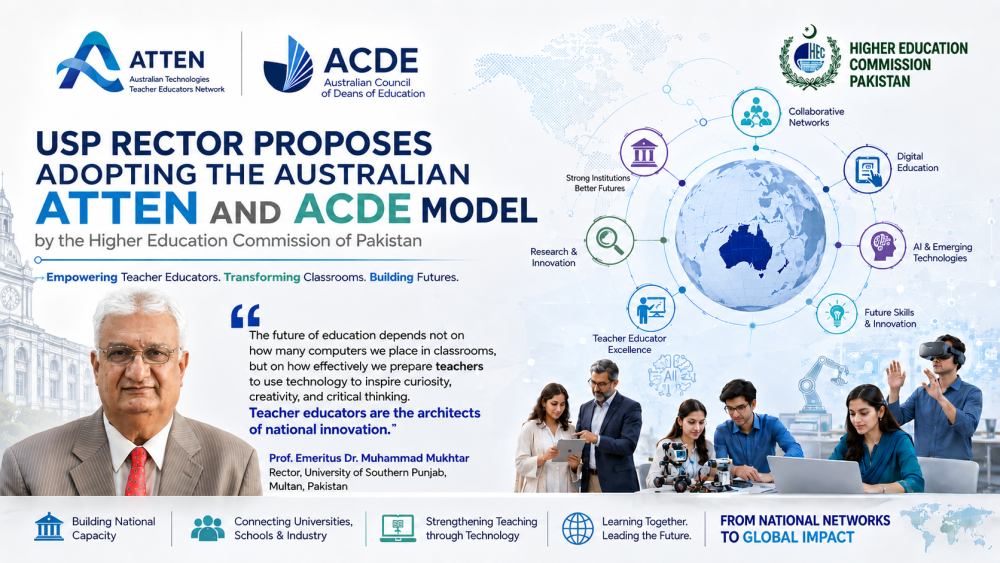
121/2026
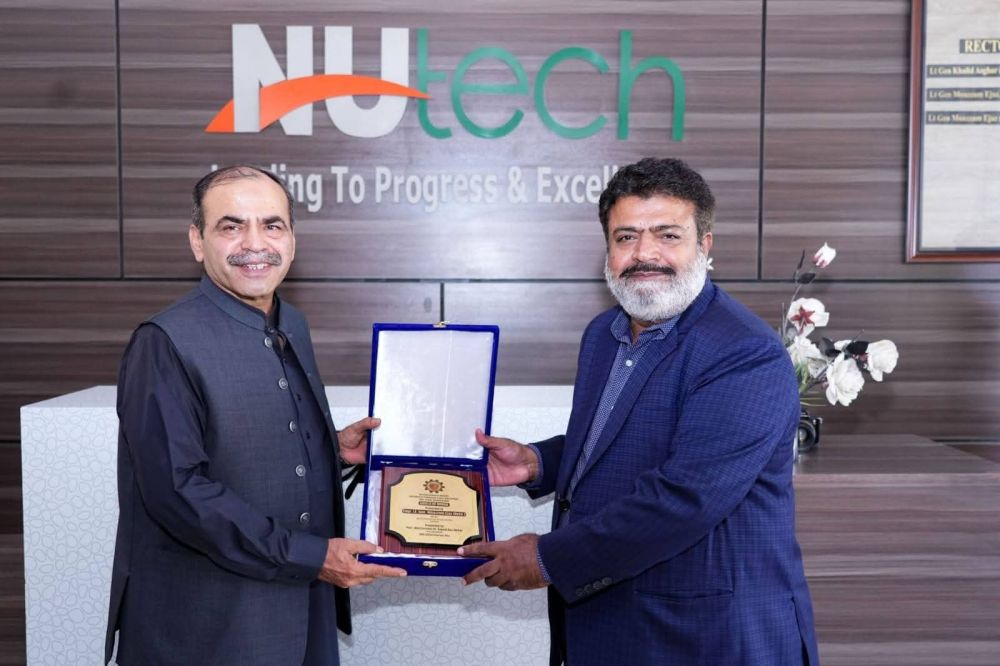
Reflecting on the Australian Technologies Teacher Educators Network (ATTEN) and the Australian Council of Deans of Education (ACDE), Prof. Emeritus Dr. Muhammad Mukhtar, Rector of the University of Southern Punjab, Multan, Pakistan, and Founding Vice Chancellor of the National Skills University Islamabad, believes these models offer valuable lessons for countries seeking to modernize teacher education and prepare graduates for the fast changing job markets.
Prof. Mukhtar thinks that:
"The future of education depends not on how many computers we place in classrooms, but on how effectively we prepare teachers to use technology to inspire curiosity, creativity, and critical thinking. Teacher educators are the architects of national innovation."
According to Prof. Mukhtar, many developing countries still treat technology education as an isolated academic discipline rather than a coordinated national strategy. While investments are often made in digital infrastructure, laboratories and devices, considerably less attention is devoted to building collaborative ecosystems that connect universities, schools, policymakers and industry.
Pakistan Has Already Taken the First Step:
Prof. Dr. Muhammad Mukhtar believes Pakistan does not need to start from scratch. In his view, the National Academy of Higher Education (NAHE) of the Higher Education Commission (HEC) has already laid an important foundation by establishing a national platform for academic leadership, faculty development, and professional learning across universities.
"The establishment of NAHE is one of the most significant reforms in Pakistan's higher education landscape. It has fostered a culture of continuous professional development that was largely absent a decade ago. The vision is closely aligned with the collaborative philosophy that underpins Australia's ATTEN."
However, he argues that the accelerating pace of technological change calls for the next stage of evolution.
"ATTEN demonstrates the value of a specialized national network devoted exclusively to technology teacher educators. Pakistan can build on the strong foundation established under the umbrella of NAHE by significantly expanding its mandate to include digital education, artificial intelligence, computational thinking, educational technology, and future skills."
Prof. Mukhtar proposes that NAHE could lead the establishment of a Pakistan Technologies Teacher Educators Network (PTTEN) as a specialized national platform under the Higher Education Commission. Bringing together faculties of education, engineering, computing, vocational education, and teacher-training institutions, the network could coordinate curriculum innovation, collaborative research, faculty development, digital resource sharing, and policy dialogue across the country.
He further suggests that the initiative should extend beyond universities to include school education departments, teacher training colleges, technology companies, accreditation bodies, and international partners. Such an ecosystem would ensure that Pakistan's teacher preparation programs remain aligned with the rapidly evolving demands of artificial intelligence, digital transformation, and Industry 5.0.
"NAHE has successfully established the architecture for academic capacity building. The next challenge is scale and specialization. By creating a national collaborative network similar to ATTEN but adapted to Pakistan's educational context, HEC can position the country as a regional leader in technology-enabled teacher education."
Among its priorities, the NAHE could:
- establish national standards for preparing Digital Technologies and Design educators;
- create communities of practice linking universities and schools;
- develop shared digital teaching resources and open educational repositories;
- provide continuous professional development in artificial intelligence, robotics, cybersecurity and emerging technologies;
- promote collaborative research on technology-enhanced learning; and
- strengthen partnerships between academia, industry and government to ensure graduates possess skills aligned with evolving labor market needs.
Prof. Mukhtar also believes that the ATTEN model has relevance far beyond Pakistan.
"Many countries in Asia, Africa, and the Middle East are experiencing similar rapid digital transformation, shortages of qualified technology teachers, and fragmented teacher education systems. A collaborative national network can accelerate reform and make better use of existing academic expertise."
He suggests that international organizations such as UNESCO, UNESCO-UNEVOC, the Commonwealth of Learning, and regional university associations could facilitate cross-border partnerships among national teacher-educator networks. Such collaboration would enable institutions to exchange research, jointly develop curricula, and share effective practices in artificial intelligence, digital pedagogy, and future skills.
Looking ahead, Prof. Mukhtar envisions an interconnected global community of technology teacher educators.
"Artificial intelligence is transforming education across borders. Our response must likewise transcend borders. National networks like ATTEN should evolve into an international alliance where universities learn from one another, conduct joint research, and prepare teachers for a world where innovation is collaborative, global, and continuous."
For Prof. Mukhtar, the lesson is clear: investing in technology without investing in those who teach it will yield only limited returns. Sustainable educational transformation begins with empowered teacher educators, supported by strong institutions, collaborative networks and a shared commitment to excellence.
"If universities aspire to educate the innovators of tomorrow," he concludes, "they must first build a community of educators capable of leading that future."