3. The Transformative Promise of Outcome-Based Education – Focusing on Competence Rather than Qualifications
Posted 3 months ago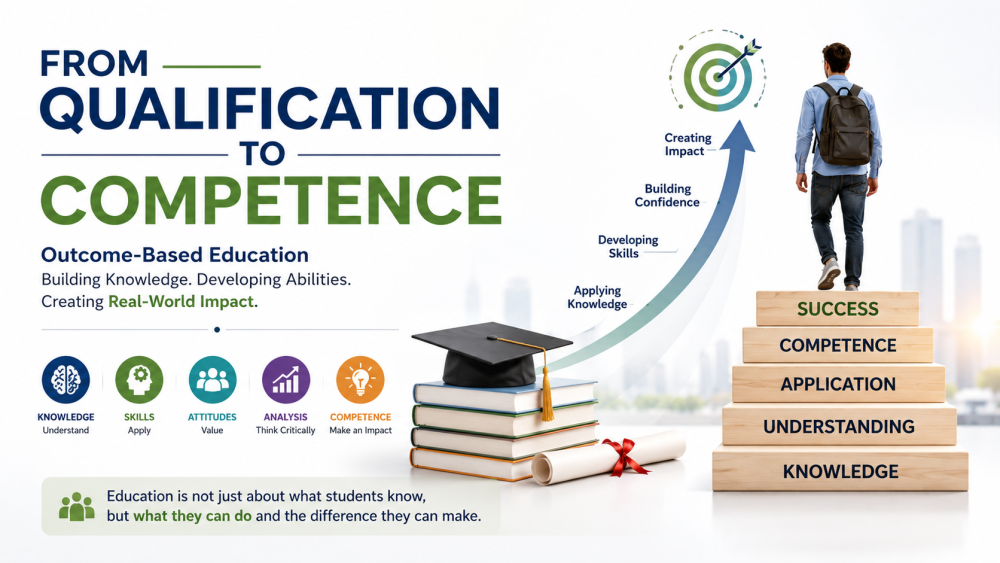
132/2026
For centuries, educational success has largely been measured by the acquisition of knowledge. Students attend lectures, study prescribed textbooks, memorize concepts, and demonstrate their understanding on exams. Those who pass receive certificates, diplomas, and degrees that qualify for further education or employment. While this traditional approach has produced generations of graduates, it raises a fundamental question: Does possessing knowledge necessarily mean possessing competence?
Outcome-Based Education (OBE) challenges this long-held assumption by redefining the purpose of education. Rather than focusing solely on what students know, OBE emphasizes what students can do with that knowledge. It transforms education from a process of knowledge transmission into a system designed to develop competent, confident, and socially responsible graduates who can address real-world challenges.
Beyond Memorization: Building Meaningful Learning
Knowledge remains the foundation of all learning. However, knowledge that is merely memorized without being understood, analyzed, applied, evaluated, or synthesized has limited educational value. Students may accurately reproduce facts on an exam yet struggle to apply that knowledge effectively in professional practice or everyday life.
True learning occurs when learners move beyond remembering information to interpreting concepts, solving authentic problems, making informed decisions, and creating innovative solutions. Competence is therefore built not merely through the accumulation of information but through meaningful engagement with knowledge.
Outcome-Based Education recognizes that acquiring knowledge is only the beginning of the learning journey. Its goal is to ensure that students can transfer classroom learning to practical situations where knowledge is useful and impactful.
The Transformation from Teaching Knowledge to Developing Competence
The central philosophy of Outcome-Based Education is a shift from teaching content to developing competencies. Traditional education often measures success by syllabus completion and exam performance. OBE, however, begins by identifying the competencies graduates must possess and then designs curricula, teaching strategies, learning activities, and assessments to achieve them.
This transformation requires educational objectives that extend beyond lower-order cognitive skills such as remembering and understanding. Learning outcomes must encompass higher-order abilities, including application, critical analysis, problem-solving, creativity, evaluation, communication, collaboration, ethical reasoning, and lifelong learning.
In an OBE environment, educational success is no longer defined by how much information has been delivered to students but by how effectively students can demonstrate the knowledge, skills, attitudes, and values required in real-world situations.
Knowledge Must Lead to Application
One of the most significant debates in education concerns who is responsible for developing practical competence. Some argue that schools and universities should focus primarily on teaching theoretical knowledge, leaving employers to provide practical training after graduation.
Others contend that many competencies cannot be acquired solely in the workplace. Professional judgment, critical thinking, teamwork, ethical decision-making, communication, laboratory techniques, clinical practice, engineering design, classroom teaching, and countless other skills require structured learning experiences within educational institutions.
Outcome-Based Education aligns closely with this latter perspective. While employers undoubtedly continue professional development, educational institutions are responsible for ensuring that graduates enter the workforce with a clearly defined minimum level of competence. Graduates should not merely understand professional concepts; they should be able to apply them confidently and responsibly from the very beginning of their careers.
Teachers as Developers of Competence
The shift from knowledge-based teaching to competency-based learning also transforms the role of educators. Teachers are no longer merely information providers; they become facilitators of learning, mentors, coaches, and designers of authentic educational experiences.
This transformation presents significant challenges. Teaching for competence requires far more than subject expertise. Educators must possess the practical skills they expect students to acquire. They need a deep understanding of how knowledge is applied in professional contexts, as well as the pedagogical expertise to cultivate higher-order thinking, inquiry, collaboration, and problem-solving.
Competency-based teaching therefore requires ongoing professional development in instructional design, assessment strategies, educational technology, curriculum development, experiential learning, and learner-centered pedagogy. Without competent teachers, developing competent graduates is an unattainable goal.
Aligning Education with the Needs of Society
Every society and every profession expects graduates to possess a defined set of competencies. Employers seek individuals who can communicate effectively, solve problems, work collaboratively, adapt to change, demonstrate ethical judgment, and contribute immediately to organizational success.
Similarly, societies require citizens who understand civic responsibilities, respect diversity, think critically, uphold ethical values, and actively contribute to sustainable development.
Outcome-Based Education begins by identifying these expectations. It poses a simple yet powerful question: What minimum competencies should every graduate possess upon completing a course or academic program?
Once these competencies are clearly articulated, curriculum, teaching methods, learning experiences, and assessments are carefully aligned to ensure that graduates consistently achieve the expected outcomes. This alignment enables educational institutions to produce graduates who are not only academically qualified but also professionally competent and socially responsible.
Rethinking Assessment
Perhaps one of the most important questions raised by Outcome-Based Education concerns assessment.
Do examination grades truly reflect a student's competence?
A high examination score undoubtedly demonstrates academic achievement. However, it may not fully capture qualities such as leadership, creativity, ethical reasoning, teamwork, communication skills, adaptability, innovation, and practical problem-solving. These competencies often determine professional success far more than examination performance alone.
Therefore, Outcome-Based Education advocates assessment systems that go beyond traditional written examinations. Authentic assessments, such as projects, portfolios, simulations, laboratory work, internships, case studies, presentations, field experiences, and workplace evaluations, provide richer evidence of student competence by measuring performance in realistic contexts.
Assessment thus becomes a tool not merely for grading students but for verifying whether intended learning outcomes have been genuinely achieved.
Preparing Graduates for an Uncertain Future
The demands of the twenty-first century continue to evolve at an unprecedented pace. Rapid technological advances, globalization, artificial intelligence, sustainability challenges, and shifting labor markets require graduates who can continuously learn, adapt, innovate, and collaborate across disciplines.
Traditional education systems centered solely on knowledge acquisition are increasingly inadequate for meeting these challenges. Future-ready graduates require competencies that integrate knowledge with practical skills, ethical values, emotional intelligence, creativity, resilience, and a commitment to lifelong learning.
Outcome-Based Education provides a comprehensive framework for developing these capabilities by ensuring that every aspect of teaching and learning aligns with clearly defined educational outcomes.
The Future of Educational Excellence
The journey from qualification to competence is one of the most significant educational transformations of our time. It recognizes that the true purpose of education extends beyond awarding degrees or completing curricula. Education must empower learners to think critically, solve meaningful problems, make ethical decisions, and contribute positively to society.
Ultimately, the measure of educational excellence is not how much information students can recall on exams, but how effectively they can apply their knowledge to improve lives, strengthen organizations, and address the complex challenges facing humanity.
Outcome-Based Education reminds us that qualifications open doors, but competence creates impact. The future of higher education, therefore, lies not in producing graduates who merely possess knowledge, but in nurturing professionals with the wisdom, skills, and confidence to transform that knowledge into meaningful action.