The Quiet Rise of Pakistan’s Digital Workforce
Posted 6 months ago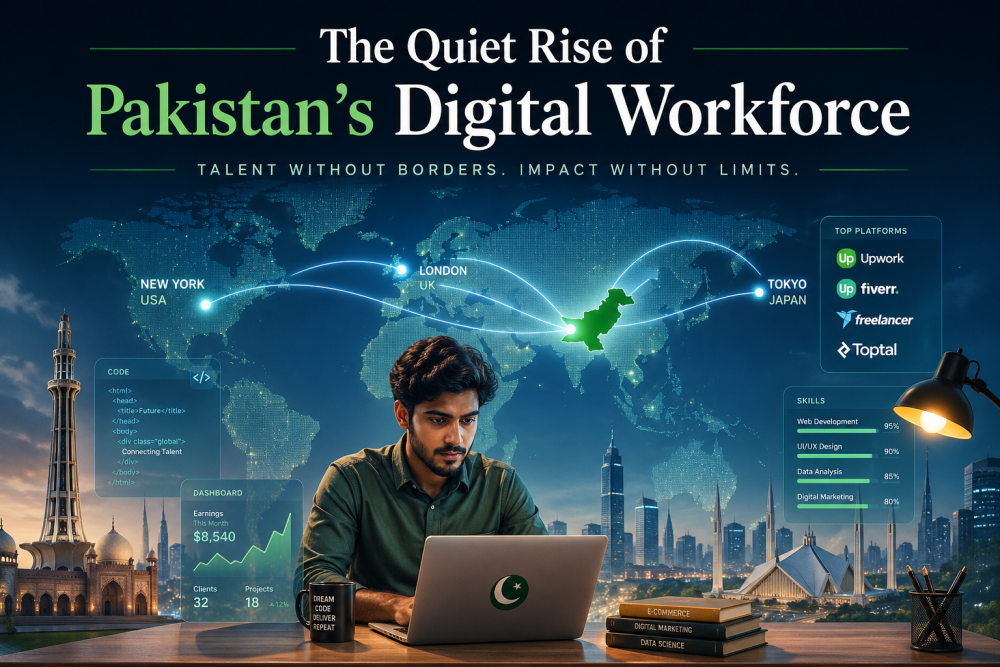
58/2026
Outsourcing is a simple idea with powerful consequences. It means a company hires people outside its own country or even outside its own organization to perform certain tasks. Instead of building a team in New York or London, a business might hire a software developer in Lahore, a graphic designer in Karachi, or a data analyst in Islamabad.
What makes outsourcing so transformative is that it enables work to cross borders instantly, often at lower cost, while maintaining equal or even higher quality. In today’s digital world, where a laptop and an internet connection can connect anyone to the global economy, outsourcing has become a defining feature of modern business.
A New Contender Emerges
For years, outsourcing was dominated by a familiar set of countries: India, the Philippines, and parts of Eastern Europe. But a new global ranking is reshaping that narrative.
Pakistan has quietly moved up to 16th place in the Global Outsourcing Talent Index 2026, surpassing countries such as the United States, the United Kingdom, and Japan.
This is not just a surprising statistic; it signals that the global map of talent is being redrawn.
More Than Just Low Cost
At first glance, one might assume Pakistan’s success stems from affordability. Lower wages do play a role, making it attractive to companies seeking to manage costs.
But that explanation is incomplete.
Pakistan’s real advantage lies in its young, growing, and increasingly skilled workforce. Millions of young people are entering the job market with training in software development, digital marketing, artificial intelligence, and other modern skills. Many are self-taught, learning through online platforms and competing globally on freelance marketplaces.
In other words, Pakistan is not just offering lower-cost labor; it is offering capable talent at scale.
The Freelance Revolution
Long before international rankings were noticed, Pakistani freelancers were already reshaping perceptions. On global platforms, they built reputations for reliability, technical expertise, and adaptability.
From small gigs to large-scale contracts, individuals across cities such as Lahore, Karachi, and Islamabad began working directly with international clients. What started as side income for many has grown into a robust digital economy.
Today, Pakistan is recognized as one of the world’s leading sources of freelance talent, particularly in technology-driven services.
A Shift in Global Economics
The more surprising part of this story is not Pakistan’s rise, but what it reveals about the rest of the world.
Advanced economies like the United States, the United Kingdom, and Japan are not lacking in talent, but they are expensive. In a world where remote work has become normalized, companies are increasingly willing to look elsewhere for equally skilled professionals at a fraction of the cost.
Outsourcing, once seen as a cost-saving strategy, is now becoming a core business model, and countries like Pakistan are benefiting from this shift.
The Challenge Ahead
Despite its progress, Pakistan’s journey is far from complete.
One of its biggest hurdles remains reliable digital infrastructure, stable power supply, and scalable tech ecosystems. Without this, growth could slow just as momentum builds.
There is also the question of sustainability: can Pakistan move beyond outsourcing into higher-value innovation, product development, and technology leadership?
A Moment of Opportunity
Pakistan now stands at an important turning point.
It has what many countries struggle to build: a large, motivated, and globally connected workforce. To fully capitalize on this, it must invest in education, infrastructure, and policy stability.
Outsourcing should not be seen as the destination. It is the entry point.
The Bigger Picture
What Pakistan’s rise ultimately shows is something bigger than one country’s success.
It shows that talent is everywhere, even when opportunity is scarce. When technology bridges that gap, the results can be transformative.
In this new world of work, geography matters less than skill. For the first time in a long time, countries like Pakistan are not just participating in the global economy; they are helping reshape it.