The Flying Car Is No Longer Just Science Fiction: Tesla Brings the Future of Mobility Closer to Reality
Posted 1 day ago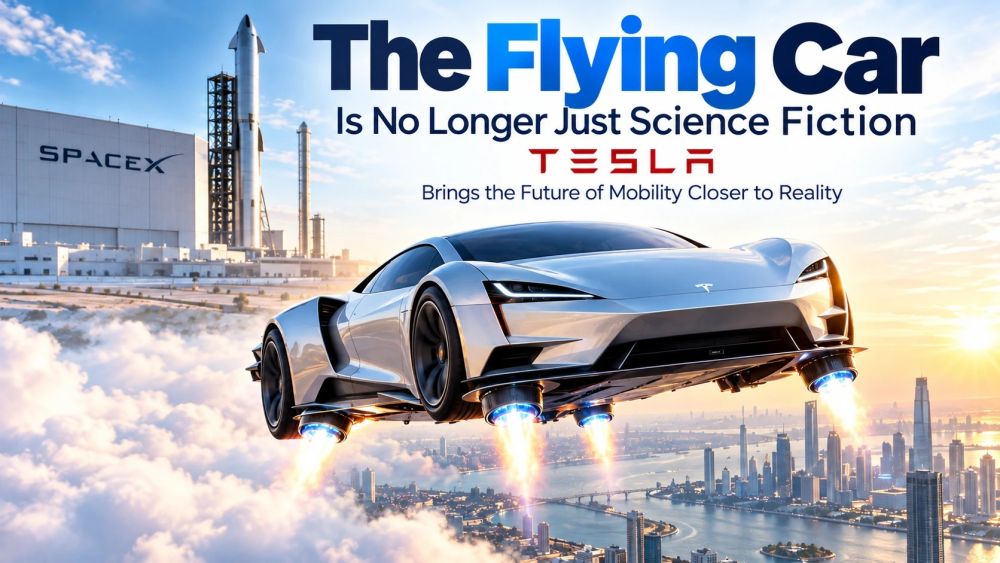
245/2026
On October 15, 2026, Elon Musk unveiled Tesla’s long-awaited next-generation Roadster at a SpaceX facility in Texas. The presentation featured a prototype equipped with rocket-inspired propulsion that performed dramatic airborne maneuvers, including mid-air rotation. The vehicle’s brief lift-off offered a striking demonstration of how automotive engineering might intersect with technologies traditionally associated with aerospace.
According to Reuters and The Verge, the new Roadster incorporates SpaceX-inspired thrusters and other unconventional systems designed to push the limits of automotive performance.
For a moment, the familiar distinction between a car and a flying machine seemed to dissolve. Yet the demonstration's significance lies less in the spectacle itself than in the larger question it raises: are we approaching a future in which personal transportation will no longer be confined to the road?
When the road meets the sky
Unlike an ordinary electric sports car, the rocket-assisted version uses cold-gas thrusters to deliver short bursts of thrust. Compressed gas is expelled through precisely positioned nozzles, producing forces that can help lift and rotate the vehicle during a demonstration. The system is fundamentally different from the electric motors that propel the car on the road.
This distinction matters. A car that can briefly rise into the air has demonstrated an extraordinary capability, but sustained flight requires far more. It demands continuous control of lift, direction, stability, and energy, along with systems designed to manage changing atmospheric conditions and respond to emergencies.
The Roadster’s airborne performance should therefore be understood as a remarkable engineering demonstration rather than as proof that an ordinary family car can now take to the skies. Nevertheless, it illustrates how engineers are increasingly willing to explore ideas that once seemed too unconventional for practical consideration.
The convergence of automotive and aerospace engineering
Perhaps the most significant aspect of the Roadster demonstration is how it brings together disciplines that have traditionally developed along separate paths.
Automotive engineers focus on road handling, structural strength, passenger protection, energy efficiency, and manufacturing at scale. Aerospace engineers must also address the complex physics of flight, weight-sensitive design, propulsion reliability, and the consequences of operating in three dimensions.
As these disciplines converge, innovations in one field may eventually influence the other. Advances in materials science, electric motors, batteries, artificial intelligence, sensors, and control systems could contribute to future generations of both ground and aerial transportation.
For young scientists and engineers, a flying car is more than an exciting spectacle. It invites us to tackle difficult problems, challenge established assumptions, and turn ambitious ideas into reliable technologies.
The sky is no longer the limit of our imagination.
Elon Musk’s Roadster demonstration captures something enduring about the human spirit: our refusal to accept that the world must remain exactly as we inherited it. From the earliest automobiles to commercial aviation and reusable rockets, technological progress has repeatedly reshaped what people consider possible.
Yet the history of innovation also teaches us to distinguish between a spectacular prototype and a mature technology. Tesla’s rocket-assisted Roadster has demonstrated an unusual ability to fly, but it has not established that flying cars are ready to become a common mode of transportation. Sustained flight, passenger safety, certification, affordability, and practical everyday use remain substantial hurdles.
The future may not arrive as science fiction predicted. Instead of every family owning a car that can fly from a driveway, we may first see specialized aircraft connecting airports, hospitals, industrial centers, and remote communities. Over time, advances in propulsion, automation, and energy storage could open further possibilities.
The essential question is therefore no longer simply whether humans can build a machine that looks like a car and briefly rises into the air. It is whether we can engineer a new generation of transportation that is safe, sustainable, affordable, and genuinely useful.
When we meet that challenge, the flying car will become more than an icon of futuristic imagination. It will mark another milestone in humanity’s ongoing effort to overcome the limitations of distance, time, and technology.
The road ahead may still be long. But for the first time in a long while, the sky itself seems to have joined the conversation.