The CLEAR+ Framework Helps in Building Smarter Organizations for the AI Age
Posted 5 months ago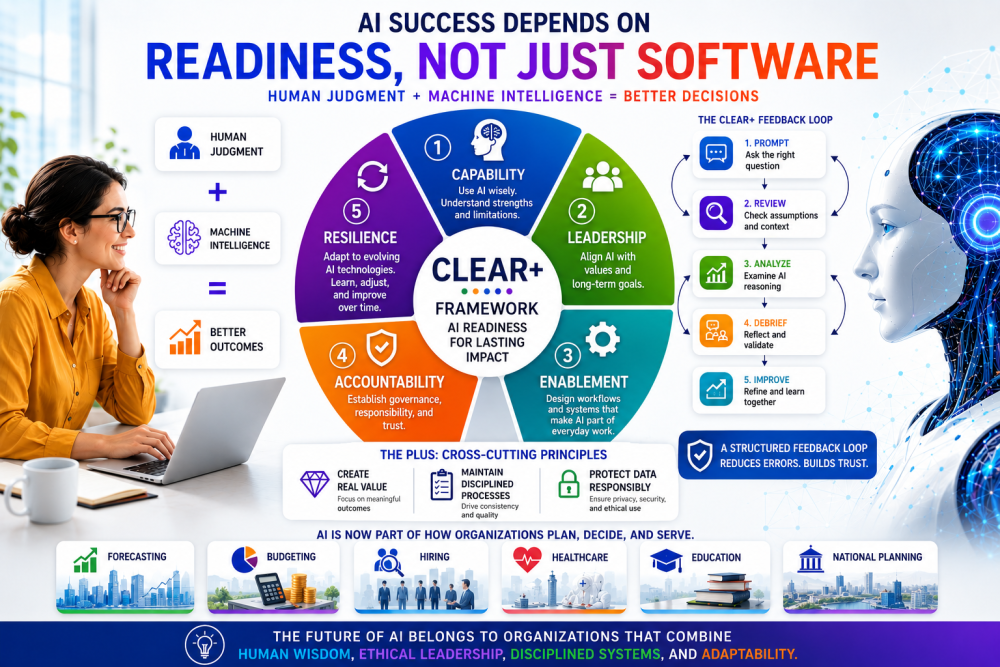
77/2026
A growing number of experts now argue that the future of AI will depend less on software and more on what might be called “organizational readiness.” Recognizing this can inspire you to take proactive steps, as success will go to institutions that know how to combine human judgment with machine intelligence rather than relying on automation unthinkingly.
One emerging approach to this challenge is the CLEAR Plus Framework, which directly addresses common organizational hurdles such as siloed teams and unclear decision-making processes, thereby enhancing practical understanding of how to foster effective human-AI collaboration.
The idea is surprisingly simple. AI systems are powerful but not always reliable. They can misinterpret instructions, fabricate information, or produce overly confident answers, a problem researchers often call “hallucination.” The CLEAR Plus approach aims to reduce these mistakes by establishing a structured feedback loop between the user and the AI.
Instead of asking a single question and accepting the response immediately, the framework encourages users to review prompts carefully, examine the AI’s reasoning, and conduct a “debriefing” after each interaction. This process fosters your confidence, clarity, and trust in effectively managing AI.
The framework includes five levels of prompting, ranging from quick everyday questions to highly advanced analytical tasks. At lower levels, users rely more on the AI for convenience and speed. At higher levels, human oversight becomes more in-depth and strategic. The goal is to balance efficiency with critical thinking.g.
What makes this idea especially important is that AI is no longer confined to small technical experiments. It is rapidly becoming integral to how organizations make decisions, manage workflows, and plan.
When AI begins to influence forecasting, budgeting, hiring, healthcare decisions, education, or national planning, it is no longer just another software tool. It becomes part of the organization’s operating system.
They require leadership, accountability, and clear decision-making rules. Without that structure, even advanced AI systems can cause confusion, inefficiency, or hidden risks, which the CLEAR Plus Framework aims to mitigate through structured governance and oversight.
The framework includes five levels of prompting, ranging from quick everyday questions to highly advanced analytical tasks, with each pillar-Capability, Leadership, Enablement, Accountability, and Resilience-providing specific, actionable steps for organizations to embed AI effectively into their operations.
The first pillar is Capability - the ability of people to use AI wisely and to understand both its strengths and limitations. This means employees must learn not only how to use AI tools, but also how to question them.
The second pillar is Leadership - ensuring AI decisions align with the organization’s values and long-term goals. Leaders must guide AI adoption strategically, providing a sense of purpose and direction rather than chasing trends.
The third pillar is Enablement - designing workflows and systems that allow AI to fit naturally into everyday operations. Technology alone is useless if employees cannot integrate it into real work.
The fourth pillar is Accountability - establishing governance, responsibility, and trust. Organizations must know who is responsible when AI systems make mistakes or influence important decisions.
Finally, there is Resilience - the ability to adapt to evolving AI technologies. Because artificial intelligence is changing rapidly, organizations need systems that can learn, adjust, and improve over time.
The “Plus” in CLEAR Plus refers to three additional ideas that affect every pillar: creating real value, maintaining disciplined processes, and responsibly protecting data. Together, these elements determine whether AI becomes a meaningful organizational capability or merely a collection of disconnected experiments.
This broader perspective reflects an important shift in how experts now think about artificial intelligence. Early conversations focused mostly on what AI could do. Today, the more urgent question is whether institutions are prepared for what AI will become.
That distinction matters enormously.
History shows that transformative technologies rarely succeed through innovation alone. Electricity, the internet, and modern computing changed society not simply because the inventions were powerful, but because organizations learned how to restructure themselves around those technologies.
Artificial intelligence appears to be following the same path.
The organizations most likely to succeed in the AI era may not necessarily be those with the most sophisticated software. Instead, they may be the ones that develop the strongest culture of readiness, combining human judgment, ethical leadership, disciplined systems, and adaptability.
In that sense, the future of AI may depend less on machines becoming smarter and more on humans becoming wiser about how they use them.