Skills AI Cannot Easily Replace - The Quiet Power of Being Human in an Intelligent Age
Posted 4 months ago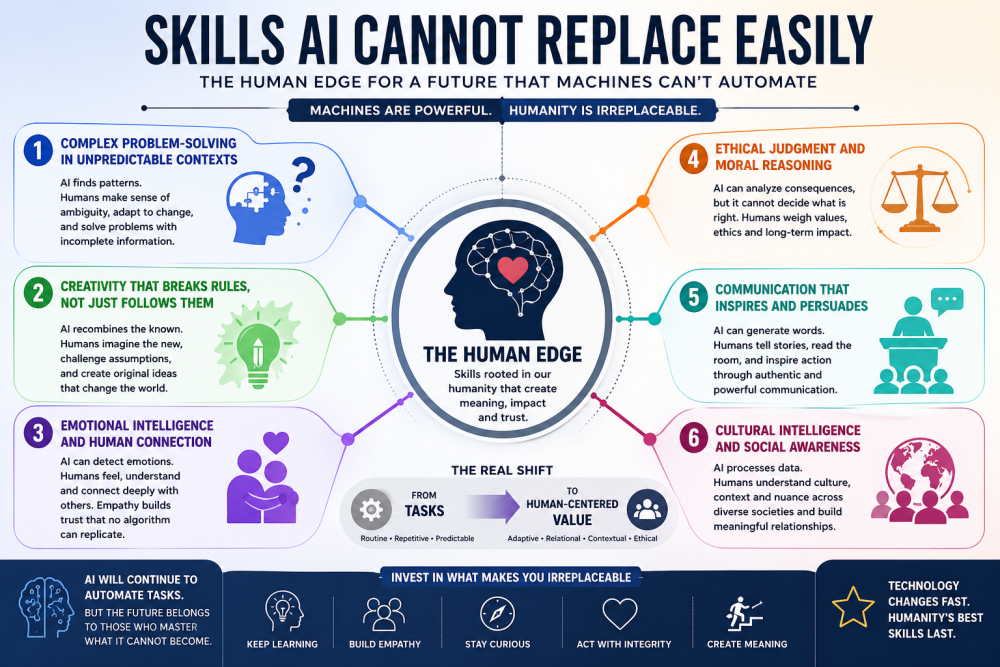
60/2026
There is a growing unease in the modern world, a quiet question echoing through classrooms, offices, and policy circles: If machines can think, what remains for us?
Artificial intelligence writes, designs, predicts, and even converses with remarkable fluency. It is fast, tireless, and increasingly accurate. For many, this signals a future in which human effort becomes obsolete. Yet that conclusion, though tempting, is profoundly incomplete.
What we are witnessing is not the replacement of human capability but its redefinition.
The machines are learning to perform tasks. Humans, however, were never meant to be defined solely by tasks.
Beyond Efficiency: The Human Advantage
Artificial intelligence thrives in environments with clear rules, stable patterns, and measurable outcomes. It excels at repetition, optimization, and scalability.
But the real world is rarely so orderly.
It is marked by ambiguity, contradiction, and nuance. It demands judgment when data is incomplete, courage when outcomes are uncertain, and wisdom when no precedent exists.
Here lies the first boundary of AI: it can assist in decision-making, providing valuable insights, but it cannot truly own or replace human judgment.
A policymaker navigating a national crisis, a physician balancing risk and empathy, and a leader choosing between profit and principle, these are not problems of calculation. They are problems of conscience and context.
And context, in all its richness, remains human.
Creativity: More Than Rearranging the Known
AI can generate art, compose music, and produce text that seems original. Yet beneath its fluency lies a fundamental limitation: it creates by learning from what already exists.
Human creativity, at its highest level, does something different.
It breaks patterns, questions assumptions, and draws on lived experience, emotion, and imagination to create something genuinely new, unlike AI, which learns from existing data.
Innovation is not just about making things better. It is about seeing what others cannot yet see.
Machines refine. Humans redefine.
The Depth of Human Connection
Perhaps the most underestimated human skill is the simplest: the ability to understand another person.
Empathy cannot be reduced to an algorithm; it involves feeling with someone, interpreting silence, sensing hesitation, and responding authentically, skills AI cannot replicate.
A teacher who inspires, a doctor who comforts, and a leader who uplifts these individuals do more than impart knowledge; they inspire, comfort, and uplift. They build trust.
And trust is not programmable.
In a world increasingly mediated by technology, genuine human connection will not diminish in value; it will become rarer and therefore more precious, encouraging the audience to cherish and prioritize empathy.
The Moral Compass
As machines grow more powerful, the ethical questions surrounding their use become more urgent.
Should an algorithm prioritize efficiency over fairness?
Should data-driven decisions override human dignity?
Who is accountable when automated systems cause harm?
These are not technical dilemmas. They are moral dilemmas.
Artificial intelligence can analyze consequences, but it cannot determine values. It lacks a conscience and cannot weigh justice against convenience.
The responsibility for ethical judgment will not disappear with automation; it will intensify.
And that responsibility belongs, unequivocally, to humans, emphasizing the moral role we must embrace in guiding the ethical use of AI and fostering a sense of duty among the audience.
Communication That Moves People
Information is abundant. Insight is not.
AI can generate messages, but it cannot fully replicate the subtle art of persuasion—the ability to read a room, adapt in real time, and speak in ways that resonate deeply with human experience.
Great communicators do more than inform; they inspire. They shape beliefs, influence action, and create shared meaning.
Whether in a classroom, a boardroom, or a public forum, the power to move people remains one of the most uniquely human capabilities.
Living with Uncertainty
Perhaps the defining feature of human intelligence is not certainty but adaptability.
Humans navigate change not by relying solely on data, but by combining intuition, experience, and resilience. They learn, unlearn, and relearn. They adapt when circumstances shift, even when there is no clear roadmap.
AI depends on structure. Humans often thrive, though reluctantly, in its absence.
The Real Transformation
The rise of artificial intelligence is not a story of human decline but of transition.
Routine work will diminish. Predictable roles will evolve. But what will rise in their place are roles that demand deeper thinking, stronger relationships, and greater responsibility.
The future will not reward those who compete with machines on speed or efficiency. It will reward those who cultivate what machines lack: judgment, creativity, empathy, and ethical clarity.
A Final Reflection
The question is not whether AI will replace us.
The question is whether we will invest in becoming the kind of human who cannot be replaced.
In a world of intelligent machines, the true advantage will belong to those who recognize that being human is not a limitation but a profound, irreplaceable strength.