Pakistan’s Youth Logged into the Future
Posted 7 months ago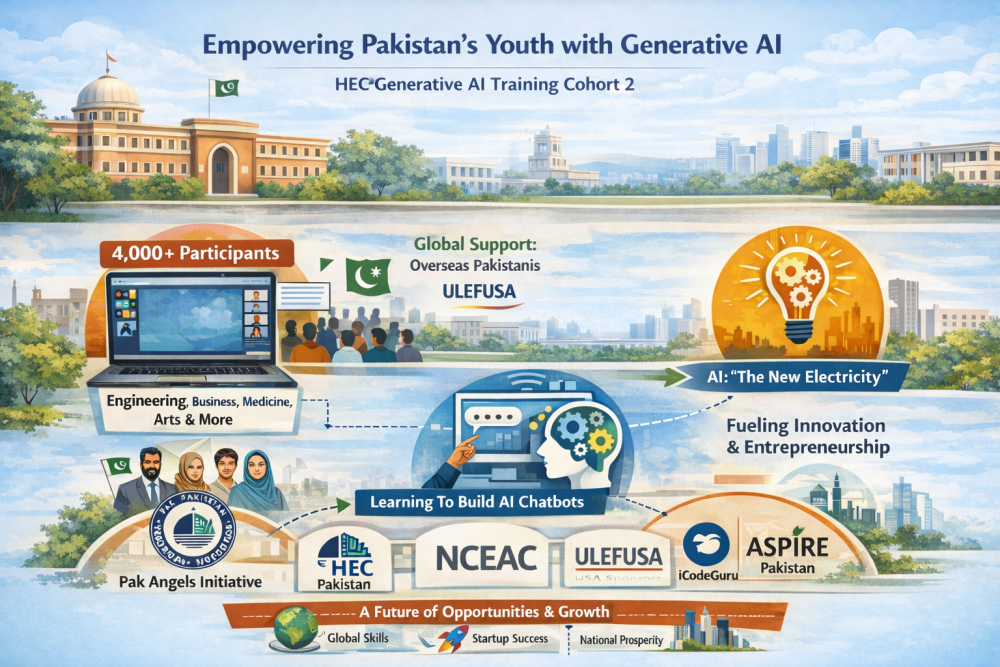
11/2026
On a quiet winter evening, January 18, 2026, a significant milestone unfolded across Pakistan's screens, marking a shared step into the future as the second cohort of the HEC Generative AI Training Program was launched at 8:00 p.m. Pakistan Standard Time, connecting thousands in homes, hostels, and campuses nationwide.
Nearly 4,000 students, teachers, freelancers, and young professionals representing over 200 universities logged in together. They came from all areas of academia: engineering, medicine, business, law, arts, and pure sciences. What united them was a shared understanding that Generative Artificial Intelligence is no longer a distant idea or a luxury only for Silicon Valley, it's quickly becoming a fundamental skill of modern life.
The six-week program, organized by Pak Angels and promoted nationwide by the Higher Education Commission of Pakistan, is offered free of charge to empower Pakistan’s youth with practical skills to build and implement Generative AI, emphasizing action over discussion.
A Digital Gathering with Real Momentum
The first session itself showed the level of interest. Nearly 1,000 participants joined live on Zoom, while more than 200 watched via YouTube Live, a digital town hall full of curiosity and hope. This was not a passive crowd. These were people who were aware that the nature of work is changing, and changing quickly.
Speaking at the launch, Founder and President of Pak Angels, described Generative AI as a force that will shape “our personal lives, our professions, and even our national destiny.” His words carried the weight of experience. Pak Angels, he noted, has already trained over 18,000 individuals across seven previous cohorts, working with partners like iCodeGuru and ASPIRE Pakistan.
This ninth cohort, he emphasized, signifies a deeper collaboration this time with the National Computing Education Accreditation Council and HEC serving as national promoters, and with ULEFUSA as the sponsor-showing a shared commitment to progress.
A Global Hand Reaching Home
The sponsorship by ULEFUSA added a deep human touch to the evening. Dr. Nomaan Mufti, a founding board member of the organization, spoke about overseas Pakistanis in the United States who still see Pakistan’s youth as its most valuable asset. His explanation was clear: to help young Pakistanis gain world-class skills so they can serve global markets with high-quality products and services, all while staying in their homeland.
It served as a reminder that talent knows no borders—and that opportunity, when shared wisely, can come back home.
“The New Electricity”
Perhaps the most powerful metaphor of the night came from the founder of iCodeGuru, who described Generative AI as “the new electricity.” Just as electricity once transformed factories, homes, and entire economies, he argued, AI is now quietly rewiring how we live and work, opening new horizons for Pakistan's youth. History, he reminded the audience, provides reassurance. The industrial age initially displaced jobs, but it also created better ones for those who adapted. The same pattern is happening today. Skills like Agentic AI, he said, will separate those who struggle from those who thrive. “The sooner we learn,” he noted, “the sooner we can improve our professional and personal lives.”
From Learning to Creating
The session went beyond inspiration. The trainers, focused the conversation on practical applications, showing how Generative AI skills can directly drive innovation and entrepreneurship. He illustrated how participants would learn to create intelligent chat system tools that once needed advanced technical teams, but are now accessible to motivated learners.
The message was clear: this training is not about using technology, but about creating with it.
More Than a Course
As the evening came to an end, one idea stayed firmly in the air. This initiative is about much more than algorithms or software. It's about preparing Pakistan’s youth for a future that's already arriving, helping startups compete globally, and building prosperity across the country.
Pak Angels officially recognized the collective effort behind the program, expressing gratitude to HEC Pakistan, NCEAC, ULEFUSA, iCodeGuru, and ASPIRE Pakistan for their involvement in what they called a “noble mission.”
It's the best way to put it. In a world often worried about what AI might take away, this gathering instead highlighted what it can give—skills, confidence, opportunity, and direction.
The screens might have gone dark at the end of the session, but for thousands of young Pakistanis, a new window to the future had just opened.