Pakistan Doesn't Need Just Coders - It Needs Smart Farmers, Doctors, Engineers, Scientists, and Innovators
Posted 3 months ago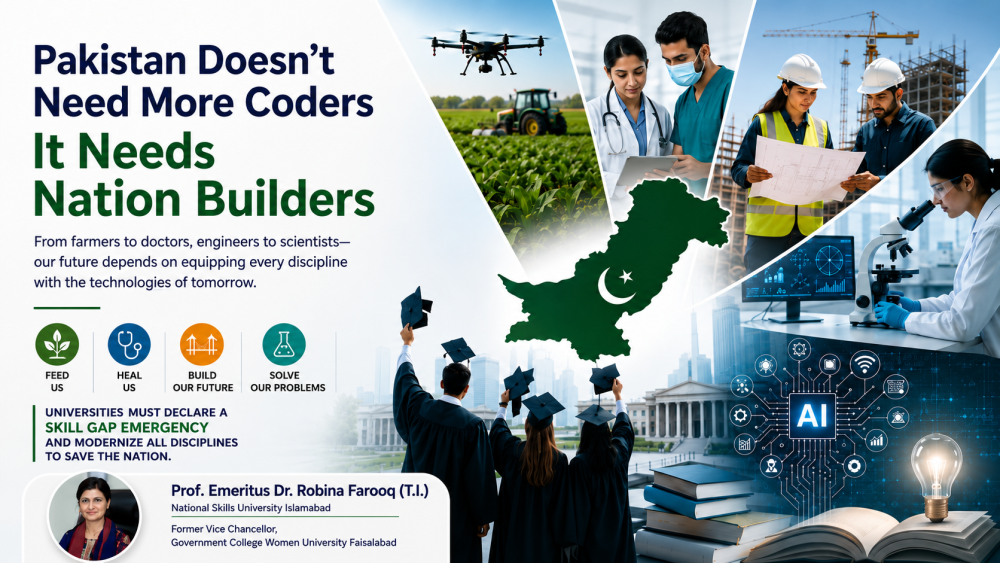
125/2026
About the Author: Prof. Emeritus Dr. Robina Farooq (T.I.) is currently serving as Campus Director of the National Skills University Islamabad, Sarmard Tanveer Campus, Muridke. Previously, she served as Vice Chancellor of the Government College Women University Faisalabad.
Pakistan doesn't need just coders. It needs farmers to feed us, doctors to heal us, engineers to build our future, and scientists to solve our problems; universities must declare a Skill Gap Emergency and modernize all disciplines to save the nation.
Every year, nearly 800,000 degrees are awarded across Pakistan. While families celebrate with garlands and photographs, a quiet crisis is unfolding. In the 2026 QS World University Rankings, several universities were ranked; however, none were in the top 300 globally. While this is concerning, it is merely a symptom of a deeper malady: a profound disconnect between what we teach and what our nation desperately needs.
We have created a system marked by an unprecedented surge in interest in Computer Science. Students, parents, and even career counselors view CS as the only golden ticket to a secure future, driven by the allure of freelancing income and global remote work. As one report starkly notes, a degree without employable training is no more than a piece of paper.
The result is a catastrophic imbalance. We are producing a surplus of IT graduates while our agricultural sector, which could save us billions in food imports, faces a shortage of agronomists and irrigation experts. We spend billions importing food while our agricultural universities struggle to fill seats. Our health sector, as exposed during COVID-19, is critically short of nurses and allied health professionals. Our industries are desperate for skilled mechanical and civil engineers to build our infrastructure and energy sectors, yet many programs are seeing declining enrollments.
This is not just an educational issue; it is a matter of national security and economic survival. We are turning our backs on the very disciplines that sustain our economy, feed our people, and keep us healthy. The Asian Development Bank estimates that this mismatch costs Pakistan 2-3% of its GDP annually. We are sitting on a demographic gold mine; 64% of our population is under 30, yet we are failing to equip them with the tools to build the nation.
So, how do we fix this? How do we make an Agriculture degree as exciting and lucrative as a Data Science degree? How do we make Civil Engineering the new, improved career? The answer lies not in abandoning one field for another, but in embedding the technology of tomorrow into the core of every discipline.
We don’t need to add an AI course to the Agriculture syllabus; we need to teach students how to use AI-powered drones for precision crop monitoring. We don't need a separate data science class for a public health student; we need to teach them to apply data visualization to track disease outbreaks. This is the only way to bridge the gap between our national needs and student aspirations.
We must fundamentally redesign our curricula to integrate modern, relevant technologies into the fabric of traditional disciplines. Agriculture & Environmental Sciences needs to be transformed through Geographic Information Systems (GIS), IoT-based smart irrigation, and AI-driven crop disease prediction. Civil & Mechanical Engineering requires deep integration of Building Information Modeling (BIM), 3D printing for construction, robotics for automation, and expertise in renewable energy systems. Allied Health Sciences must pivot toward telemedicine, health informatics, and the use of AI in diagnostic imaging. Basic Sciences (Chemistry/Biology/Mathematics) need to be taught through the lens of computational modeling, bioinformatics, and data analytics. The Social Sciences must embrace computational social science, using big data to solve complex societal problems and creating new-age roles for experts in behavioral economics, public policy, and digital communication.
The HEC has taken the right first step by revising the computing curriculum to include 14 specializations, including AI, Data Science, and Cybersecurity. But this reform must be a wave that lifts all boats. We need to launch a National Curriculum Modernization Drive that mandates every university to develop a Technology Integration Plan.
Of course, there will be resistance. The greatest hurdle will be the faculty. After years of a rigid system, many fear the unknown. This is where investment in large-scale, ongoing Faculty Development Programs is non-negotiable. As one senior academic lamented, many faculty members lack exposure to current industry practices, and senior faculty have lost interest in teaching at the graduate level. We must incentivize innovation, fund faculty retraining, and create a culture of lifelong learning.
We also cannot ignore the practical realities of labs. You can’t teach IoT without sensors, Robotics without kits, or Bioinformatics without computational power. This requires investment, but it also requires creativity. Public-private partnerships with industry can help establish state-of-the-art labs. We must move away from chalk-and-talk and embrace coding and creation.
This is an opportunity to redefine the university's role. The university of the future is not a factory for degrees; it is a living lab for the nation's development. It is the place where a student can graduate with a degree in Agriculture and a portfolio of AI-driven farming projects, prepared to start a business or secure a high-paying job in the global ag-tech industry.
Will our students pursue a field solely because it’s labeled high-paying freelancing? Or will we build an education system that fulfills their aspirations while solving Pakistan's most pressing challenges? The future of Pakistan’s economy and its youth depends on how we answer this question. It’s time to stop creating job-seekers and start creating nation-builders.
Disclaimer
The views, opinions, interpretations, and conclusions expressed in articles published on HunarNama are solely those of the authors and do not necessarily reflect the views, policies, or positions of HunarNama, its editorial team, management, or affiliated institutions.
HunarNama is an independent intellectual forum dedicated to fostering informed dialogue, scholarly discussion, and the exchange of ideas among academics, researchers, practitioners, and experts. The publication of an article should not be construed as an endorsement of its content by HunarNama.
Authors are fully responsible for the accuracy, originality, and integrity of their submissions, including all facts, data, references, analyses, and opinions presented. HunarNama accepts no liability for any errors, omissions, or consequences arising from the use or interpretation of published content.
By providing a platform for diverse perspectives, HunarNama fosters constructive debate while upholding the principles of academic freedom, professional ethics, and responsible scholarship.