1- Outcome-Based Education (OBE): Focusing on Quality Rather Than Quantity
Posted 3 months ago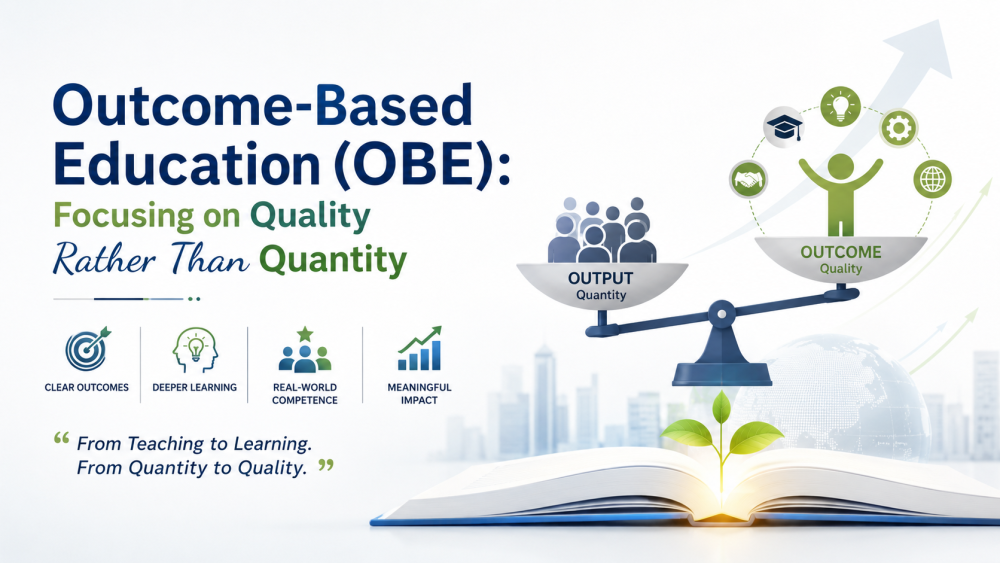
130/2026
Outcome-Based Education (OBE) is a transformative philosophy of teaching and learning that shifts the focus of education from what is taught to what learners are genuinely able to know, do, and demonstrate at the end of an educational experience. Unlike the traditional education system, which primarily emphasizes completing syllabi, classroom instruction, and examinations, OBE measures success by the competencies, skills, attitudes, and real-world capabilities students acquire.
A fundamental concept in OBE is the distinction between output and outcome. Output refers to the immediate product of an educational process, such as the number of students who graduate or the amount of content delivered in classrooms. For example, a university that graduates thousands of students each year has achieved high output. However, output alone says little about the effectiveness of education. Outcome, by contrast, reflects the quality and performance of graduates, their knowledge, critical thinking, technical competence, problem-solving ability, professional ethics, communication skills, employability, and contribution to society. In essence, output measures quantity, whereas outcome measures quality.
In an Outcome-Based Education system, a university's true success is not measured by enrollment figures, graduation rates, or students' Grade Point Averages (GPAs). Instead, it is evaluated by how effectively graduates perform in their professions, how quickly they secure meaningful employment, the confidence employers place in their abilities, their career progression, and the positive impact they have within their communities. Employer satisfaction, graduate employability, professional competence, innovation, and lifelong learning become key indicators of educational excellence.
At the classroom level, the distinction is equally important. In traditional teaching, success is often measured by how much information an instructor delivers in a lecture. OBE, however, asks a more meaningful question: How much of that knowledge has the student understood, retained, applied, analyzed, and transformed into practical competence? Learning is considered successful only when students can transfer classroom knowledge to real-world situations, solve authentic problems, think critically, and continue learning independently.
Outcome-Based Education also highlights an important challenge facing many educational institutions. As universities expand enrollment to increase access or ensure financial sustainability, there is a risk that educational quality may decline if resources, faculty capacity, laboratories, learning support, and quality assurance mechanisms do not scale proportionally. Institutions that prioritize output growth without safeguarding outcomes often experience a gradual decline in academic reputation and employer confidence. OBE therefore advocates responsible growth, where expansion never compromises educational quality.
Ultimately, Outcome-Based Education fosters a culture of continuous improvement, accountability, and student-centered learning. It requires institutions to define clear learning outcomes, align curricula, teaching methods, and assessments with those outcomes, and continuously evaluate whether graduates possess the competencies demanded by society and industry. Rather than asking "How much did we teach?", OBE asks the far more important question: "What can our graduates actually do?" This shift from teaching to learning, from quantity to quality, and from academic achievement to professional competence makes Outcome-Based Education one of the most effective approaches to preparing graduates to thrive in an increasingly competitive and knowledge-driven world.