Microsoft Seeing AI: Giving Sight a Voice for Blinds
Posted 1 day ago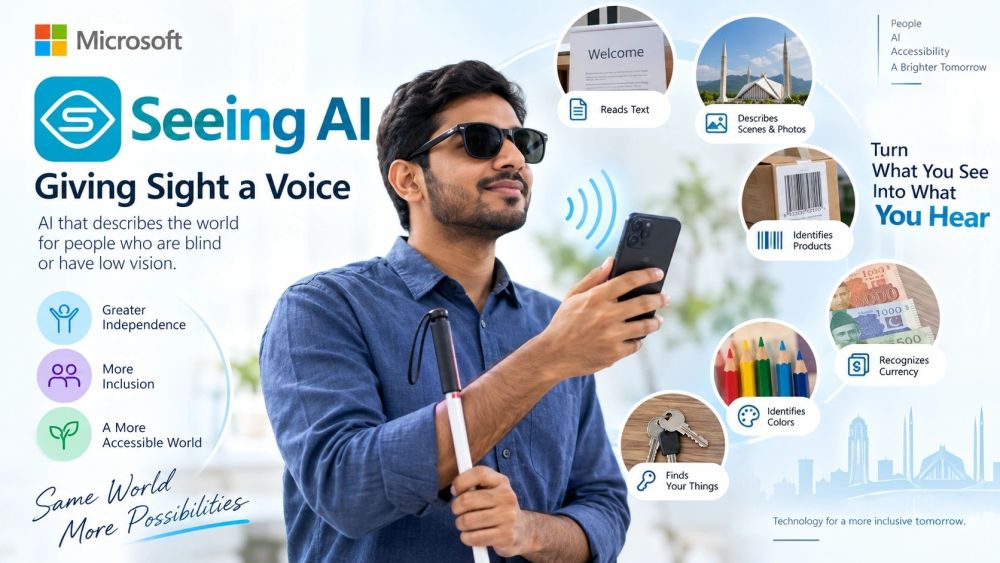
213/2026
Artificial intelligence is increasingly moving beyond productivity and entertainment to address real human needs. Microsoft Seeing AI is one of the most compelling examples. Designed for and with people who are blind or have low vision, Seeing AI is a free mobile application that uses artificial intelligence to describe the visual world in spoken language.
At its simplest, Seeing AI works like a “talking camera.” A user points a smartphone camera at something, and the app uses computer vision and AI to interpret what it sees and convey the information via audio. It can read printed text, describe photographs and scenes, identify products, recognize currency and colors, and provide information about people and objects.
From Reading Text to Understanding Images
One of Seeing AI's most useful capabilities is reading text aloud. Users can point their phone at a document, sign, menu, or other printed material, and the app reads the content to them. The application can also recognize document structure and, more recently, allow users to ask questions about documents, for example, finding a particular item on a receipt or a specific date in a calendar.
Its capabilities extend well beyond text. The Describe function can provide detailed descriptions of photographs and let users ask questions about what appears in an image. Seeing AI can also describe videos stored on a device, making visual content in a user's photo library more accessible.
A Practical AI Assistant for Everyday Life
Seeing AI is particularly powerful because its applications are practical, not merely impressive. Its Products feature can recognize barcodes and QR codes and provide product information. Currency recognition helps users identify notes, while Colors helps distinguish colors. A Find My Things capability allows users to teach the system to recognize personal objects and then locate them using audio cues.
The app has also explored more sophisticated forms of spatial awareness. Its World experience can announce nearby objects using spatial audio on supported devices, helping users understand unfamiliar environments. Microsoft has also been experimenting with hands-free use through camera-equipped wearable hardware, reflecting Seeing AI's potential evolution from a smartphone app into a more natural assistive technology. (Seeing AI)
Why Seeing AI Matters
Seeing AI matters not only for its technical sophistication but also for its potential to increase independence. Tasks that sighted people may perform almost unconsciously reading a label, identifying an object, understanding a photograph, or checking a document can pose substantial barriers for someone with visual impairment. AI can help convert these visual signals into information that can be heard and understood.
Seeing AI also illustrates an important direction for AI development: technology designed with accessibility in mind, not accessibility added as an afterthought. Microsoft describes the project as continually evolving in response to feedback from the blind and low-vision community and to advances in AI research.
At the same time, AI-generated descriptions should not be treated as infallible. Microsoft itself advises users to exercise judgment when interpreting AI-generated information.
The Bigger Picture
Seeing AI demonstrates what happens when artificial intelligence is applied to a fundamental human challenge. Rather than simply generating text or images, it translates the visual environment into an accessible audio experience.
In this sense, Microsoft's Seeing AI is more than another AI application. It offers a glimpse of how intelligent technologies can help remove barriers, promote independence, and make the digital and physical worlds more accessible. As computer vision, generative AI, and wearable devices continue to improve, applications such as Seeing AI could become an increasingly important part of inclusive, human-centered technology.


