HEC Pakistan Directs Universities to Implement Revised National Curricula from Fall 2026
Posted 3 months ago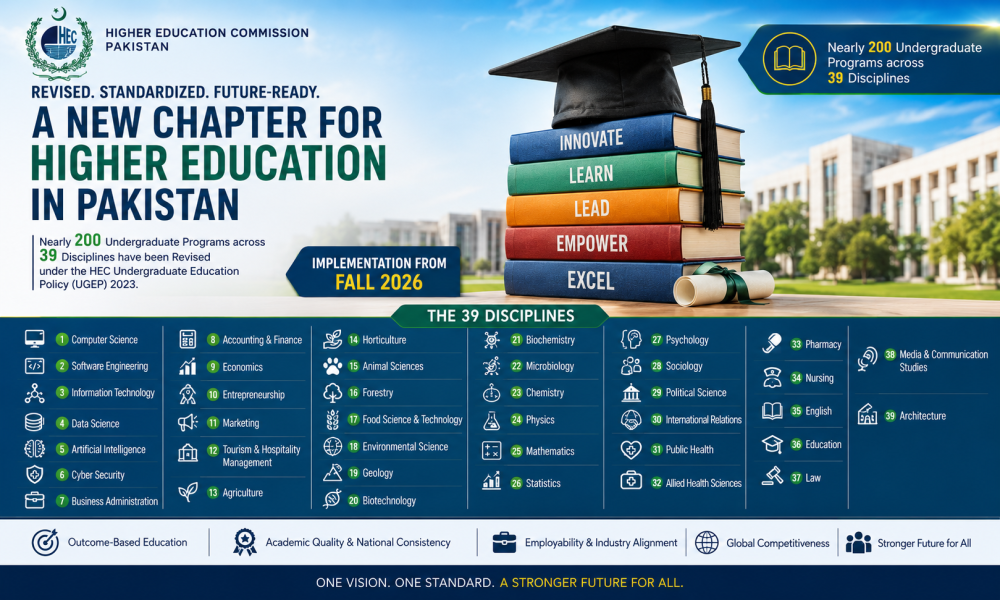
99/2026
The Higher Education Commission (HEC) of Pakistan has directed all public and private universities and degree-awarding institutions to implement the newly revised undergraduate curricula developed by the National Curriculum Review Committees (NCRCs), effective with Fall 2026 Semester admissions.
The comprehensive curriculum revision undertaken during 2025–26 is one of the largest national academic standardization initiatives in recent years. Nearly 200 undergraduate academic programs across 39 disciplines have been reviewed, revised, and standardized through extensive consultation with academia, industry, employers, accreditation bodies, and other stakeholders.
The revised curricula have been developed within the framework of the HEC Undergraduate Education Policy (UGEP) 2023, with a strong emphasis on academic quality, outcome-based education (OBE), employability, national consistency, and alignment with emerging technologies and evolving market demands.
According to the HEC, the revised curricula set standardized academic benchmarks, including degree nomenclature, admission eligibility, academic pathways, credit-hour requirements, general education requirements, learning outcomes, specialization streams, and quality-assurance parameters. Universities have been advised to adopt these curricula in their true spirit to ensure national uniformity and maintain the credibility and comparability of undergraduate qualifications across Pakistan.
The Commission has further emphasized that all admissions and academic offerings from Fall 2026 onward, as well as accreditation processes by relevant councils, where applicable, should fully comply with the revised curricula and the provisions of the Undergraduate Education Policy 2023.
The revised curriculum package spans a broad range of disciplines, including Computer Science, Business and Management Studies, Agriculture, Allied Health Sciences, Architecture, Biochemistry, Chemistry, Environmental Science, Education, English, Law, Mathematics, Physics, Pharmacy, Psychology, Public Health, Sociology, Statistics, Media and Communication Studies, Microbiology, Political Science, Zoology, and many other academic fields.
This initiative is expected to strengthen the quality, relevance, and international competitiveness of higher education in Pakistan by ensuring that university graduates possess the knowledge, skills, and competencies needed to meet current national priorities and global workforce expectations.