From Static Papers to Intelligent Research Assistance through Paper2Agent
Posted 1 day ago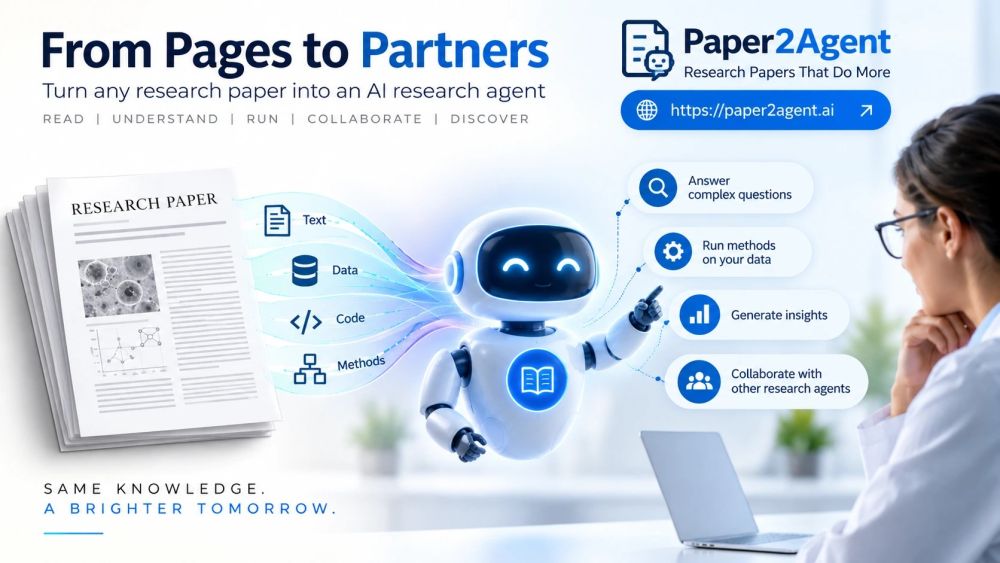
224/2026
AI is transforming static scientific papers into interactive research agents that can answer questions, run analyses, and even collaborate with other AI systems.
For centuries, the scientific paper has been the basic currency of discovery. A scientist experiments, analyzes the results, and publishes the findings. Other researchers then read the paper, study its methods, locate the accompanying data and code, and attempt to reproduce or build upon the work.
But there is a problem: a scientific paper is essentially a static object that describes knowledge that may be dynamic and computational.
A new artificial-intelligence system called Paper2Agent is challenging the traditional model. Instead of treating a research paper as merely something to read, it turns the paper and its associated code, data, and analytical methods into an interactive AI agent that researchers can question and instruct in ordinary language.
The idea could change how scientific knowledge moves from journal pages to the laboratory.
From paper to research assistant
Imagine discovering a complex genetics research paper. Normally, understanding it might require hours of reading. If you want to use its method on your own data, you might also need to find the authors' software, install it, understand its requirements, and learn how to operate it.
Paper2Agent attempts to remove much of that friction.
The system examines not only the paper's text but also its supplementary material, datasets, code, and computational workflows. It then creates an AI-accessible collection of tools via a standardized interface called the Model Context Protocol (MCP). A large language model can then interact with these tools using natural-language instructions.
The result is something resembling a virtual corresponding author, an AI representation of a particular research project that can explain the work and, importantly, use its methods.
Instead of asking, “What does this paper say?”, a researcher could potentially ask:
“Apply the method described in this study to my dataset.”
That is a profound difference.
A paper that can do something
The distinction becomes clearer with an analogy.
A traditional cookbook tells you how to prepare a meal. An AI-enabled cookbook could understand the recipes, access the ingredients, and actually guide or even perform the cooking.
Paper2Agent aims to apply a similar transformation to scientific papers: from experiment instructions to an interactive system that can execute the associated methods.
The researchers tested the approach across several scientific applications. One example involved AlphaGenome, an AI system designed to analyze DNA sequences and predict biological outcomes. Paper2Agent created an agent around the research in roughly 45 minutes, with reported computing costs of about US$14. In the researchers' tests, the resulting agent answered genetics questions with very high accuracy.
More importantly, the system could use the underlying method to investigate questions beyond those explicitly addressed in the original paper.
That opens an intriguing possibility: a published discovery could serve as a starting point for discoveries rather than merely the endpoint of an investigation.
When scientific papers start talking to one another
The most interesting possibility may be what happens when individual paper agents start working together.
Consider a researcher studying complex disease. One scientific paper may present a method for analyzing DNA variation. Another may describe a technique for studying gene expression. A third may offer a method for analyzing cellular behavior.
Today, connecting these discoveries often requires a human researcher to understand all three fields and manually combine the methods.
In the Paper2Agent framework, specialized AI agents representing different research papers can interact with one another. The underlying research demonstrated collaborations among agents using different computational methods and showed that multiple agents could contribute to scientific investigation.
The vision is therefore larger than an AI chatbot that summarizes papers.
It is closer to a digital scientific ecosystem in which methods can communicate with one another.
Could this accelerate discovery?
Science advances partly by connecting ideas that were once separated.
A biologist may know an important biological question but lack the computational expertise to analyze it. A computer scientist may have an excellent analytical method but know little about a particular disease. AI agents could bridge these areas.
For students and researchers entering unfamiliar disciplines, such systems could also make the literature less intimidating. Instead of spending days learning how a particular computational method works, researchers could interact with an agent representing that method and ask questions in ordinary language.
Technology could therefore make scientific knowledge more accessible, reusable, and interdisciplinary. Nature's report describes this as a move toward making papers easier to reproduce and helping researchers understand unfamiliar fields.
But an AI agent is not a scientist
There is an important limitation.
Turning a paper into an AI agent does not automatically make the underlying science correct. AI systems can still misinterpret questions, draw inappropriate inferences, or generate hypotheses that require experimental validation.
The Paper2Agent researchers have attempted to address one important problem: AI-generated code that does not faithfully reproduce the original method. Their system tests tools against the reference code and reported results, and the resulting tools can retain links back to the original code to support traceability.
Even so, computational reproduction is not equivalent to biological or clinical validation.
An AI may identify an intriguing genetic mechanism, for example, but that hypothesis may still need to be tested in cells, animals, or humans.
The human scientist remains essential not merely to operate the system, but to decide which questions matter, whether an answer makes scientific sense, and what to test next.
The future of the scientific paper
For generations, scientific publishing has followed a familiar sequence:
Discovery → Paper → Reading → Reproduction → New Discovery
AI agents could introduce a different model:
Discovery → Paper + Data + Code → Interactive Agent → Collaboration → New Discovery
That may ultimately be the more important story.
The goal is not simply to help scientists read papers faster. It is to make scientific knowledge active.
- A paper could become something a researcher can question.
- A method could become something a researcher can immediately use.
- A dataset could become something an AI can analyze.
- And discoveries from different fields could potentially become components of a larger computational research team.
According to Prof. Emeritus Dr. Muhammad Mukhtar, Rector of the University of Southern Punjab, Multan, scientific papers may be entering a new stage in their long history. For centuries, papers have told us what scientists discovered. The next generation of scientific papers may also help us discover what comes next.