From Paperwork to Intelligent Governance: How Universities Are Changing
Posted 13 hours ago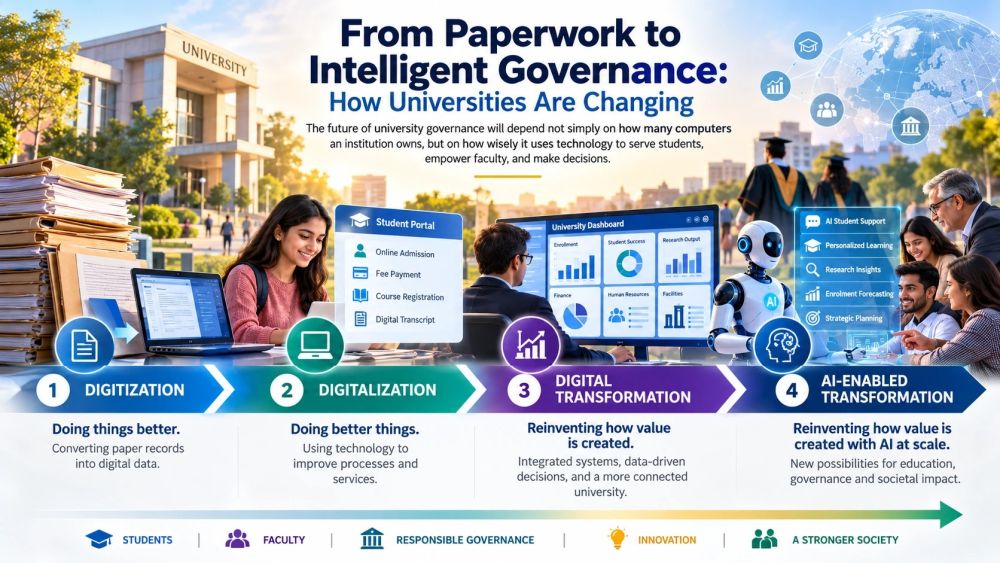
259/2026
The future of university governance will depend not simply on how many computers an institution owns, but on how wisely it uses technology to serve students, empower faculty, and make decisions.
Universities are entering a new era in which connected, data-driven, and increasingly AI-enabled governance is gradually replacing traditional administration. This evolution can be understood through four stages: 1) digitization, 2) digitalization, 3) digital transformation, and 4) AI-enabled transformation. Each stage builds on the previous one, moving universities from managing information more efficiently to rethinking how they fulfill their educational and social responsibilities.
The journey begins with digitization, converting paper records into digital data. A university scans admission forms, stores exam results electronically, and creates digital archives of official correspondence. Information becomes easier to access and manage, though the institution's established procedures may remain largely unchanged.
The next stage is digitalization, which improves everyday processes. Online admissions, electronic fee payments, digital attendance, learning management systems, and automated transcript requests reduce delays and make university services more convenient. Instead of visiting several offices to complete a single task, students can access multiple services through a digital portal. Administration is becoming faster, more transparent, and more accessible.
The third stage, digital transformation, drives bigger institutional change. Rather than simply improving individual processes, the university reconsiders how its departments collaborate, how decisions are made, and how performance is measured. An integrated management system connects admissions, finance, human resources, examinations, research, and student services. Leadership dashboards help the rector and senior management monitor enrollment, budget utilization, faculty development, and student progress. Governance becomes more coordinated, evidence-based, and responsive.
The emerging fourth stage is AI-enabled transformation, which opens new possibilities for education and institutional management. Artificial intelligence can assist with routine correspondence, provide round-the-clock student guidance, help faculty develop learning resources, analyze research trends, and forecast future enrollment. AI-supported analysis can also help leaders compare strategic options before allocating resources. For example, a university could combine enrollment patterns, regional employment trends, and student preferences to identify academic programs that may better serve its community.
For universities in Pakistan, particularly those serving underserved regions, these developments offer opportunities to expand educational access, improve institutional efficiency, and align academic programs with evolving labor-market needs. AI-supported learning, digital skills programs, and integrated administrative systems could help institutions reach students who face geographic, financial, or educational barriers.
However, technology alone cannot ensure good governance. Universities must protect personal data, maintain cybersecurity, guard against algorithmic bias, and preserve academic integrity. Decisions on admissions, examinations, recruitment, promotions, and disciplinary matters require clear policies, accountability, and sound human judgment. Artificial intelligence should strengthen responsible leadership, not replace it.
The progression from digitization to AI-enabled transformation is therefore much more than a technological upgrade. It represents a shift from managing documents to improving processes, to redesigning institutions, and finally to creating new possibilities through intelligent collaboration between people and technology.
The university of the future will not be the one that merely adopts the most advanced technology, but the one that uses it wisely to make education more accessible, governance more accountable, and knowledge more valuable to society.
3. What does this mean for university leadership?
For a rector, vice-chancellor, governing board, or senior management team, these four stages offer a practical roadmap for institutional development.
|
Stage |
Main governance priority |
Potential university initiative |
|
1. Digitization |
Reliable, accessible records |
Electronic records and digital archives |
|
2. Digitalization |
Efficient service delivery |
Online admissions, fee payments and examination services |
|
3. Digital transformation |
Integrated, evidence-based governance |
Unified university management system and leadership dashboards |
|
4. AI-enabled transformation |
Intelligent, responsible decision-making |
AI-assisted student support, enrolment forecasting and strategic planning |
Prof. Emeritus Dr. Muhammad Mukhtar, Rector of the University of Southern Punjab, Multan, Pakistan, recommends that academia in Pakistan and the developing world avoid using AI merely to automate inefficient processes. First, organize the university's data, improve its processes, integrate its systems, and establish appropriate governance policies. Then introduce AI where it can deliver genuine educational and institutional value. Drawing on his recent past contributions at the National Skills University Islamabad and now at the University of Southern Punjab, Multan, Pakistan, he notes that the journey from digitization to AI-enabled transformation is arduous because faculty and administration hold diverse perceptions. However, the younger generation, including students, is more receptive and will propel university systems toward contemporary transformations. In this respect, Prof. Mukhtar particularly cited recent competency-based evaluations in computational programs organized by the Higher Education Commission of Pakistan.
Recalling his recent past experiences, Prof. Mukhtar says that when he tried to propose the Professor of Practice and competency-based assessment during his tenure at the first-ever skills university in the capital city of Pakistan, he met with much more resistance; however, now the same system idea is gaining momentum, for which there was immense resistance in the power corridors of academia.
In conclusion, the stages of university transformation described above aren't rigidly separated but are integrated and collaborative. A university may use advanced AI in one department while still digitizing paper records in another. What matters is a deliberate progression toward an institution that is more efficient, transparent, responsive, and capable of learning from its own performance.