From Admission to Employability: Re-structuring Undergraduate Education in Pakistan
Posted 9 months ago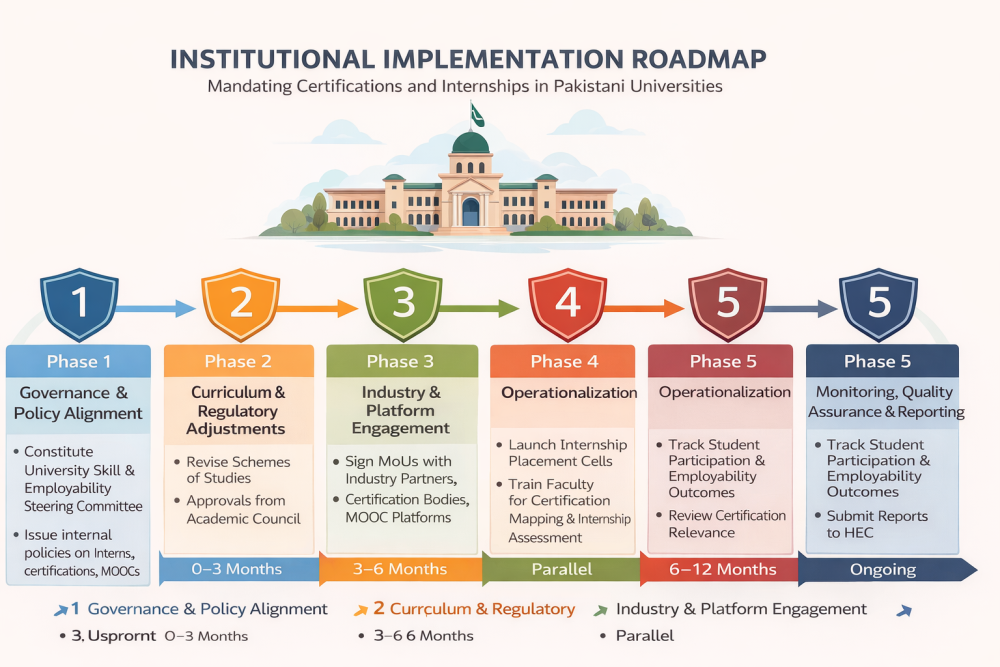
5/2026
A Letter addressed to all Public and Private Universities/degree-awarding institutes (DAIs) by the Academics Division of the Higher Education Commission of Pakistan (Letter No. HEC/CURR/GEN/2025/8036 dated September 15, 2025) discusses the incorporation of mandatory certifications and internships in undergraduate programs. This letter is in reference to the Prime Minister of Pakistan's directives as per U.O. 10-OPHRD/DS (IA-III) 2025, dated 25th March 2025.
A- Introduction
The Higher Education Commission of Pakistan (HEC), following the Prime Minister’s directives and the Undergraduate Education Policy (2023), has issued detailed advisory requiring the integration of supervised internships, industry-relevant certifications, MOOCs, and micro-credentials into undergraduate degree programs. The policy aims to greatly improve graduate employability, support professional mobility, and align with both national and international labor market needs. The following are the key features of this initiative:
1. Mandatory Internships (Minimum 3 Credit Hours)
All undergraduate degree programs must include supervised internships as an essential part of the curriculum, ensuring students gain valuable practical experience alongside their academic studies. To support this, universities are encouraged to establish formal partnerships with industry, small and medium-sized enterprises, and public sector organizations, and to utilize remote and online internship opportunities to adapt to changing workplace models and increase access for students.
2. Integration of Industry-Relevant Certifications
Undergraduate programs will include mandatory or embedded professional certifications in high-demand fields like information technology, health, agriculture, construction, the environment, business, and the digital economy. These certifications can be provided by either national or international organizations, provided they meet established standards of relevance, credibility, and alignment with program learning outcomes.
3. Academic Credit for Certifications (1–6 Credit Hours)
Academic departments of universities or degree-awarding institutions may formally align approved certifications with course learning outcomes, allowing them to be recognized as part of the academic program. When appropriate, these certifications may substitute for traditional courses, thereby reducing curriculum redundancy and improving learning efficiency through targeted, skills-focused education.
According to the Academic Division, Higher Education Commission, Islamabad, Government of Pakistan, “Incorporation of Mandatory Certifications and Internships in Undergraduate Programs”
“To incentivize students to pursue subject-related certifications, a department may accept credit hours for certifications subject to course mapping and approval from statutory university bodies under the following conditions:
- The level of certification and the skills gained in the certification should be on par with the Course Learning Outcomes (CLOs) of that specific course.
- The certification will be considered at a minimum of 1 credit hour and a maximum of 6 credit hours, subject to its course mapping and the workload involved as determined by the university. (The certification will be considered equivalent to 1 credit hour if it comprises at least 16 hours of classroom exposure or 48 hours of lab exposure).
- The relevance, authentication, and assessment of the certification may be determined by the department or faculty offering the degree program.
- The certification must be issued by a recognized, credible, and relevant certification body, preferably national or international organizations with established standards.
- Students must provide verifiable documentation (e.g., a certificate, transcript, course outline) demonstrating completion of the certification, which must be reviewed by the concerned department for approval.
- The certification should have been completed within the last 3 years prior to the acceptance request to ensure the skills are current and relevant to industry needs.”
4. Replacement of Electives with International Certifications (CS/IT)
The main beneficiaries will be students in the Computer Science and Information Technology programs. Students can replace elective courses with internationally recognized professional certifications equivalent to three credit hours. This enables them to develop globally relevant technical skills while remaining aligned with program objectives.
5. MOOCs and Micro-Credentials
Universities in Pakistan are encouraged to partner with reputable global MOOC platforms to give students access to high-demand, industry-relevant skills, enhance learning flexibility, and supplement traditional academic teaching with internationally recognized micro-credentials.
6. Alignment with NAVTTC and Provincial Skill Bodies
Universities can collaborate with national and provincial skill development agencies to offer short, skill-based courses that complement academic programs and avoid regulatory conflicts. At the federal level, the National Vocational and Technical Training Commission (NAVTTC) oversees overall policy coordination, sets national skill standards, and develops accreditation frameworks aligned with labor market needs. Provincial agencies like the Technical Education and Vocational Training Authority provide technical and vocational training through their network of institutes. Meanwhile, the Punjab Skills Development Authority manages quality assurance, accreditation, and standardization of skill programs across Punjab. Additionally, the Punjab Skills Development Fund supports demand-driven training by financing market-relevant skills initiatives in partnership with industry and training providers. Working strategically with these organizations enables universities to leverage established certification systems, industry links, and regulatory expertise, thereby enhancing student employability and effectively contributing to Pakistan’s national skills ecosystem.
B. Strategic Benefits for Pakistani Universities
The successful implementation of these initiatives is likely to significantly enhance graduate employability and student placement outcomes by aligning academic learning with market-relevant skills. It will also strengthen university–industry partnerships, increasing the institution’s social relevance and responsiveness to economic needs. Additionally, adopting outcome-based education and integrating skills will help improve national and international rankings while closely aligning with national skills strategies, export-focused workforce needs, and broader human resource development plans.
C. Benefits to Students
✔ Internships are now mandatory
You will complete at least one supervised internship as part of your degree to gain real work experience.
✔ Professional Certifications Count
You can earn national or international certifications related to your field, and these may count as university credit.
✔ More Skills, Less Theory-Only Learning
Your degree will include hands-on skills that employers want.
✔ Online Learning is Recognized
Courses from MOOCs and global platforms can help you earn micro-credentials and certifications.
✔ CS & IT Students Get Extra Flexibility
Your electives can be replaced with international tech certifications, making you more competitive globally.
Why This Is Good for Students
- Better career opportunities after graduation
- Stronger resume with practical experience and certifications
- Skills aligned with local and global job markets
- More confidence entering professional life
A university degree will not just be a qualification; it will be a launchpad for a career.
C. Tentative Implementation Roadmap for Universities / Degree Awarding Institutions
Phase 1: Governance & Policy Alignment (0–3 Months)
- Establish a University Skill & Employability Steering Committee.
- Issue internal policy on:
- Internship integration
- Certification credit acceptance
- MOOCs and micro-credentials
- Identify priority programs (IT, Business, Health, Agriculture, etc.)
Phase 2: Curriculum & Regulatory Adjustments (3–6 Months)
- Revise Schemes of Studies to include:
- 3-credit internship modules
- Certification-mapped courses
- Obtain approvals from:
- Boards of Studies
- Academic Council
- Relevant Statutory bodies
Phase 3: Industry & Platform Engagement (Parallel)
- Sign MoUs with:
- Industry partners (corporate, SMEs, public sector)
- Certification Bodies (National & International)
- MOOC platforms
- Establish industry advisory panels for each faculty.
Phase 4: Operationalization (6–12 Months)
- Launch internship placement cells or strengthen ORIC/career offices
- Train faculty on:
- Certification mapping
- Internship assessment frameworks
- Create employer evaluation and project assessment tools
Phase 5: Monitoring, Quality Assurance & Reporting (Ongoing)
- Monitor student participation, completion, and career outcomes
- Periodic review of certification relevance
- Submit compliance and progress reports to HEC by the designated deadlines.
This HEC initiative is more than just a regulatory requirement; it is a structural reform that transforms universities into engines of employability, innovation, and community development. Institutions that implement it proactively will become national leaders in skills-based higher education.
This initiative marks a shift from theory-focused education to skills-based learning, ensuring that Pakistani graduates are not only academically qualified but also economically productive, globally competitive, and socially relevant.