2. Competence: Beyond Qualifications Toward Real-World Performance
Posted 3 months ago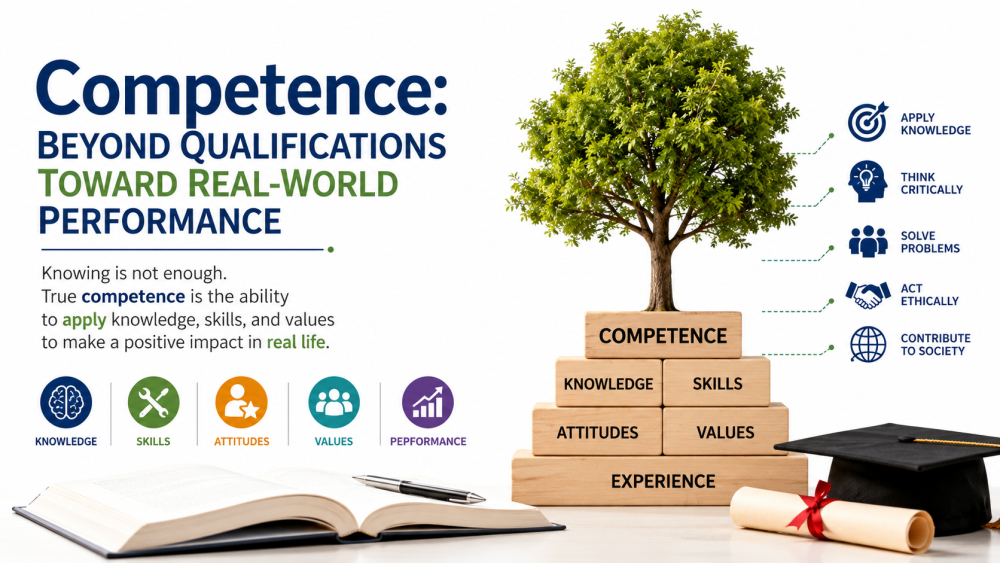
131/2026
In the twenty-first century, education is no longer judged solely by the number of graduates it produces or the certificates it awards. Instead, its true value lies in developing individuals who can apply knowledge effectively, solve real-world problems, and contribute positively to society. This shift has brought the concept of competence to the forefront of educational reform, particularly within the framework of Outcome-Based Education (OBE).
The Organization for Economic Co-operation and Development (OECD) defines competence as the ability to meet complex demands or perform tasks by integrating knowledge, skills, attitudes, values, experience, and other cognitive and non-cognitive attributes. Competence is therefore much more than possessing information; it is the capacity to use that information effectively in diverse and often challenging situations.
The OECD further emphasizes the importance of key competencies. These essential capabilities enable individuals to succeed across multiple areas of life and contribute to a productive, ethical, and sustainable society. These competencies extend beyond academic achievement to include critical thinking, communication, collaboration, leadership, adaptability, ethical reasoning, and lifelong learning.
Qualified Does Not Always Mean Competent
One of the most common misconceptions in education is the belief that a qualified individual is automatically competent. In reality, qualification and competence are fundamentally different concepts.
Qualification typically results from acquiring knowledge and passing examinations. Degrees, diplomas, and certificates indicate that a learner has completed prescribed coursework and met academic requirements. Competence, however, is demonstrated by the effective application of knowledge in authentic situations. It reflects whether an individual can perform tasks successfully, solve practical problems, make informed decisions, and adapt knowledge to changing circumstances.
This distinction explains why many graduates excel on exams yet struggle when faced with real-world workplace challenges. Academic success alone cannot guarantee professional effectiveness. True competence is achieved only when knowledge is put into action.
Education Beyond Memorization
Many educational systems continue to reward memorization over meaningful learning. Students often acquire extensive theoretical knowledge but receive limited opportunities to apply it. Consequently, they become knowledgeable but not necessarily capable.
Competence Is Demonstrated Through Performance
The difference between qualification and competence becomes even clearer when practical professions are examined.
A person may pass a driving exam and obtain a driver's license, yet this does not automatically make them a competent driver. Competent driving requires much more than understanding vehicle controls or memorizing traffic regulations. It demands sound judgment, hazard perception, emergency response skills, defensive driving techniques, knowledge of vehicle maintenance, and the ability to make safe decisions under pressure.
Similarly, competence in medicine cannot be measured solely by passing written exams. A competent physician must integrate scientific knowledge with clinical reasoning, communication, ethical decision-making, empathy, teamwork, and practical procedural skills.
In every profession, competence emerges from the successful integration of knowledge, skills, attitudes, and experience.
Competence in Teaching: More Than Subject Expertise
Teaching offers one of the clearest examples of why competence extends beyond academic qualifications.
A university lecturer may hold a doctorate in chemistry, physics, engineering, or mathematics and have exceptional expertise in the field. However, subject expertise does not automatically translate into excellence in teaching.
Effective teachers require a broad set of complementary competencies, including instructional design, pedagogy, assessment strategies, communication skills, educational psychology, curriculum development, classroom management, digital literacy, data analysis, and the ability to motivate diverse learners. They must also continuously assess student learning, adapt instructional methods, and foster critical thinking rather than rote memorization.
Unfortunately, many educational institutions continue to recruit faculty primarily based on subject qualifications and research publications, while giving comparatively little attention to pedagogical competence. Although research productivity remains important, excellent researchers are not necessarily excellent educators. Institutions committed to educational quality must therefore recognize teaching competence as an equally essential professional attribute.
Competence Builds Better Societies
Competence is not limited to technical or professional performance. It also encompasses the ethical, social, and civic capabilities that enable individuals to be responsible citizens.
Many developing countries face a paradox: students complete primary and secondary education, yet society continues to struggle with issues such as civic responsibility, ethical conduct, social discipline, environmental stewardship, and respect for diversity. Learners may have studied citizenship, social studies, or religious education, but often fail to apply these lessons to everyday behavior.
The true outcome of education should therefore be measured not merely by what students know about ethics or citizenship, but by how consistently they practice these principles in their daily lives. Genuine competence is reflected in actions, values, and responsible decision-making rather than in examination scores alone.
Measuring Competence
Traditional assessment systems primarily evaluate knowledge acquisition through written exams. While these remain important, they offer only a partial picture of student learning.
Competence requires broader assessment approaches, including authentic projects, case studies, simulations, portfolios, internships, presentations, laboratory work, reflective practice, peer assessment, workplace evaluations, and performance-based assessments. These methods enable learners to demonstrate not only what they know but also what they can do.
Educational institutions should likewise evaluate their teachers using comprehensive appraisal systems that measure instructional effectiveness, student engagement, teaching innovation, curriculum development, assessment quality, mentorship, and professional development, in addition to research achievements.
From Knowledge to Capability
Outcome-Based Education challenges institutions to redefine what constitutes educational success. Rather than asking whether students have completed a curriculum, it asks whether they have developed the competencies needed to thrive in their professions and contribute meaningfully to society.
Ultimately, competence is the successful integration of knowledge, skills, attitudes, values, and experience into effective performance. Qualifications may open doors, but competence sustains careers, drives innovation, and strengthens communities.
The ultimate purpose of education is therefore not merely to produce graduates with degrees, but to develop individuals who can think critically, act ethically, solve complex problems, adapt to change, and translate knowledge into meaningful action. In a rapidly evolving world, competence, not qualification alone, has become the true measure of educational excellence.