China's Practical PhDs Program Supports Skills in Emerging Technologies and Product Development
Posted 6 months ago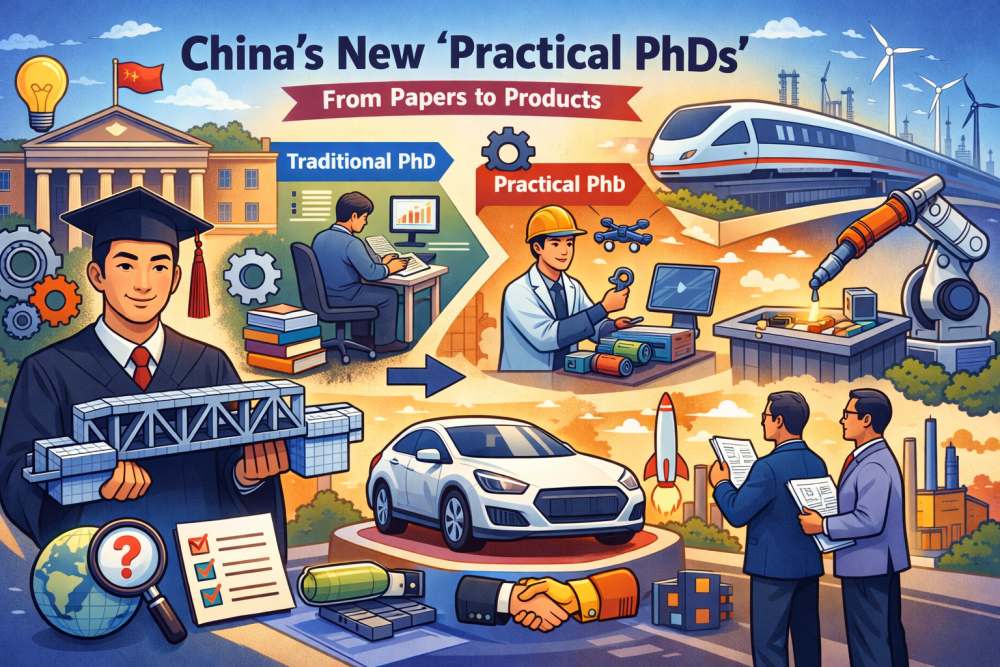
27/2026
According to a recent report in Nature, a world-class scientific journal, China has taken a bold step in higher education by awarding its first “practical” PhD degrees, not for writing traditional academic papers but for developing real products and inventions. This new type of doctorate aims to cultivate engineers who can create solutions and promote innovation, rather than focusing solely on scholarly research and publications.
What Are ‘Practical PhDs’?
Traditionally, PhDs, the highest academic degrees, require students to conduct in-depth research and produce a thesis that advances knowledge in their field. However, in China’s new model, candidates can earn a PhD by demonstrating actual products or technologies they have developed. These might include engineering prototypes, software, or scientific devices.
For example, the first recipient earned his practical doctorate not with a paper but by describing a bridge-building product: Lego-like reinforced steel blocks that can be assembled into a bridge support structure.
Why This Matters - The Big Pros
✅ Boosts Real-World Innovation
This practical degree focuses more on real product development, encouraging graduates to create technologies that industry or society can use right away. It provides a direct link between education and innovation.
✅ Aligns Academic Training with Industry Needs
Engineering is a field where practical skills and applied solutions matter. By emphasizing hands-on work, China aims to develop engineers capable of solving real-world problems across infrastructure and advanced technology sectors. This will really empower Engineering Technology education in China and around the world by following this model.
✅ May Attract More Talent
Students interested in inventing and building instead of spending years on academic writing might find this model more engaging and relevant. It could help institutions attract talented, solution-focused thinkers.
Potential Downsides and Concerns
⚠️ Quality and Academic Rigor
Traditional PhDs are based on strong theoretical frameworks and peer-reviewed research. Critics might ask how China's practical PhDs will be recognized internationally, raising questions about their global academic standing and credibility.
⚠️ Assessment Standards
How do institutions fairly evaluate a “product” against academic research? Without clear, standardized assessment criteria, there’s a risk of subjectivity or inconsistency across universities, which may concern policymakers and educators alike.
⚠️ Balance Between Theory and Practice
Practical training is important, but research theory remains essential for breakthrough innovations. Critics may question how China's model ensures a balance that allows future engineers to handle complex, research-intensive challenges without sacrificing scientific rigor.
What This Means for the Future
China’s move reflects a larger trend in global education: connecting university degrees more closely with industry needs and innovation outcomes. Many countries and universities are rethinking traditional academic paths to equip graduates for real-world challenges better.
If the experiment succeeds, we may see:
🔹 Modern PhD models that combine academic research with applied development.
🔹 Increased partnerships between universities and industry, promoting technology upskilling and commercialization.
🔹 A shift in how employers value doctoral training — not just for academic credentials, but for fresh innovation capacity.
However, success depends on clear evaluation frameworks and balance. If universities can establish rigorous criteria for practical work while maintaining strong research foundations, this new model could cultivate engineers who are both critical thinkers and effective problem-solvers.
Take Home Message
According to Professor Dr. Muhammad Mukhtar, Editor-in-Chief of HunarNama, China’s introduction of “practical PhDs” seems like an interesting new name and marks an important shift in higher education, signaling a move away from purely publication-driven academic success toward a more results-focused innovation model. However, he warns against calling it entirely unprecedented. In his opinion, several universities' doctoral programs in the United States have long incorporated product development and industry collaboration into PhD training. Reflecting on his doctoral experience, partially funded by a pharmaceutical company, he explains that his research focused on identifying a drug target for an opportunistic fungal pathogen, a project grounded in both theoretical science and real-world application. This shows that applied, industry-linked doctoral research isn’t new; it continues a long-standing model in which discovery and development go hand in hand.
Dr. Mukhtar emphasizes that a well-designed, practical PhD program should boost technology development by equipping students with the requisite skills without compromising theoretical depth. Every successful product, whether in engineering, biotechnology, or pharmaceuticals, is based on solid scientific principles that a doctoral candidate must fully master. While the practical PhD approach offers clear benefits such as stronger industry connections, faster technological progress, and enhanced innovation ecosystems, it also raises important concerns about academic standards, research quality, and international recognition of these degrees. The long-term success of this model will ultimately depend on balancing foundational research with applied innovation. Its true impact will become evident as more graduates enter the marketplace and the global research community, where their contributions will serve as the ultimate test of the model’s credibility and effectiveness.
Commenting on this article, Prof. Dr. Javaid Laghari, former Chairperson of the Higher Education Commission of Pakistan, says;
How does one evaluate whether the product developed equates to the learning outcome of a PhD degree, which today includes theory and research?
A reply from Prof. Dr. Sohail Naqvi, former Executive Director of the Higher Education Commission of Pakistan and Current Chairperson @ Knowledge Streams and Convener of the National Strategic Task Force on Doctoral Education Reforms, followed this.
Dr. Leghari, perhaps based on international best practices, you could propose a way forward.
This was followed by Dr. Laghari's comments as follows;
There are no standard global SOPs for such cases. The universities, being autonomous, make their own assessment and award criteria, which are later generally reviewed by accreditation agencies during their visits.
HEC makes policies in Pakistan, and as the head of the doctoral education task force, it will be difficult to go against established norms.
However, in the case of a "product" rather than research, the idea would be that solving a "massive" real-world problem should require just as much original research as writing a thesis. The proof would be in the product, not in the paper. However, how and who defines what is "massive," "original," and "useful" to warrant a PhD?
On a separate note, there's a lot of debate lately about the 'utility' of traditional research. The argument is that many PhD papers are never actually used, read, or cited. These new programs aim to fix that by making the final 'thesis' an original, useful product that stands up in the real world.
For a PhD by product, the decision is still made by a committee of experts, and in this case, includes industry leaders alongside professors. Instead of checking for citations, they check if the product actually solves a technical problem that has been stuck for years.
It's essentially replacing a peer-reviewed paper with a peer-reviewed prototype or product.
Please also note that any new policy on whether it is original research, a product, or has a socio-economic benefit would open up a Pandora's box.
The image used in this article has been developed through ChatGPT 5.2