Chairman PHEC Leads Global Academic Dialogue on International Research Collaboration
Posted 1 day ago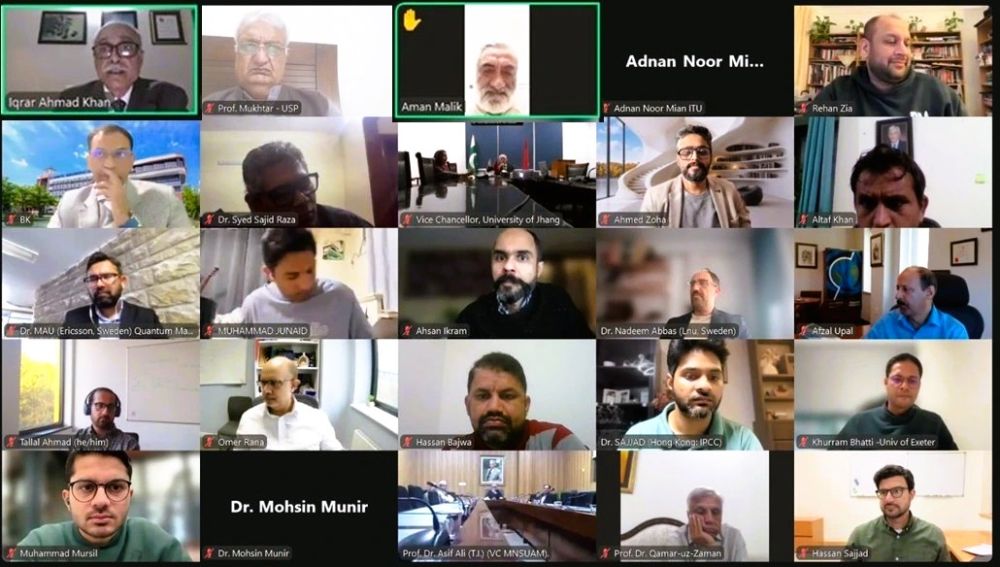
263/2026
The Punjab Higher Education Commission (PHEC) convened an international online meeting to explore academic linkages, collaborative research, and innovation in Punjab's higher education institutions, bringing together distinguished scholars, researchers, university leaders, and academic experts from around the world. This session discussed on the Artificial Intelligence and its utilization in Pakistan.
Prof. Dr. Iqrar Ahmad Khan, Chairman of the Punjab Higher Education Commission (PHEC), moderated the meeting, which was attended by Prof. Emeritus Dr. Muhammad Mukhtar, Rector of the University of Southern Punjab (USP), Multan, Pakistan, along with several Vice Chancellors from public and private sector universities of Pakistan, prominent scholars and experts representing universities and research institutions from different countries.
The meeting highlighted PHEC's Strategic Action Plan 2026–2030, especially the Global Linkages Initiative and the Research and Development (R&D) Clusters Initiative. These initiatives connect Punjab's universities with international academic talent, mobilize the Pakistani academic diaspora, and build sustainable partnerships for research, innovation, and knowledge transfer.
The Global Linkages Initiative seeks to reconnect universities with international scholars, professional experts and accomplished members of the Pakistani diaspora. It has built an extensive international expert network, with more than 4,200 registrations and 221 international experts mapped across participating networks.
The initiative placed particular emphasis on Artificial Intelligence (AI) and One Health. The AI network includes 122 experts from 23 countries, while the One Health network includes 101 experts from 25 countries.
The discussion covered seven priority domains of Artificial Intelligence:
- Cybersecurity, Trustworthy AI and Blockchain.
- AI for Sustainability, Energy, Policy and Societal Impact.
- Computer Vision and Intelligent Sensing.
- Robotics and Autonomous Systems.
- AI for Health, Medicine and Life Sciences.
- Human-Centered and Immersive AI.
Participants explored practical ways to engage international experts through joint research projects, faculty development, curriculum modernization, guest lectures, webinars, visiting faculty arrangements, academic mentoring, consultancy and shared research resources.
The R&D Clusters Initiative proposes ten thematic research clusters linking 27 universities. It is designed to overcome institutional and disciplinary barriers by bringing researchers, facilities and expertise together through virtual collaborative networks.
The program seeks to move university research beyond a predominantly publication-oriented approach toward impact-driven research that addresses national and provincial priorities. It has received 166 proposals, with 25 shortlisted.
Participants also discussed governance, monitoring mechanisms, sustainable research funding, and measurable outcomes, including innovative products, policy briefs, trained human resources, and industry linkages.
Rector USP Highlights the Importance of Global Academic Partnerships
Participating in the deliberations, Prof. Emeritus Dr. Muhammad Mukhtar, Rector of the University of Southern Punjab, emphasized the importance of connecting Pakistani universities with distinguished international scholars and research networks. He underscored that such initiatives can significantly enhance institutional research capacity, promote interdisciplinary collaboration, and expose faculty and students to international standards of scholarship and innovation.
Prof. Mukhtar also put forth the idea of offering Adjunct Professorship to international scholars and industrialists so they can help Pakistan. According to Professor Dr. Aman Ullah Malik similar strategy is already being exercised by The University of Faisalabad with impressive impact in high quality research and world class teaching facilities.
The international participation and exchange of ideas reflected a shared commitment to making Punjab's higher education sector more globally connected, research-oriented and responsive to emerging technological and societal challenges.