Can an Invisible AI Watermark Save the Internet?
Posted 2 months ago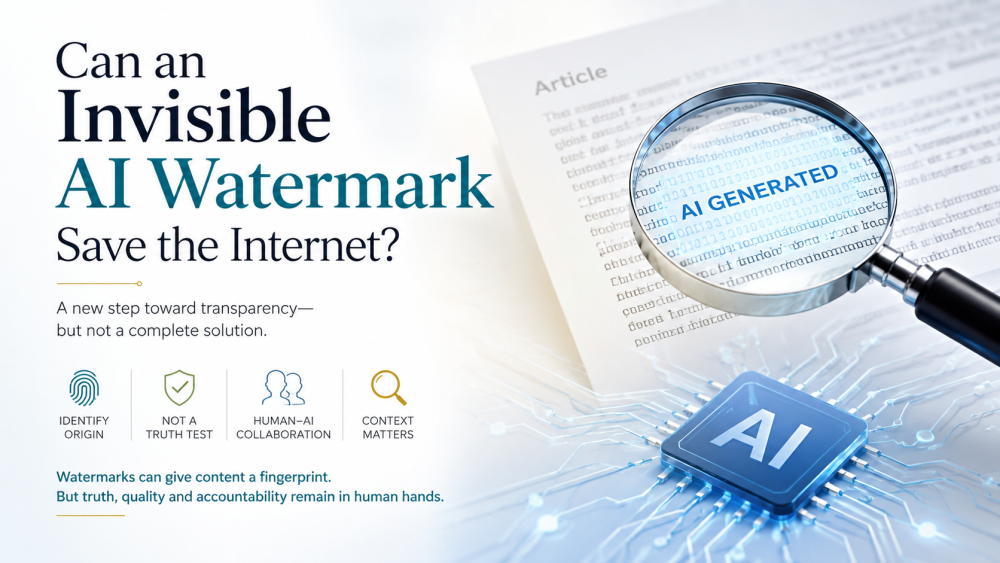
184/2026
Artificial intelligence produces an extraordinary amount of content: articles, images, essays, software, and social media posts. But as AI becomes better at creating convincing material, a new problem is emerging: How will we know what was created by a human and what was produced by a machine?
A recent Nature article describes an important effort to address this problem. Anthropic, the company behind Claude, has introduced technology that embeds an invisible watermark in AI-generated text, while AI-generated images can carry digitally signed information about their origin.
The concept is remarkably simple. The watermark is not something a reader can see. Instead, it creates a subtle statistical pattern in how an AI chooses words. Specialized systems can later analyze the text and determine whether it originated from the AI system.
It sounds like a technological solution to an increasingly visible problem.
But there is a catch.
A watermark can identify origin, not truth.
The greatest misunderstanding would be to treat an AI watermark as a truth detector.
It is not.
A completely accurate scientific explanation generated by AI could carry the same watermark as fabricated misinformation. The watermark can tell us where the content came from, but not whether it is correct, useful, or ethical.
That distinction is critical.
Human beings can produce misinformation without AI. AI can also produce highly accurate and valuable information. Therefore, identifying AI-generated material cannot replace scientific verification, fact-checking, or human judgment.
The human-AI boundary is becoming blurred.
There is another difficult question: What exactly counts as AI-generated?
- Suppose a scientist writes an article but asks AI to improve its grammar. Is the article AI-generated?
- What if AI reorganizes the paragraphs, but the ideas belong entirely to the researcher?
- What if a student writes most of an assignment and uses AI only to improve the language?
The future will likely not be divided into two simple categories: human and machine. Instead, we are entering an era of human–AI collaboration.
That makes a simple “AI-generated” label potentially misleading.
Can the watermark be defeated?
There is also the problem of an inevitable technological arms race.
If AI companies develop better watermarks, others will try to remove or weaken them. Rewriting, paraphrasing, translation, and other transformations can make statistical watermarks harder to detect.
This does not make watermarking useless. It simply means that we should not regard it as an unbreakable digital fingerprint.
Nor should a detector's verdict be treated as unquestionable evidence, particularly in universities, workplaces, or scientific publishing. Technological probability should not automatically become a human judgment.
What we really need
Watermarking can still become an important part of responsible AI.
It could help readers, publishers, and institutions understand the provenance of digital content. But it should be only one layer of a much larger system that includes transparency, fact-checking, scientific validation, disclosure policies, and human accountability.
The more important question may therefore not be:
“Was AI used?”
It should be:
“How was AI used, and does that use matter?”
Using AI to correct grammar is very different from using it to fabricate research results. Generating a fictional image is very different from presenting an AI-generated image as a real photograph of an actual event.
The bigger lesson
There is an intriguing irony here. We are developing AI to create information and now developing AI to identify information created by AI. The danger is that we become so focused on detecting machine-generated content that we forget the real objective: preserving truth, quality, originality, and accountability.
An AI watermark may give a digital document a fingerprint.
But a fingerprint is not a certificate of truth.
The real challenge of the AI era is not simply learning to recognize machine-generated information. It is learning to decide what to trust, says Prof. Dr. Muhammad Mukhtar, Rector of the University of Southern Punjab, Multan, Pakistan.