Can AI Really Tell Who Wrote an Essay? The Science Behind the AI Detection Debate
Posted 3 months ago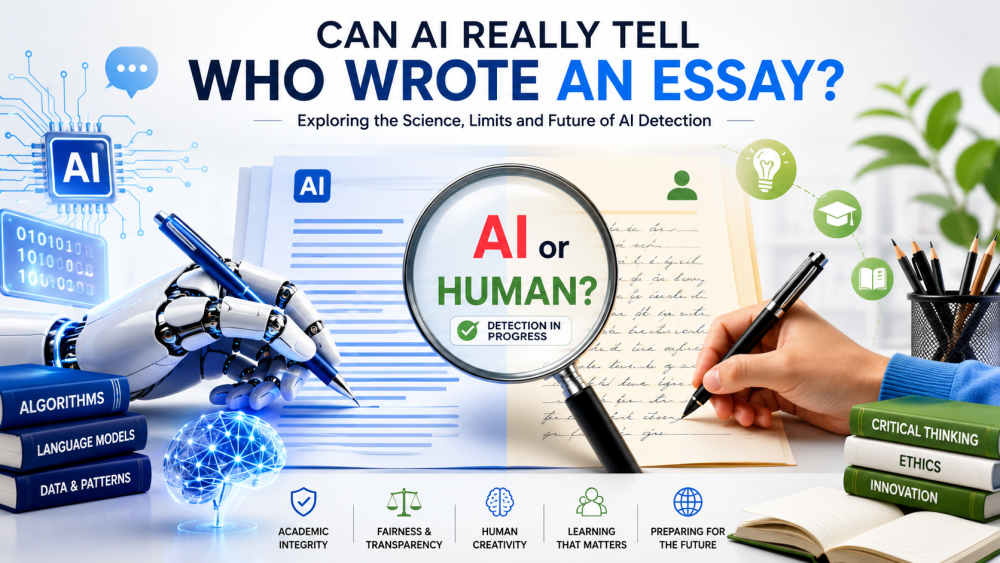
115/2026
Event Video is available HERE
As generative artificial intelligence rapidly transforms education, universities increasingly rely on AI-detection software to flag assignments that chatbots may have written. But can these digital watchdogs truly distinguish human creativity from machine-generated text? Growing scientific evidence suggests the answer is far more complicated than many people realize.
An article published in the Nature journal states, “Clear evidence of AI detectors’ difficulties in correctly assessing human-written text was highlighted by several users on the social-media platform Reddit - they discovered that the US Declaration of Independence is often flagged as AI-written. Nature ran part of the 1776 text through ZeroGPT a number of times and was told it was between 95% and 100% AI-generated.”
Imagine spending days crafting a university application essay or research assignment, only to have a computer incorrectly flag your work as AI-generated. This scenario is increasingly common as educational institutions adopt AI-detection tools to safeguard academic integrity.
The rise of powerful language models such as ChatGPT has fundamentally changed the landscape of writing. Students can now generate essays, reports, and assignments in seconds. In response, schools and universities have turned to AI-detection software, hoping it can identify AI-generated content. Yet the science behind these tools reveals significant limitations that warrant careful attention.
A New Generation of Digital Detectives
For years, plagiarism-detection software helped educators identify copied material by comparing student submissions against millions of published documents. Generative AI poses an entirely different challenge.
Unlike plagiarism, AI-generated writing is often original in phrasing, making it invisible to conventional plagiarism checkers. This has led to the rapid development of AI detectors such as GPTZero, ZeroGPT, Copyleaks, Grammarly, QuillBot, and Turnitin, all of which claim to detect AI-generated text.
How Can a Computer Detect Another Computer?
Most AI detectors rely on a statistical concept known as perplexity.
Human writing is inherently unpredictable. People use unique expressions, vary sentence structure, and occasionally break linguistic patterns for emphasis or creativity. AI systems, however, often generate text in highly predictable sequences because they calculate the most probable next word.
Detection software measures this predictability. If a passage appears unusually regular or statistically consistent, it may be flagged as AI-generated.
An infographic published in a Nature Journal article illustrates this process by showing how AI systems frequently replace common words with synonyms or subtly restructure sentences while preserving meaning. Sophisticated algorithms can sometimes recognize these stylistic patterns, although they are often difficult for human readers to notice.
Accuracy Remains a Serious Concern
Scientific studies reviewed in Nature paint a cautious picture.
One major evaluation found that although AI detectors successfully identified many fully AI-generated documents, they also incorrectly labeled approximately 16 percent of genuine human-written essays as AI-generated (a false positive). Other studies found that detectors became less reliable when evaluating writing produced by newer, more advanced language models, yielding inconsistent results and frequent false alarms.
One remarkable experiment demonstrated just how unreliable these systems can be. Portions of the United States Declaration of Independence, written nearly 250 years before artificial intelligence existed, were repeatedly classified by AI detectors as 95 to 100 percent AI-generated.
Such findings raise important questions about whether these tools should ever be used as decisive evidence against students.
An Endless Technological Race
The challenge is becoming even greater as artificial intelligence evolves.
Researchers report that while detectors may reasonably well identify unedited AI-generated text, their accuracy declines dramatically even after minor revisions. A second AI system can easily rewrite text to evade detection, and specialized "humanizer" applications are designed to lower AI-detection scores.
Experts describe this competition as a technological arms race in which detectors constantly struggle to keep pace with increasingly sophisticated AI writing systems.
The Hidden Risk of Bias
Perhaps the most troubling discovery involves fairness.
A Stanford University study found that essays by people whose first language was not English were incorrectly identified as AI-generated at remarkably high rates. Because these writers often use simpler vocabulary and more predictable sentence structures, detection algorithms may mistakenly interpret their writing as machine-generated.
This means that some of the world's most diligent students may face greater scrutiny simply because of how they naturally write.
Universities Are Reconsidering Their Approach
Concerns about AI detectors have now extended beyond classrooms.
Court cases have overturned disciplinary actions largely based on AI-detection software, while higher education regulators have warned universities against relying exclusively on these systems. Some institutions have even chosen not to activate commercial AI detectors because of unresolved concerns about transparency and reliability.
Even companies that develop these technologies acknowledge their limitations. Rather than serving as proof of misconduct, AI-detection scores are increasingly presented as indicators that encourage educators to examine assignments more carefully and engage students in discussion.
From Detecting AI to Detecting Learning
Many educational researchers believe the conversation needs to change.
Artificial intelligence is rapidly becoming a standard productivity tool in education and the workplace. Like calculators, spellcheckers, and search engines before it, AI can support learning when used responsibly.
The real challenge, experts argue, is distinguishing appropriate use from misuse, not eliminating AI. Instead of relying on uncertain detection software, universities are being encouraged to redesign assessments so that students demonstrate critical thinking, reasoning, creativity, and the development of their ideas throughout the writing process. New educational platforms are even beginning to record drafting histories and revision patterns rather than simply analyzing the final document.
The Future Lies in Trust and Transparency
Artificial intelligence will undoubtedly remain part of education's future. But current research suggests that AI-detection tools are not yet reliable enough to serve as judges of academic honesty.
They may help identify patterns worth investigating, but they cannot definitively determine whether a human or a machine authored a piece of writing.
According to Prof. Dr. Muhammad Mukhtar, Rector of the renowned private sector university, the University of Southern Punjab, Multan, Pakistan artificial Intelligence is no longer a technology of the future; it is the defining technology of our time. As educators, our responsibility extends beyond teaching students how to use AI; we must prepare them to use it wisely, ethically, and responsibly.
The emerging evidence reminds us that while AI can support learning, it cannot replace human curiosity, critical thinking, creativity, integrity, and sound judgment. Likewise, AI-detection tools should be seen as supportive technologies rather than unquestionable arbiters of truth. No algorithm should be the final judge of a student's honesty or potential.
At the University of Southern Punjab, we believe the future of education lies not in policing technology but in redesigning learning. Our focus must shift from merely evaluating written products to assessing the learning process itself, fostering originality, problem-solving, collaboration, and lifelong learning. Universities must cultivate graduates who can work alongside artificial intelligence while preserving uniquely human qualities that machines cannot replicate.
As AI continues to reshape every profession, educational institutions must lead this transformation with vision, fairness, and innovation. The ultimate purpose of higher education is not merely to produce assignments but to nurture ethical leaders, skilled professionals, and responsible citizens capable of solving tomorrow's challenges.
The future belongs not to those who fear artificial intelligence, but to those who learn to harness it with wisdom, integrity, and purpose. Let us ensure that our classrooms remain places where technology enhances learning, but where humanity continues to lead.